



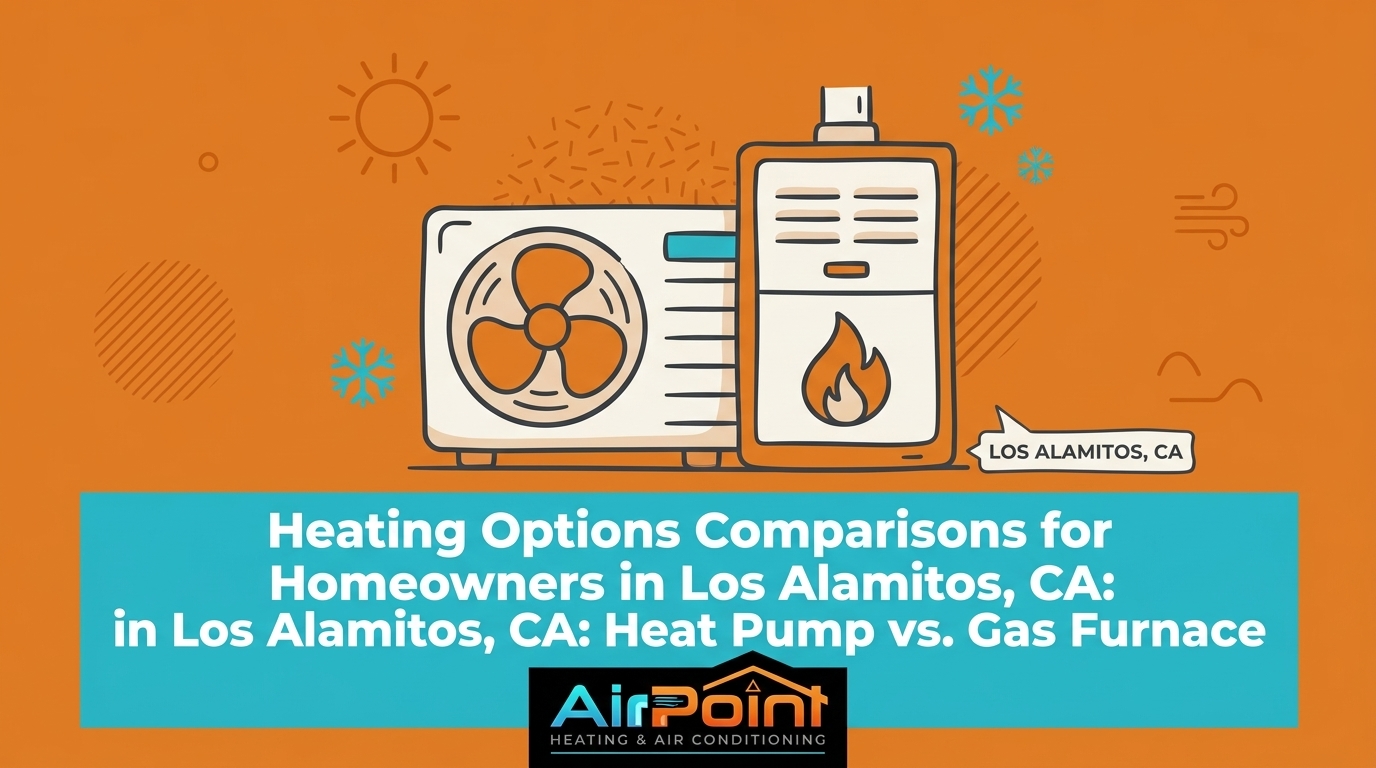
Heating Options Comparisons for Homeowners in Los Alamitos, CA: Heat Pump vs. Gas Furnace
Is It Time to Rethink Your Heating Strategy This Fall?
Are you looking for clear options comparisons for homeowners who need to replace an aging heating system before the winter chill sets in? When our technicians at AirPoint Heating & Air Conditioning visit homes across Los Alamitos for fall maintenance, we are constantly asked how to know whether to stick with what you have or upgrade to newer technology. The short answer is that the mild Southern California climate makes this decision entirely different from the rest of the country. While a traditional furnace might be the default choice in colder states, replacing your equipment during the October pre-winter heating startup window gives our team a chance to help you re-evaluate what actually makes sense for your home.
Upgrading your HVAC system right now is also a prime opportunity to integrate comprehensive indoor air quality solutions that protect your family year-round. If you want to avoid peak-season delays and make a confident choice, it is time to schedule HVAC service and explore your options with a local expert.
The Southern California Climate Advantage
Most national HVAC advice assumes you are dealing with harsh, freezing winters. When you read generic guides online, they often skew their recommendations toward massive, oversized gas furnaces designed to battle blizzards. Here is the thing: if you live in Los Alamitos and surrounding Southern California coastal-adjacent areas, that advice simply does not apply to your home.
Our local weather patterns change the heating system calculation entirely. The coastal marine layer and mild winter lows in the 40s and 50s create a unique microclimate. You rarely, if ever, see temperatures drop below freezing. These mild temperatures happen to be the exact optimal performance zone for modern electric heating technology.
In our years of serving Orange County coastal microclimates, the team at AirPoint Heating & Air Conditioning has seen firsthand how installing an over-engineered furnace designed for a snowy climate often leads to short-cycling, wasted energy, and uneven temperatures in a Southern California home.
Why Local Climate Matters for HVAC Sizing
• Avoiding short-cycling: An oversized system turns on and off too quickly, wearing out parts prematurely.
• Maximizing efficiency: Systems operate best when matched to the actual heating load of the environment.
• Targeted comfort: Mild winters require steady, low-level heat rather than sudden, intense blasts of hot air.
Understanding your local climate advantage is the first step toward choosing a system that delivers reliable comfort without inflating your monthly utility bills.
Gas Furnaces: The Traditional Heating Approach
For decades, the gas furnace has been the standard heating approach for most homes. If you currently have a gas furnace, you already have the necessary gas line infrastructure, making a direct replacement seem like the path of least resistance. Modern high-efficiency gas furnaces are incredibly powerful, with Annual Fuel Utilization Efficiency (AFUE) ratings maxing out between 90% and 98%. This means that up to 98% of the fuel consumed is converted directly into usable heat for your home.
However, sticking with tradition has its drawbacks. Gas furnaces only provide heating, meaning they sit idle for more than half the year while you rely on a separate air conditioner. They also carry a larger carbon footprint due to fossil fuel combustion.
If you choose to replace a gas furnace, our technicians highly recommend doing so during the October pre-winter heating startup window. This timing allows us to perform essential safety and performance testing—like checking for carbon monoxide leaks and inspecting the heat exchanger—before you actually need to turn the heat on.
Pros and Cons of Gas Furnaces
• Pro: High heat output. Gas furnaces generate intense, warm air quickly, which is great for rapid heating.
• Pro: Infrastructure compatibility. If you already have gas lines and proper venting, installation is straightforward.
• Con: Heating only. You still need a completely separate system for summer cooling.
• Con: Carbon footprint. Burning natural gas releases emissions, which conflicts with modern electrification goals.
• Con: Safety risks. As gas furnaces age, the risk of cracked heat exchangers and carbon monoxide leaks increases.
Electric Heat Pumps: The All-in-One Climate Solution
When we recommend electric heat pumps to our Los Alamitos customers, it is because they represent a massive leap forward in home comfort technology. Unlike a furnace that burns fuel to generate heat, a heat pump uses electricity to move heat from one place to another. Even when it feels chilly outside in Southern California coastal-adjacent areas, there is still ambient heat energy in the air. The heat pump extracts this energy, compresses it to raise the temperature, and transfers it inside your home.
Because moving heat requires significantly less energy than creating it, heat pumps are remarkably efficient. In fact, they can deliver up to three times more heat energy to your home than the electrical energy they consume to operate.
The greatest advantage of a heat pump is its dual functionality. It is not just a heater. A specialized reversing valve allows the system to switch directions in the summer. Instead of pulling heat indoors, it extracts heat from inside your home and dumps it outside, serving as highly efficient air conditioning systems. You get year-round comfort from a single piece of equipment.
Understanding the Efficiency Metrics
When evaluating heat pumps, you will look at two main ratings:
• HSPF (Heating Seasonal Performance Factor): Measures heating efficiency over the winter season. Higher numbers mean better efficiency.
• SEER (Seasonal Energy Efficiency Ratio): Measures cooling efficiency during the summer.
One common myth we hear about heat pumps is that they fail in cold weather. While it is true that older generation heat pumps struggled in sub-zero temperatures, that is completely irrelevant here. Our local winters never reach the freezing thresholds that cause severe efficiency drops, making heat pumps the ultimate year-round climate solution for Southern California.
Side-by-Side Comparison: Which System Wins?
To make the best decision for your home, you need to see how these systems stack up directly against each other. When evaluating equipment for Los Alamitos and surrounding Southern California coastal-adjacent areas, our team finds that the "winner" depends heavily on your existing setup and long-term goals.
Gas furnaces measure efficiency by how well they burn fuel (AFUE), while heat pumps measure efficiency by how well they transfer heat (HSPF). Environmental impact is another major differentiator; heat pumps run entirely on electricity, which can be sourced from renewables, whereas furnaces rely strictly on fossil fuels.
Here is a breakdown of how the two systems compare across key categories.
• Primary Function — Gas Furnace: Heating only — Electric Heat Pump: Heating and cooling
• Efficiency Metric — Gas Furnace: AFUE (Max 90% - 98%) — Electric Heat Pump: HSPF (Transfers up to 300% more energy)
• Environmental Impact — Gas Furnace: Burns fossil fuels (higher emissions) — Electric Heat Pump: Runs on electricity (lower emissions)
• Ideal Climate — Gas Furnace: Harsh, freezing winters — Electric Heat Pump: Mild winters (40s-50s lows)
• Maintenance Needs — Gas Furnace: Annual fall inspection (combustion safety) — Electric Heat Pump: Bi-annual checks (runs year-round)

Infrastructure and Air Quality Considerations
Upgrading to a new high-efficiency heating system is not just about swapping out a metal box in your garage or attic. It requires evaluating the infrastructure that supports it. A pattern we see often during October pre-winter heating startups is that a brand-new high-efficiency system is only as good as the ductwork distributing the air.
Modern HVAC systems move air differently than older models. They often require precise static pressure and airflow to operate efficiently. If your existing ducts are undersized, leaking, or poorly designed, a brand-new high-efficiency system will struggle to keep you comfortable. We highly recommend professional ductwork inspection and services to ensure your new system can deliver conditioned air properly without wasting energy into your attic or crawlspace.
Integrating Air Quality Enhancements
A system replacement is the best time to think about what you are breathing. Modern HVAC upgrades can significantly improve home air circulation. Because the system will be pushing air through your entire home, you can easily tie in advanced filtration.
The proactive approach: Homeowners looking to further protect their family from dust, allergens, and airborne pathogens can enhance indoor air quality with air purifiers integrated directly into the new ductwork. Whole-home purifiers work seamlessly with both furnaces and heat pumps, ensuring that every time your system kicks on, it is actively cleaning the air you breathe.
Navigating Generic Energy Incentives
One major factor driving homeowners toward new technology is the availability of financial incentives. As the push for energy efficiency and home electrification grows, there are numerous programs designed to make high-efficiency upgrades more accessible.
Federal tax credits and state-level energy rebates frequently favor high-efficiency electric heat pumps over traditional gas furnaces. Because heat pumps drastically reduce fossil fuel consumption, government programs heavily incentivize their installation. Additionally, local utility incentive programs may also apply to qualifying installations in Los Alamitos and surrounding Southern California coastal-adjacent areas.
While we cannot guarantee specific incentive amounts or program availability, factoring in these generic incentives can significantly alter the long-term value calculation of a system replacement. A system that seems like a larger upfront investment might actually yield a better return when you combine tax credits, utility rebates, and ongoing monthly energy savings.
Our team always advises homeowners to consult with a qualified tax professional or check directly with their local utility provider to verify current programs and eligibility requirements before making a final decision.
Frequently Asked Questions About Heating Upgrades
Is a heat pump or furnace better for Southern California?
A heat pump is generally better suited for Southern California's mild climate. Because our winter temperatures rarely drop below freezing, heat pumps operate at peak efficiency year-round. They also provide the added benefit of serving as your air conditioner during the hot summer months, giving you two systems in one.
How efficient are heat pumps in mild winters?
Heat pumps are incredibly efficient in mild winters, often delivering up to three times more heat energy than the electrical energy they consume. In the 40-to-50-degree range common during an October pre-winter heating startup, there is abundant ambient heat in the outdoor air for the system to capture and move indoors.
Do heat pumps work in cold weather?
Yes, modern heat pumps work exceptionally well in cold weather. While older models struggled when temperatures dipped below freezing, today's advanced heat pumps can extract heat even in sub-zero conditions. For coastal California residents, cold weather performance is never an issue because it simply does not get cold enough to challenge the system.
What are my heating replacement options?
Your primary heating replacement options are installing a new high-efficiency gas furnace, upgrading to an electric heat pump, or utilizing a dual-fuel system that combines both. The best choice depends on your home's existing infrastructure, your energy goals, and whether you also need to replace your air conditioning unit.
Can I use my existing ductwork if I switch to a heat pump?
In most cases, you can use your existing ductwork if you switch to a heat pump, provided the ducts are in good condition and properly sized. However, a professional inspection is required to check for leaks, adequate insulation, and proper airflow capacity to ensure the new heat pump operates efficiently.
Make Your Heating Decision Before the Cold Arrives
Choosing the right heating system ultimately depends on your home's existing infrastructure, your long-term efficiency goals, and the unique demands of the coastal climate. By exploring comprehensive options comparisons for homeowners, you can move past generic advice and select a system that truly fits your needs.
Do not wait for your old system to fail on the coldest night of the year. The October pre-winter heating startup window is the perfect time to make a proactive choice. We encourage you to get a professional assessment from our team to weigh your options safely and accurately. Reach out today to schedule HVAC service and secure your family's comfort for the season ahead.
Other Blogs
Latest Blog Posts

Home Maintenance Tips and Troubleshooting: Navigating Fall Heater Startup Smells in Los Alamitos
The Essential Fall Home Maintenance Checklist: Decoding HVAC Startup Smells
Finding Your Efficiency Sweet Spot: Using a SEER Savings Calculator for HVAC Upgrades

Customer Testimonials


I recommend Air Point for your HVAC needs."