






Why Knowing How to Decide Between Repair and Replacement Can Save You Thousands
Knowing how to decide between repair and replacement starts with one core question: does fixing your current system make financial and practical sense, or is it costing you more than a fresh start would?
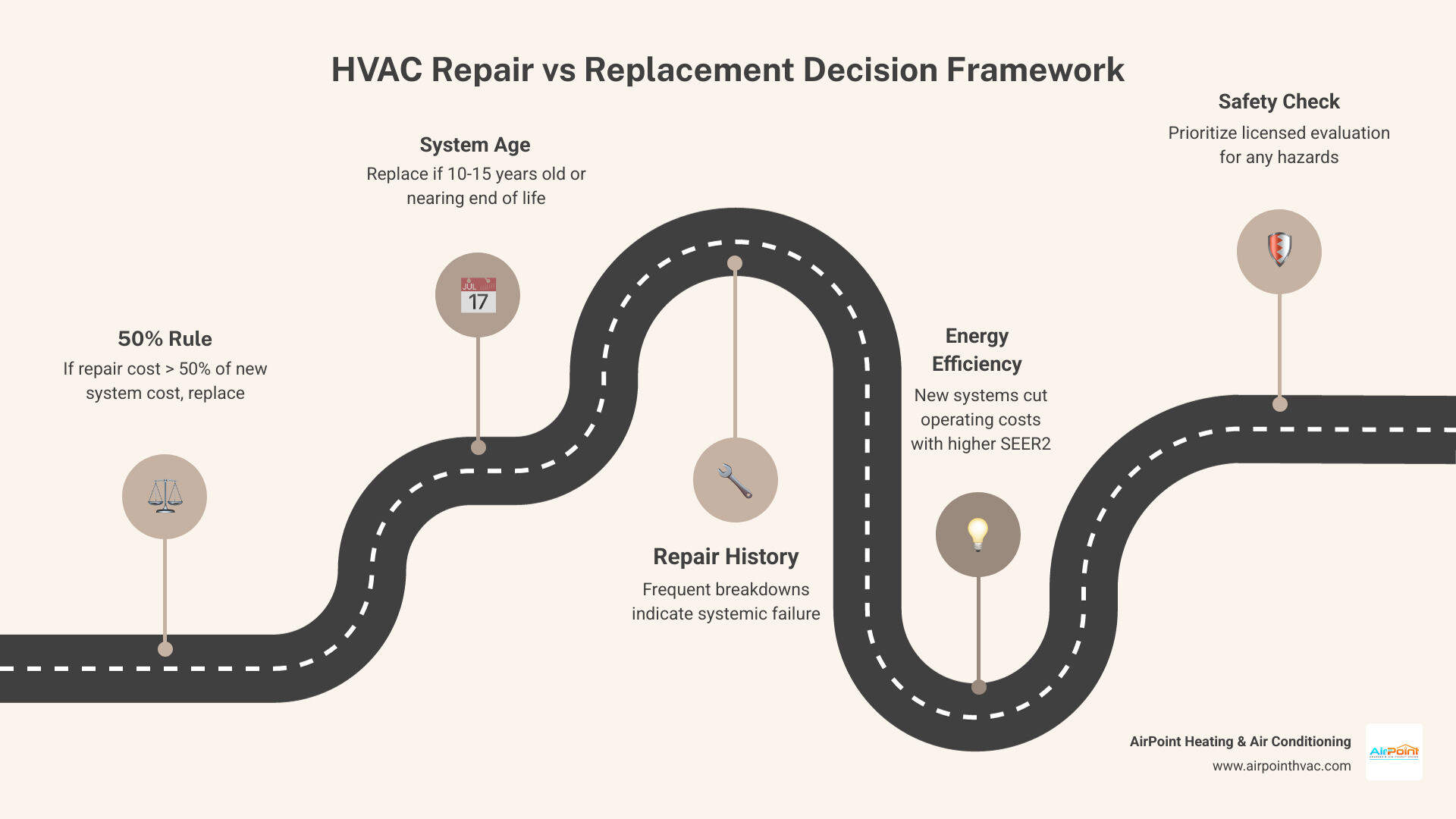
Here's a quick framework to guide your decision:
- Apply the 50% Rule - If the repair cost exceeds 50% of what a comparable new system would cost, replacement is generally the smarter move.
- Check the system's age - HVAC systems typically last 10-15 years. The closer yours is to that threshold, the stronger the case for replacement.
- Count your repair history - Frequent breakdowns signal systemic decline, not isolated bad luck.
- Factor in energy efficiency - Older systems cost significantly more to run. Newer models can reduce operating costs meaningfully.
- Consider safety - Any system posing a safety risk needs a licensed technician's evaluation before cost even enters the conversation.
For homeowners in Los Alamitos, this decision hits especially hard when summer heat or winter cold arrives and your HVAC system picks the worst possible moment to fail. You're not just weighing a repair bill — you're weighing your family's comfort, your monthly energy costs, and your peace of mind.
The challenge is that most people make this call under pressure, mid-breakdown, without a clear framework. A quick patch feels like the safe, affordable choice. But for aging systems, repeated repairs can quietly add up to more than a full replacement would have cost — and leave you no more comfortable or reliable than before.
This guide walks you through exactly how to make that call with confidence, covering everything from cost analysis and system age to energy efficiency gains and safety considerations specific to HVAC systems in Orange County homes.
The Economic Framework: How to Decide Between Repair and Replacement
When we visit homes in Cypress or Seal Beach to look at a struggling air conditioner, we often see homeowners wrestling with the "sunk cost fallacy." This is the psychological trap where you keep pouring money into a failing system because you’ve already spent so much on it in the past. To avoid this, we need a cold, hard economic framework.
The most vital metric we use is the Total Cost of Ownership (TCO). This isn't just the price of the repair today; it includes the projected energy bills over the next five years, the likelihood of another component failing, and the loss of comfort during downtime.

A key part of this is understanding the "50% Rule." Historically, this rule suggests that if a repair costs more than 50% of the price of a new system, you should replace it. However, some high-intensity organizations, like the U.S. Marine Corps, actually use a 65% threshold for their equipment. For a residential homeowner, sticking closer to the 50% mark is usually safer because you don't have a dedicated motor pool of technicians to keep a "zombie" unit running indefinitely.
To get a better sense of your specific equipment's needs, you can explore our detailed guides on Know When to Replace AC and When to Consider Furnace Replacement.
Applying the 50% Rule to Modern Systems
In April 2026, the 50% rule remains a gold standard, but it requires context. You must compare the repair quote against the cost of a comparable modern system. If you have an old R-22 "Freon" unit from 2012, a "comparable" replacement isn't just a basic box; it’s a high-efficiency SEER2-compliant unit.
If your repair is 40% of the cost of a new unit, but your current unit is already 12 years old, that 40% is likely a poor investment. Why? Because the remaining 60% of the machine is still 12 years old and prone to the next failure. Economic rationality suggests that "buying" a few more months of life for a high percentage of the replacement cost is essentially throwing money away.
How to Decide Between Repair and Replacement Using Depreciation
In accounting, we often use "straight-line depreciation" to value an asset. Imagine your HVAC system has a 15-year life. Each year, it loses 1/15th of its value. By year 10, the "book value" is only a third of what you paid.
When you are figuring out how to decide between repair and replacement, look at the residual value. If the repair costs more than the current market value of the unit, it’s a total loss. Just as you wouldn't spend $4,000 to fix a transmission on a car worth $3,000, you shouldn't spend a significant amount on a furnace that has already lived 90% of its expected life. For more on this, check out the Best Option for Furnace Replacement.
Critical Factors Beyond the Repair Bill
While the dollar amount on the invoice is important, it’s rarely the whole story. In our experience serving families from Huntington Beach to Fullerton, comfort and safety often outweigh the pure math.
One major factor is technological obsolescence. In 2026, HVAC technology has moved leaps and bounds beyond what was available even a decade ago. Modern systems offer variable-speed compressors and smart home integration that older "on/off" systems simply can't match.
Evaluating System Age and Reliability
Most HVAC systems are designed for a 10-15 year lifespan. As we approach that 15-year mark, we look at metrics like MTBF (Mean Time Between Failures). If your system has broken down twice in the last two years, the MTBF is dropping. This component fatigue is systemic. When a blower motor goes in an old unit, the extra strain often causes the capacitor or control board to fail shortly after. Recognizing these Furnace Replacement Top Signs can save you from a mid-winter emergency.
Performance and Energy Efficiency Gains
This is where replacement often pays for itself. Modern SEER2 ratings and Energy Star certifications mean that a new unit can be up to 30% more efficient than a unit from 2014. If you live in a warmer area like Anaheim or Irvine, those monthly savings add up. When you calculate the TCO, you’ll often find that the "cheaper" repair is actually more expensive over five years because of the higher utility bills. This is a major factor When to Consider Heat Pump Replacement.
Repair vs. Replacement: A Quick Comparison
| Feature | Repairing Existing Unit | Replacing with New Unit |
|---|---|---|
| Upfront Cost | Lower | Higher |
| Monthly Bills | Remains High | Decreases (up to 30%) |
| Warranty | Limited (usually 30-90 days) | Comprehensive (10+ years) |
| Reliability | Uncertain | High (New MTBF cycle) |
| Air Quality | Limited by old filtration | Advanced (HEPA/UV options) |
Data-Driven Decisions with Maintenance Metrics
We believe in using data, not guesswork. When we service a home in Long Beach or Garden Grove, we look at the historical maintenance logs. If we see a pattern of "Mean Time to Repair" (MTTR) increasing—meaning it’s taking longer and becoming more complex to fix the unit—that’s a red flag.
By tracking these reliability trends, we can perform a "Root Cause Analysis." Is the part failing because it’s old, or is it failing because the entire system is oversized and "short-cycling"? If the system was poorly designed for the home's square footage from day one, no amount of repair will ever make it efficient. In these cases, it's always Time to Replace Your Air Conditioning Unit.
Leveraging Historical Maintenance Logs
If you’ve lived in your home for several years, look back at your records. A single repair might be a fluke. Three repairs in three years is a trend. Systemic decline is real; as seals dry out and heat exchangers thin, the system becomes a "money pit." We use this data to help you see the "tipping point" where the cost of keeping the old unit exceeds the cost of financing a new, reliable one.
The Role of Parts Availability and Warranties
One of the most frustrating things for a homeowner in Yorba Linda or La Mirada is being told that a $50 part is "discontinued." As systems age, OEM (Original Equipment Manufacturer) parts become harder to find. This leads to longer lead times and higher costs for "universal" parts that might not fit or perform as well.
Furthermore, a new system comes with a fresh warranty. Most modern replacements offer 10-year parts warranties, giving you a decade of predictable costs. A repair on a 12-year-old unit usually only warrants the specific part replaced, leaving the rest of the aging machine vulnerable.
Sustainability and Environmental Considerations
In 2026, we are more conscious than ever of our carbon footprint. Repairing an old, inefficient unit might seem "green" because you aren't throwing a machine in a landfill, but the reality is often the opposite.
Older units often use R-22 refrigerant, which is being phased out due to its ozone-depleting properties. Even newer R-410A systems are seeing shifts toward more eco-friendly refrigerants. A modern, high-efficiency replacement reduces resource conservation by using less electricity and utilizing newer, safer refrigerants. When we do replace a system, we ensure sustainable disposal of the old unit, recycling the metal and safely recovering the chemicals.
Frequently Asked Questions about HVAC Decisions
How to decide between repair and replacement for a 12-year-old system?
At 12 years, your system is in the "danger zone." You should look at the cumulative repair costs over the last three years. If those costs, plus the current repair, exceed 50% of a new unit's price, replace it. Also, consider the efficiency gap. A 12-year-old unit is likely 20-30% less efficient than a 2026 model. If you plan to stay in your Los Alamitos home for more than three years, the energy savings alone often justify the upgrade.
What are the pitfalls of the 50% rule in 2026?
The 50% rule is a great heuristic, but it can be a pitfall if you don't account for installation overhead and inflation. In 2026, the cost of labor and materials has changed. Sometimes, a repair that is only 30% of the replacement cost is still a bad idea if the system uses an obsolete refrigerant that will make the next repair impossible. Always consider "subjective value"—if the old unit is loud and doesn't dehumidify well, even a "cheap" repair won't make you happy with the result.
How to decide between repair and replacement when safety is a concern?
Safety overrides everything. If your furnace has a cracked heat exchanger (which can leak carbon monoxide) or if your AC has significant electrical scorching, the decision is usually made for you. While some safety issues can be repaired, a "licensed evaluation" is mandatory. In many cases, the cost of bringing an old, unsafe unit up to 2026 safety and compliance standards is so high that replacement is the only logical and safe path forward.
Conclusion: Making the Right Call for Your Home
How to decide between repair and replacement doesn't have to be a stressful guessing game. By using the 50% rule, looking at the age of your system, and factoring in the massive energy efficiency gains of modern technology, the right choice usually becomes clear.
At AirPoint Heating & Air Conditioning, we’ve spent years helping our neighbors in Los Alamitos, Huntington Beach, and across Orange County navigate these exact crossroads. As a family-owned business, we value honest communication over a quick sale. Our goal is always your long-term comfort and "happiness"—which often means helping you avoid the trap of endless, expensive repairs.
Whether you need a precision tune-up to extend the life of your current unit or a professional assessment to see if it’s finally time for an upgrade, we are here to help. We provide fast, expert solutions backed by a 100% satisfaction guarantee.
Don't wait for the next breakdown to leave you in the heat. Book your expert HVAC evaluation today for fast, reliable service.
Other Blogs
Latest Blog Posts
Do UV Light Purifiers Actually Neutralize Fall Mold Spores in Your HVAC System?
Diagnosing Short-Cycling in Oversized Furnaces Installed During the 90s Housing Boom
Retrofitting La Mirada Mid-Century Homes with Zoning Systems for Better Temperature Control

Customer Testimonials



I recommend Air Point for your HVAC needs."