







Why Coastal Humidity Creates Mold Risk in Your Beach House
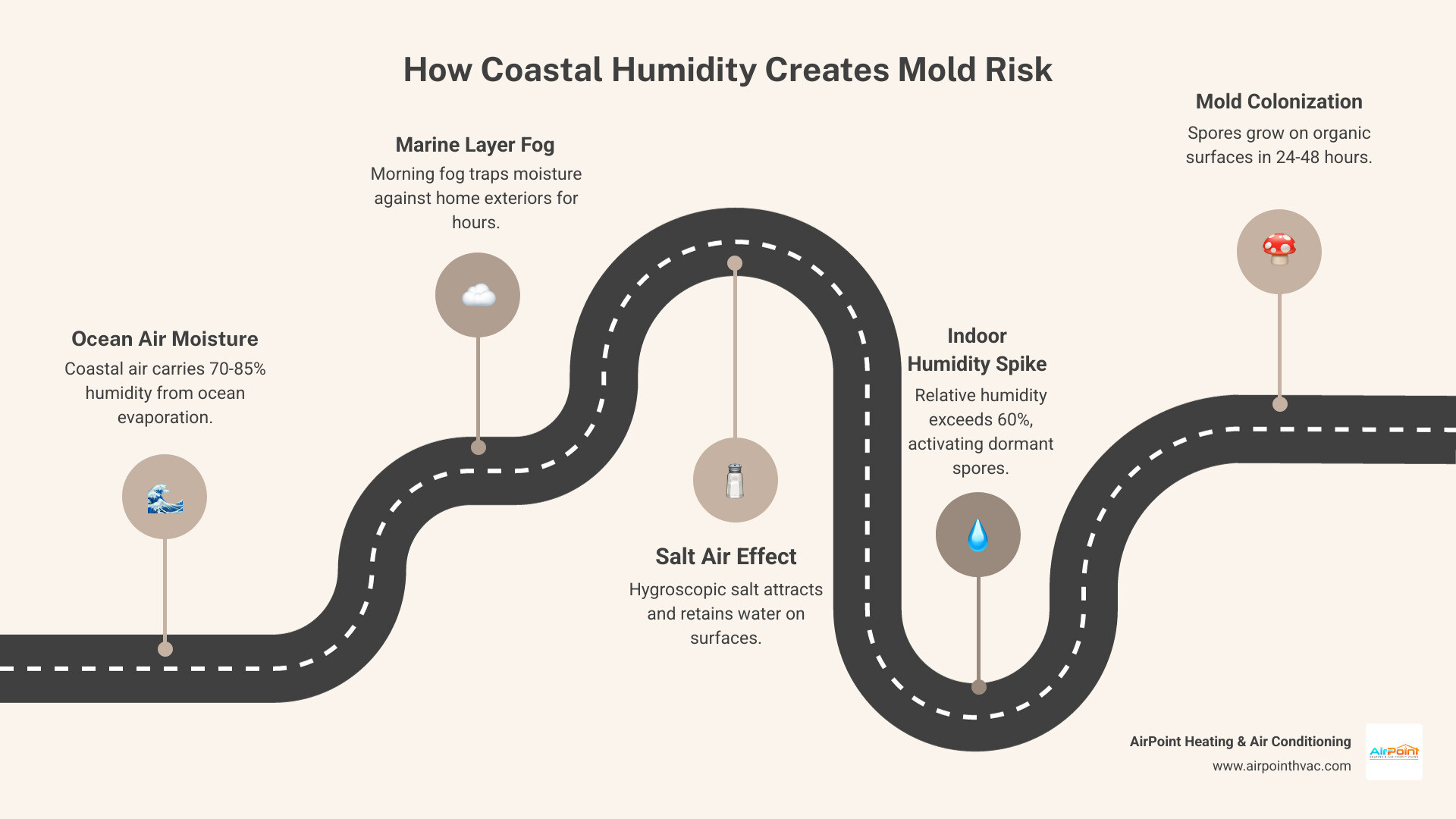
How coastal humidity creates mold risk comes down to one simple fact: ocean air carries far more moisture than inland air, and that moisture never really leaves your home. When indoor relative humidity climbs above 60% — which happens routinely in coastal areas — mold spores that are already floating through your air find exactly what they need to take hold. Within just 24 to 48 hours, those spores can begin colonizing walls, insulation, ductwork, and flooring. Often silently, and completely out of sight.
Here is a quick breakdown of why coastal homes are especially vulnerable:
- Persistent high humidity - Coastal regions like Orange County regularly see morning humidity levels of 70-85%, pushing indoor air well past the mold-growth threshold
- Marine layer fog - Low coastal clouds trap moisture against your home for hours each morning, especially during "May Gray" and "June Gloom" seasons
- Salt air - Salt is hygroscopic, meaning it actively attracts and holds water, keeping surfaces damp longer than they would otherwise dry
- Poor air circulation - Coastal home designs that maximize ocean views often sacrifice ventilation, trapping humid air indoors
- Storm exposure - Rain events and high surf push additional moisture into wall cavities, crawl spaces, and attics
- Fast mold timeline - Once humidity exceeds 60%, mold can begin growing in as little as 24 hours on any organic surface, including drywall, wood framing, and carpet
Nearly half of all U.S. homes — around 47% — already have some form of mold or dampness. In coastal communities, that number skews even higher. If your beach house sits close to the water, the odds are not in your favor without the right protections in place.
The Science of How Coastal Humidity Creates Mold Risk

Understanding the science behind mold growth is the first step in protecting your home. Mold spores are ubiquitous; they exist everywhere in nature, both indoors and out. However, they remain dormant until they find the "perfect storm" of conditions: a food source (like drywall or wood), a comfortable temperature, and, most importantly, moisture.
In our service areas—from the misty mornings in Seal Beach to the breezy afternoons in Mission Viejo—the primary driver of mold is relative humidity (RH). When the RH in your home exceeds 60%, the air becomes saturated enough to provide the hydration mold needs to germinate. This isn't a slow process. Research shows that mold can begin colonizing surfaces in as little as 24 to 48 hours once that threshold is crossed.
Microscopic spores are lightweight and travel easily through the air. In a humid coastal environment, these spores aren't just sitting on surfaces; they are part of the Indoor Air Quality you breathe every day. If your home has poor circulation, these spores settle into porous materials like carpets, upholstery, and insulation, which act like sponges for ambient moisture. Enhancing Indoor Air Quality requires a proactive approach to keeping that humidity dial turned down.
How Coastal Humidity Creates Mold Risk in HVAC Systems
Your HVAC system is designed to keep you cool, but in coastal cities like Huntington Beach, it can unintentionally become a mold incubator. The problem often starts with salt air corrosion. The salty breeze that feels so good on your skin is actually quite abrasive to the metal components inside your AC unit. Over time, salt causes the evaporator coils to corrode, leading to inefficient cooling and excessive condensation buildup.
When moisture sits inside your dark, cool ductwork, it creates the ideal habitat for mold. As the blower motor pushes air through these damp channels, it can pick up spores and distribute them to every room in the house. This is why Whole House Air Filtration La Palma CA and specialized dehumidification are so critical. If your system is "short-cycling"—turning on and off too quickly—it never runs long enough to actually remove the moisture from the air, leaving your home sticky and vulnerable. Investing in Whole House Dehumidification Huntington Beach CA ensures that your HVAC system focuses on drying the air as much as cooling it.
Environmental Triggers: Marine Layers and Salt Air
If you live in a place like Seal Beach or Newport Beach, you’re familiar with the "marine layer." This phenomenon occurs when cool, moist air from the ocean is trapped under a layer of warmer air. This fog doesn't just block the sun; it raises the dew point, meaning condensation forms more easily on your windows, siding, and even inside your walls.
Salt air adds another layer of complexity. Salt is "hygroscopic," which is a fancy way of saying it loves water. When salt particles settle on your home’s surfaces, they pull moisture out of the air and hold it there. This keeps your window frames, door seals, and exterior walls damp for much longer than they would be inland. Our Huntington Beach Air Quality Guide highlights how these coastal breezes can carry moisture deep into your home's structure. Without proper Indoor Air Quality Seal Beach CA measures, this moisture penetration can lead to structural rot and hidden mold colonies.
Vulnerable Zones in Coastal Properties
Not all parts of your home are created equal when it comes to mold risk. In coastal properties, the "out of sight, out of mind" areas are usually the most dangerous.
- Crawl Spaces: These are often the ground zero for mold. High soil moisture combined with humid coastal air creates a swamp-like environment under your feet.
- Unventilated Attics: In the summer, attics in places like Irvine or Fullerton can reach 140°F. When that heat meets the cool air of your AC system, condensation forms on the ducts and rafters.
- Wall Cavities: This is where how coastal humidity creates mold risk becomes a structural threat. Moisture can seep through porous stucco and get trapped behind the drywall.
- Bathrooms and Laundry Rooms: These areas generate their own moisture, which is exacerbated by the high ambient humidity of the coast.
To combat this, many homeowners in South Cypress and Newport Beach are turning to dedicated moisture control. For example, Whole House Dehumidification Newport Beach CA can help stabilize the environment in these hidden zones. Similarly, Whole House Dehumidification South Cypress CA prevents the "stack effect," where damp air from the crawl space is pulled up into the living areas of the home.
Signs of Hidden Growth in Beach Houses
How do you know if you have a problem before you actually see green spots on the wall? In the coastal climate of Orange County, you have to use your other senses.
- The "Musty" Smell: That earthy, damp odor is actually the scent of mold "off-gassing." If a room smells like an old basement, there is likely active growth nearby.
- Sticking Doors and Drawers: High humidity causes wood to swell. If your closet doors are suddenly hard to open, your indoor RH is likely too high.
- Bubbling Paint or Wallpaper: This is a sign that moisture is trapped inside the wall, pushing the finish away from the surface.
- Window Condensation: If you see "sweat" on the inside of your windows every morning, it’s a clear indicator that your Indoor Air Quality Orange County CA needs attention.
In areas like Laguna Beach, where homes are often built into hillsides with limited airflow, these signs are even more common. Utilizing Whole House Dehumidification Laguna Beach CA can stop the moisture accumulation that leads to these frustrating structural issues.
Health Risks of Airborne Exposure
Mold isn't just a threat to your home's value; it’s a threat to your family’s health. Exposure to airborne mold spores in damp indoor environments is linked to a 30-50% increase in the risk of developing asthma. For those who already have respiratory issues, the presence of mold can lead to frequent flare-ups, allergic rhinitis, and persistent coughing.
Because mold spores are so small, they are easily inhaled deep into the lungs. This is why Whole House Air Purification South County CA is a popular choice for families in our coastal communities. By scrubbing the air of these microscopic irritants, you can significantly improve the health of your indoor environment. For a deeper dive into these risks, check out our Indoor Air Quality Solutions Complete Guide.
Professional Prevention and Humidity Control
If you're serious about stopping mold, you have to move beyond portable "bucket" dehumidifiers. While they might help a small closet, they can't handle the latent heat and moisture load of an entire coastal home.
| Feature | Standard AC Unit | Whole-House Dehumidifier |
|---|---|---|
| Primary Goal | Lowering Temperature | Removing Moisture |
| Efficiency | Low (removes moisture only while cooling) | High (dedicated moisture removal) |
| Humidity Control | Passive | Active & Precise |
| Mold Prevention | Moderate | Superior |
| Ideal RH Range | Often stays above 55% | Maintains 30-50% |
Achieving Comfort with Whole House Dehumidifier systems means you can keep your home at a crisp, dry 45% humidity even when the fog is thick outside. For residents in Long Beach, Whole House Dehumidification Long Beach CA is often the missing piece of the puzzle for total home comfort. In La Palma, we recommend Whole House Dehumidification La Palma CA to protect both the home's structure and the efficiency of the HVAC system.
Professional Detection of How Coastal Humidity Creates Mold Risk
Sometimes, the moisture is there, but you can't see it. That’s where professional technology comes in. Our technicians use infrared thermography (thermal imaging) to "see" temperature differences behind your walls. Since damp areas are cooler than dry ones, moisture pockets show up as dark plumes on our screens.
We also use air sampling to quantify exactly how many mold spores are in your air compared to the outdoors. If your indoor count is higher, you have an active colony somewhere. Detecting how coastal humidity creates mold risk early can save you from an expensive remediation project later. Professional detection ensures that we address the root cause—the moisture—rather than just cleaning the surface.
Frequently Asked Questions about Coastal Mold
What is the critical humidity threshold for mold growth?
The magic number is 60%. Once your indoor relative humidity stays above 60% for a 24-hour window, mold spores have enough moisture to begin the germination process. Ideally, you want to keep your home between 30% and 50% to ensure that surfaces stay dry and spores remain dormant.
How do regional climates like San Diego and Florida compare?
While Florida is famous for its 74% year-round average humidity, Southern California has its own unique risks. Our "May Gray" and "June Gloom" periods create months of sustained high humidity that can be just as dangerous for mold growth. While Florida's risk is often tied to heat and rain, our risk is tied to the persistent marine layer and the hygroscopic nature of salt air along the Pacific.
Why is my AC alone not enough to stop mold?
Most air conditioners are designed to control temperature, not humidity. In coastal areas, we often have "cool but humid" days. On these days, your AC might only run for 10 minutes to reach your target temperature. This is called "short-cycling." Because it doesn't run long enough, it doesn't have time to pull the moisture out of the air, leaving your home cool but damp—the perfect environment for mold.
Conclusion
Living by the ocean is a dream, but it requires a specialized approach to home maintenance. At AirPoint Heating & Air Conditioning, we understand the unique challenges that coastal humidity brings to our neighbors in Los Alamitos, Huntington Beach, and beyond. We are a family-owned, award-winning business dedicated to the philosophy that "comfort is happiness."
Whether you need a precision HVAC tune-up to fight salt air corrosion or a whole-house dehumidification system to finally get rid of that musty smell, we are here to help. Our licensed and certified technicians offer fast, expert solutions backed by a 100% satisfaction guarantee. Don't let coastal humidity turn your beach house into a mold magnet.
Ready for a fresher, drier home? Book Now for fast, reliable service from the AirPoint team!
Other Blogs
Latest Blog Posts
Do UV Light Purifiers Actually Neutralize Fall Mold Spores in Your HVAC System?
Diagnosing Short-Cycling in Oversized Furnaces Installed During the 90s Housing Boom
Retrofitting La Mirada Mid-Century Homes with Zoning Systems for Better Temperature Control

Customer Testimonials



I recommend Air Point for your HVAC needs."