



Why Is Air Quality Bad in Huntington Beach, CA Today? (And How to Protect Your Home)
Why Is Air Quality Bad in Huntington Beach Today? (The October HVAC Dilemma)
Why is the sky suddenly hazy, and where can you find reliable local service expertise and area tips to keep your family breathing safely indoors? At AirPoint Heating & Air Conditioning, our team fields dozens of calls every fall when homeowners wake up to a thick layer of smog or a distinct campfire smell along the coast. It usually means a collision of seasonal environmental factors has arrived right at your doorstep. Outdoor air quality often suffers drastically during the fall months, leaving many homeowners trapped inside with the windows tightly shut.
This creates a very specific, concrete problem for local residents: the dreaded October heating startup. After sitting idle for months, turning on your heater for the first cool fall night often produces a strong smell of burning dust. Normally, you would just open a few windows to air out the house. But when the outdoor Air Quality Index (AQI) is hazardous, ventilating your home with outside air is no longer a safe option.
You are suddenly faced with a difficult decision. Is that strange burning smell coming from your vents just a harmless seasonal nuisance, or does it point to a serious safety hazard? Because you cannot rely on fresh air from outside, investing in professional indoor air quality solutions is the safest way to breathe easier. If you are unsure whether your system is operating safely, our technicians always recommend that the best course of action is to schedule HVAC service before the cold weather sets in permanently.
What Environmental Factors Are Trapping Smog and Smoke on the Coast?
To understand why the air feels so heavy and difficult to breathe, it helps to look at the specific meteorological conditions affecting the region. The Air Quality Index (AQI) measures how clean or polluted your air is, along with associated health effects. When AQI levels push over 100, the air becomes unhealthy for sensitive groups. Once it crosses 150, it begins affecting everyone, regardless of underlying health conditions.
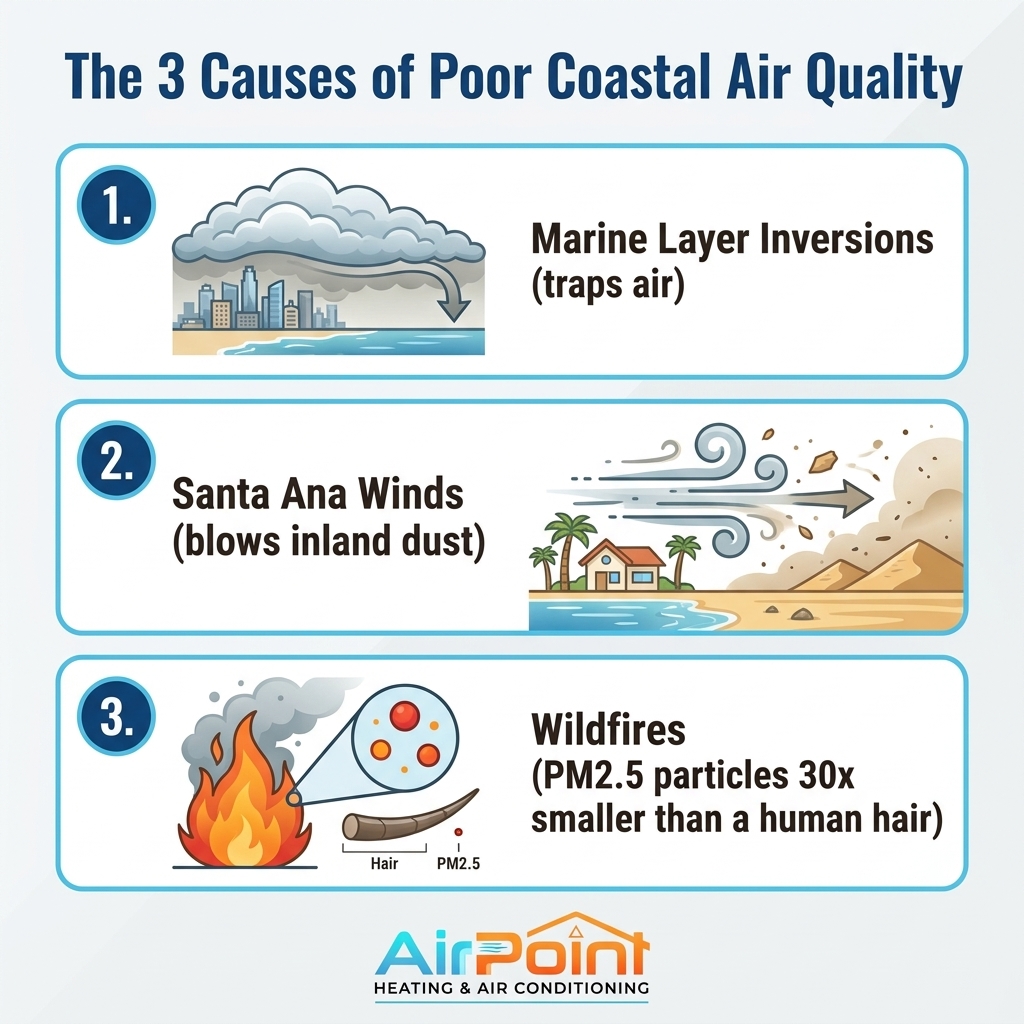
For residents in Los Alamitos and surrounding coastal-adjacent communities, poor air quality is rarely caused by just one factor. In our experience working across Orange County, it is usually a perfect storm of three distinct environmental events happening all at once.
The Role of the Coastal Marine Layer
Temperature inversions are a common phenomenon along the coast. Normally, air gets cooler the higher you go into the atmosphere. However, a marine layer inversion flips this process upside down. Cool, dense ocean air gets trapped beneath a heavy lid of warmer air above it. This invisible ceiling prevents everyday smog, vehicle emissions, and particulate matter from dispersing into the upper atmosphere, locking it all at ground level where you breathe.
The Impact of Seasonal Santa Ana Winds
Just as the marine layer traps air on the coast, the seasonal Santa Ana winds actively push new pollutants into the area. These strong, dry winds sweep down through the mountain passes, picking up massive amounts of inland dust, dirt, and debris. When this high-speed desert air collides with the stagnant coastal marine layer, the dust has nowhere to go but directly into your neighborhood.
Regional Wildfires and Particulate Matter
The most dangerous element of fall air quality is fine particulate matter, known as PM2.5, generated by regional wildfires. These microscopic particles of ash and smoke are carried for miles by the wind. When wildfire smoke enters a coastal inversion layer, the sky turns an eerie orange, and the air smells like a campfire. Because these particles are so small, they easily seep through tiny cracks around your doors and windows, severely impacting your indoor air quality.
Why Does My Heater Smell Like Burning Dust When I Turn It On?
If you have ever experienced an October heating startup, you are likely familiar with the sudden, sharp smell of burning dust filling your living room. While alarming, our team reassures customers every fall that this is usually a basic mechanical reality of how your heating system works.
The settling process: Throughout the long, warm summer months, your furnace or heat pump sits completely inactive. During this downtime, everyday household dust, pet dander, and airborne debris settle directly onto the heat exchanger, the burners, and the surrounding internal components.
The burn-off phase: When the thermostat finally clicks over to "heat" for the first time in months, those internal components rapidly reach very high temperatures. The accumulated layer of dust is instantly incinerated. This flash-burning creates a distinct, dusty odor that is blown straight through your ductwork and out of your vents.
The ventilation dilemma: In a normal scenario, you would simply open your front door and a few windows to let the harmless dust smell escape. However, when the outdoor air is thick with wildfire smoke and trapped smog, opening a window will instantly flood your home with dangerous PM2.5 particles. This forces you to keep the house sealed tight, meaning you must rely entirely on your HVAC system's internal filtration to clean the indoor air while the dust smell dissipates.
When Is a Startup Smell a Safety Hazard Requiring a Professional?
Because you cannot easily air out your home during a poor AQI event, you need to know exactly what you are smelling. As licensed professionals, we always warn our customers that the line between a harmless October heating startup and a serious mechanical failure is thin, and guessing incorrectly can put your home at risk.
Here is a breakdown of what we consider normal versus what requires immediate professional attention:
• Brief, dusty smell that fades in 1-2 hours — Likely Cause: Normal dust burn-off from summer settling — Action Required: None. Let the system run its cycle.
• Acrid, melting plastic, or electrical burning odor — Likely Cause: Failing blower motor, melting wire insulation, or overheating relay — Action Required: Turn off system immediately and call a professional.
• Loud "boom" or "bang" followed by a gas smell — Likely Cause: Delayed ignition (gas building up before lighting) — Action Required: Turn off system immediately. Major safety hazard.
• Continuous, visible smoke coming from vents — Likely Cause: Active internal burning or severely clogged filter — Action Required: Turn off system. Evacuate if smoke worsens. Call for help.
Never attempt a DIY teardown: Diagnosing delayed ignition, testing electrical relays, or inspecting a heat exchanger for microscopic, dangerous cracks requires a licensed professional. Opening the furnace cabinet yourself exposes you to high-voltage electricity and raw gas lines. If your system exhibits any of the warning signs above, shut it off at the thermostat and wait for one of our experts to arrive.
How Can I Filter Wildfire Smoke Without Restricting HVAC Airflow?
When the air outside in Los Alamitos and surrounding coastal-adjacent communities turns hazy with wildfire smoke, your first instinct is likely to buy the thickest, highest-rated air filter you can find at the hardware store. A pattern we see often on our service calls is well-meaning homeowners accidentally damaging their equipment this way. While proper filtration is critical, the wrong filter can actually destroy your heating and cooling system.
• The threat of PM2.5: Particulate matter from wildfire smoke is approximately 30 times smaller than a single strand of human hair. These microscopic particles easily bypass the cheap, 1-inch fiberglass filters that many homeowners use, recirculating straight back into your living room.
• The high-efficiency solution: Upgrading to a pleated filter with a higher MERV (Minimum Efficiency Reporting Value) rating, or installing a dedicated whole-home air purifier, traps these tiny smoke particles before they enter your ductwork.
• The airflow warning: Simply slapping a hospital-grade, high-MERV filter into an older HVAC system is dangerous. Thick filters create massive air resistance. If your blower motor has to strain to pull air through a dense filter, the motor can overheat, or the heat exchanger can crack from a lack of airflow.
Balancing clean air with safe system operation is a delicate process. To protect your equipment while still filtering out hazardous smoke, we highly recommend reading about how high-MERV filters affect your air conditioner's airflow and consulting with our technicians about what rating your specific blower motor can handle.
Does the Sudden Switch from Summer AC to Fall Heating Damage Ductwork?
The weather in Los Alamitos and surrounding coastal-adjacent communities rarely follows a gentle, predictable curve. Late-season heat waves are incredibly common, meaning your HVAC system might be blasting cold air on a Tuesday afternoon, only to be switched over to full heating by Thursday night.
This abrupt transition places immense mechanical stress on your system and your ductwork. Here is what our team typically finds happening behind the walls:
• Thermal expansion and contraction: When metal and flexible ductwork rapidly shift from pushing freezing cold air to pushing hot air, the materials expand and contract. Over time, this constant shifting can weaken the seals and joints connecting your ducts.
• Exposing hidden weaknesses: Aging air conditioning systems that struggled through the heavy summer heat often hide failing capacitors or worn belts. The sudden demand of a heating cycle can be the final straw that causes these weakened parts to snap.
• Pulling in dirty air: If the thermal stress causes your duct joints to crack open, your system will start pulling raw, unfiltered air directly from your dusty attic or damp crawlspace and blowing it into your living areas.
If you notice that your home gets exceptionally dusty when the heater runs, or if certain rooms feel drafty, you likely have compromised ducts. Scheduling a professional ductwork inspection and sealing with AirPoint Heating & Air Conditioning ensures that all the conditioned air actually reaches your rooms, and no dirty air is being pulled in from behind the walls.
Are There Energy Rebates for Upgrading to Better Indoor Air Quality Systems?
If your current system struggles to clear out the smell of an October heating startup, or if we are constantly having to repair it during weather transitions, it might be time to consider a replacement. Older units simply lack the blower capacity and filtration technology needed to handle heavy coastal smog and wildfire smoke effectively.
Financial incentives for upgrading: You do not always have to bear the full cost of a new system alone. Generally applicable energy rebates and federal tax credits often apply to qualifying high-efficiency heat pumps and advanced indoor air quality upgrades. Because these programs change frequently, our team always advises verifying current generic utility incentive programs with a professional installer or a tax advisor before making a purchase.
The local difference: When dealing with complex air quality issues, you want a team that understands the unique coastal microclimate. Working with the local experts at AirPoint Heating & Air Conditioning means getting recommendations tailored to marine layers and Santa Ana winds, all backed by a 100% satisfaction guarantee on every diagnostic visit and installation.
Frequently Asked Questions About Huntington Beach Air Quality
When the sky turns gray in Los Alamitos and surrounding coastal-adjacent communities, homeowners naturally have questions about how to protect their families. Here are the most common concerns we hear during poor air quality events.
Why is it so smoggy in Huntington Beach today?
A combination of the coastal marine layer trapping air, Santa Ana winds bringing dust, and regional wildfire smoke creates heavy smog. The temperature inversion acts as a lid, keeping vehicle emissions and particulate matter pinned close to the ground where we breathe.
Is a burning smell normal when turning on the heater for the first time?
Yes, a brief smell of burning dust is normal, but persistent electrical odors or smoke indicate a safety hazard. The initial smell is just summer dust burning off the heat exchanger, which should fade entirely within an hour or two of operation.
How do I improve indoor air quality during a fire?
Keep windows closed, run your HVAC system on 'recirculate' or 'fan on', and use high-MERV filters or dedicated air purifiers. Make sure all doors are tightly sealed, and avoid using gas stoves or burning candles, which add more pollutants to your indoor air.
Why is the air quality bad in Orange County?
Geographic basins trap vehicle emissions, while seasonal winds and wildfires introduce high levels of particulate matter. The surrounding mountains prevent the smog from blowing away naturally, allowing pollutants to build up over several days of stagnant weather.
Can I just open my windows to clear out the furnace smell?
Not when the outdoor AQI is hazardous; doing so will introduce dangerous PM2.5 particles into your home. Instead of opening windows, rely on your system's internal air filter and run ceiling fans to help disperse the harmless dust odor safely.
Ensure Your Home Breathes Easy This Fall
A safe, odor-free October heating startup is essential for your family's comfort and peace of mind as the seasons change. At AirPoint Heating & Air Conditioning, we believe you should never have to guess whether a strange noise or a burning smell coming from your vents is a harmless quirk or a dangerous mechanical failure.
By upgrading your filtration and ensuring your ductwork is sealed, you can protect your indoor air from coastal smog, Santa Ana dust, and wildfire smoke all season long. Don't wait until the coldest night of the year to find out if your system is working safely. Take proactive steps today and schedule HVAC service with our local experts who can verify your home is ready for whatever the weather brings.
Other Blogs
Latest Blog Posts
Heating Options Comparisons for Homeowners in Los Alamitos, CA: Heat Pump vs. Gas Furnace

Home Maintenance Tips and Troubleshooting: Navigating Fall Heater Startup Smells in Los Alamitos
The Essential Fall Home Maintenance Checklist: Decoding HVAC Startup Smells

Customer Testimonials


I recommend Air Point for your HVAC needs."