




Heat Pump vs. Gas Furnace: HVAC Options Comparisons for Homeowners
Is It Time to Rethink Your Pre-Winter Heating Strategy?
Are you staring at an aging heating unit and wondering how to navigate the available options comparisons for homeowners before the cold weather truly sets in? As the autumn leaves fall and evening temperatures begin to drop, many households face a critical crossroads regarding their indoor comfort. The realization that a current heating setup might not survive another season often leads to a major choice: should you transition to a modern heat pump, or is it better to stick with a traditional gas furnace replacement?
If you are evaluating your home's HVAC systems, you can schedule HVAC service to get a professional assessment and clarify your next steps.
Making this choice requires balancing immediate heating needs with long-term, year-round energy efficiency. November pre-winter preparation is the ideal window to evaluate these systems objectively, rather than waiting for a mid-winter breakdown that forces a rushed purchase. A proactive approach allows you to weigh the mechanical differences, assess your home's existing infrastructure, and determine which technology aligns best with your long-term efficiency goals. This guide will walk you through an objective, comprehensive evaluation of both options so you can move forward with confidence.
The Core Differences Between Heat Pumps and Gas Furnaces
To make an informed decision about your home's thermal comfort, it helps to understand the fundamental mechanics behind each system. While both ultimately warm your living space, they achieve this result through entirely different scientific principles. One relies on creating heat through fuel consumption, while the other focuses on moving existing thermal energy from one place to another. This distinction plays a massive role in how they perform, especially within a Los Alamitos coastal-adjacent climate.
How Gas Furnaces Generate Heat
Gas furnaces are the traditional powerhouses of the heating industry. They operate on a straightforward principle: generating heat through controlled combustion. When your thermostat signals a drop in temperature, the furnace activates a sequence of events designed to produce rapid, high-temperature warmth.
1. Ignition and Combustion: The system opens a gas valve, delivering natural gas or propane to the burner, where an igniter lights the fuel.
2. Heat Exchange: The resulting flames heat up a metal component called the heat exchanger. The toxic combustion gases remain safely contained inside this chamber.
3. Air Circulation: The blower motor pulls cold indoor air across the exterior of the hot heat exchanger. As the air passes over the hot metal, it absorbs the heat.
4. Distribution and Exhaust: The newly warmed air is forced through your ductwork into your living spaces, while the dangerous combustion byproducts are vented safely out of your home through a dedicated flue pipe.
Because they generate their own heat, gas furnaces can deliver incredibly warm air regardless of how freezing it gets outside. They have been the historical standard for home heating for decades.
How Heat Pumps Transfer Heat
Heat pumps take a completely different approach. Instead of burning fuel to create heat, they use electricity and advanced refrigerants to absorb thermal energy from the outside air and transfer it inside. Even when the air outside feels cold to the human touch, there is still ambient thermal energy present that a heat pump can harvest.
1. Heat Absorption: The outdoor unit's fan pulls ambient air across a coil filled with extremely cold, low-pressure liquid refrigerant. The refrigerant absorbs the heat from the outside air and evaporates into a gas.
2. Compression: The compressor squeezes this gas, significantly raising its temperature and pressure.
3. Heat Release: This hot, pressurized gas travels to the indoor unit. As indoor air blows across the indoor coil, the refrigerant releases its captured heat into your home.
4. The Reversing Valve: The most significant advantage of a heat pump is its reversing valve. By flipping this valve, the entire process runs backward, allowing the system to act as your air conditioning during the summer by pulling heat out of your home and releasing it outdoors.
Because moving heat requires significantly less energy than generating it from scratch, heat pumps boast remarkable efficiency ratings under the right weather conditions.
Evaluating Year-Round Efficiency for Southern California
When comparing heating systems, location is everything. The extreme-cold heating power of a large gas furnace is often unnecessary in moderate coastal environments. In the Los Alamitos coastal-adjacent climate, winter temperatures rarely dip below freezing, remaining well within the optimal, high-efficiency operating range for standard heat pumps. This specific regional weather pattern changes the entire calculation for homeowners.
One of the most valuable aspects of a heat pump in this environment is its ability to handle seamless cooling-to-heating transitions during unpredictable autumn weather. Southern California is famous for its "shoulder seasons," where you might experience a warm, sunny afternoon that requires cooling, followed by a brisk November night that demands reliable heating. A heat pump handles this fluctuation effortlessly with a single piece of equipment, shifting modes as the thermostat dictates.
Furthermore, because heat pumps do not rely on combustion, they operate with exceptional electrical efficiency when the outside temperature is mild. Standard heat pumps can deliver up to three times more heat energy to a home than the electrical energy they consume. This coefficient of performance drops in sub-zero climates, but in a coastal-adjacent zone, the system rarely encounters temperatures low enough to strain its efficiency.
Finally, there is the issue of coastal moisture. High humidity can make mild cold feel much more piercing, and it can make warm days feel stifling. Because a heat pump runs longer, gentler cycles than a traditional furnace, it spends more time moving air across its coils. This extended circulation provides excellent, consistent indoor humidity control, addressing the dual-threat of coastal dampness and temperature swings simultaneously.
Side-by-Side Comparison: Heat Pump vs. Gas Furnace
To simplify this major decision, it helps to look at how these two technologies stack up against each other across several critical categories. The right choice depends heavily on your home's current setup, your long-term goals, and how you prioritize upfront installation versus ongoing operational efficiency within a Los Alamitos coastal-adjacent climate.
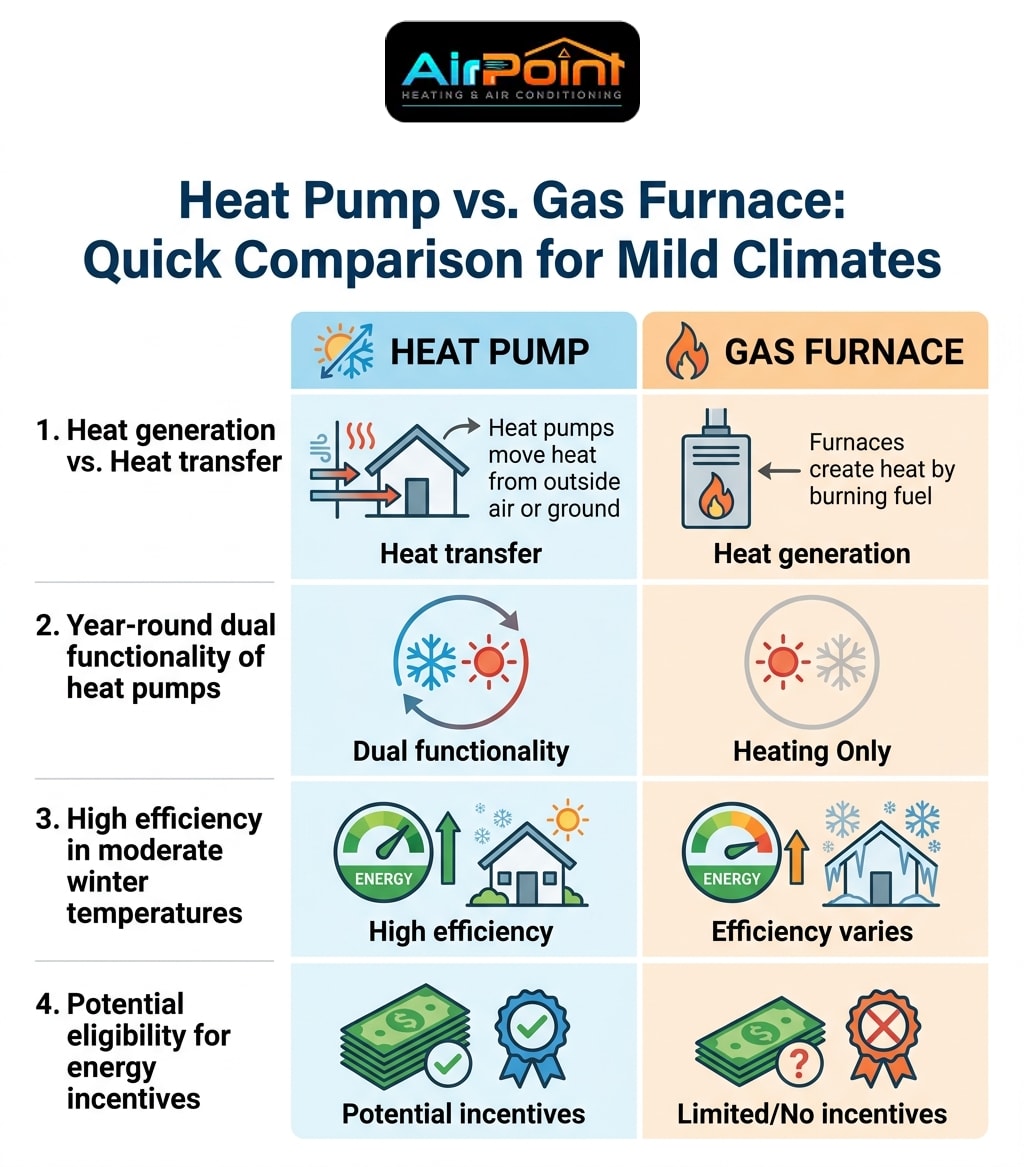
• Primary Function — Heat Pump System: Provides both heating and cooling (two-in-one). — Gas Furnace System: Provides heating only (requires separate AC).
• Energy Source — Heat Pump System: 100% Electricity. — Gas Furnace System: Natural gas or propane (plus minimal electricity for the blower).
• Efficiency Profile — Heat Pump System: Extremely high efficiency in mild to moderate climates; transfers heat. — Gas Furnace System: High efficiency available, but fundamentally limited by the realities of fuel combustion.
• Installation Needs — Heat Pump System: May require electrical panel upgrades to handle the dedicated 220v circuit. — Gas Furnace System: Requires intact gas lines, secure flue venting, and carbon monoxide safeguards.
• Air Delivery Feel — Heat Pump System: Delivers a steady, consistent flow of moderately warm air. — Gas Furnace System: Delivers short, intense blasts of very hot air.
• Lifespan Expectancy — Heat Pump System: Generally shorter (runs year-round for both heating and cooling). — Gas Furnace System: Generally longer (typically rests during the summer months).
Installation Complexities: Swapping a gas furnace for another gas furnace is often straightforward if the existing gas lines and exhaust flues are up to modern safety codes. Transitioning to a heat pump, however, might require evaluating your home's electrical panel. Older homes with 100-amp service may need an electrical heavy-up to support the new heat pump's circuitry safely.
Environmental Impact: Heat pumps are entirely electric. If your home utilizes solar panels or sources electricity from renewable grids, a heat pump can heat your home with a virtually zero-carbon footprint. Gas furnaces will always rely on fossil fuels, though modern condensing furnaces extract far more heat from that fuel than older models did.
When Replacing an Aging Gas Furnace Makes Sense
Despite the growing popularity of heat pumps, there are many scenarios where sticking with a traditional gas furnace is the most logical, cost-effective choice for a homeowner. A typical pattern we see during November pre-winter preparation is that homes with existing, well-maintained gas infrastructure are perfectly positioned for a direct, high-efficiency furnace swap.
If your home already has properly sized gas lines, a safe and compliant exhaust flue, and ductwork designed for the high-velocity airflow of a furnace, replacing the old unit with a new gas model minimizes installation disruption. The labor required to run new high-voltage electrical circuits for a heat pump—especially if the home's main electrical panel requires an expensive upgrade to support the extra load—can sometimes outweigh the long-term energy savings of switching away from gas.
Furthermore, modern gas furnaces are engineering marvels compared to the units manufactured twenty years ago. High-efficiency condensing furnaces utilize a secondary heat exchanger to capture exhaust heat that older models simply vented out the chimney. This means that even if you choose to stay with gas, upgrading an aging system will still yield a noticeable improvement in fuel utilization and operational safety.
Finally, if you are planning a broader system overhaul—such as relocating the HVAC equipment to a different part of the house or redesigning the ductwork—staying with the fuel source your home is already built around can keep the project scope manageable. A thorough assessment of your home's specific architecture will reveal whether the path of least resistance is a modern furnace or a complete technological shift.
Navigating High-Efficiency Incentives and Upgrades
One of the most compelling reasons to evaluate your heating system during November pre-winter preparation is the evolving landscape of energy incentives. Upgrading to high-efficiency systems can yield long-term energy savings on your monthly utility bills, but it can also unlock various financial incentives designed to encourage energy conservation.
Homeowners should be aware that generic federal tax credits frequently apply to qualifying high-efficiency heat pump installations, as well as certain top-tier gas furnaces. Additionally, many local utility providers offer their own energy rebates to customers who permanently reduce their grid demand by installing advanced climate control technology.
• Verify Eligibility: Always verify eligibility requirements with a qualified tax professional before making a purchase based on anticipated credits.
• Check Local Utilities: Contact your local electricity and gas providers to ask about current efficiency rebate programs for residential HVAC upgrades.
• Keep Documentation: Maintain all manufacturer certificates and installation invoices, as these are required when claiming efficiency incentives.
Understanding Generic Tax Credits
Federal incentives for energy-efficient upgrades are designed to offset a portion of the initial installation cost. These programs focus strictly on high-efficiency equipment requirements. A baseline, builder-grade system rarely qualifies; the equipment must meet specific seasonal energy efficiency ratios (SEER2) and heating seasonal performance factors (HSPF2). Because these programs update frequently, consulting with your installation professional about which specific models meet current federal guidelines is a crucial step in the decision-making process.
Beyond the heating equipment itself, a system replacement is the ideal time to evaluate the air you breathe. Because the installation team is already modifying your ductwork and air handler, it is highly cost-effective to integrate indoor air quality solutions at the same time. Adding advanced filtration, UV purification, or whole-home humidification during a furnace or heat pump replacement ensures your new system circulates the cleanest air possible from day one.
De-Risking Your HVAC System Upgrade Decision
Choosing between a heat pump and a gas furnace is a major investment, but the process does not have to be stressful. The key to eliminating guesswork is relying on a thorough, no-pressure evaluation of your current system's health and your home's unique thermal dynamics.
A professional evaluation goes far beyond simply looking at the metal box in your garage or attic. Experts perform detailed load calculations—often referred to as a Manual J calculation—to determine the exact system size needed for your specific floor plan, window layout, and insulation levels. Guessing the size of a new system based on the old unit's specifications is a recipe for disaster. An oversized system will short-cycle, leading to premature wear and poor humidity control, while an undersized system will run endlessly without ever reaching your desired temperature.
Regardless of whether you choose a heat pump that runs year-round or a gas furnace paired with an air conditioner, routine care remains non-negotiable. Annual maintenance is required to ensure longevity, protect your manufacturer warranties, and keep your air conditioner running smoothly through the hottest months of the year.
Finally, transition anxiety is real, especially when switching from a familiar technology to something new. Working with a provider that offers a 100% satisfaction guarantee and 24-hour service availability serves as a critical peace-of-mind factor. Knowing that emergency support is always a phone call away de-risks the upgrade process, ensuring that your home remains comfortable and safe regardless of what the Los Alamitos coastal-adjacent climate brings.
Frequently Asked Questions
Is a heat pump better than a gas furnace in California?
A heat pump is often considered ideal for California's climate due to its mild winters. Because heat pumps transfer heat rather than generating it via combustion, they operate with exceptional energy efficiency when outdoor temperatures remain above freezing. Additionally, they provide both heating and cooling, making them a versatile year-round solution for regions with long, hot summers and moderate winters.
Do heat pumps work efficiently in mild winters?
Yes, mild winters are exactly the environment where heat pumps achieve their highest efficiency ratings. When the outside air is cool but not freezing, the system requires very little electrical energy to harvest ambient heat and transfer it indoors. This makes them significantly more efficient than traditional electric resistance heaters or gas furnaces during moderate seasonal weather.
Should I replace my aging gas furnace with a heat pump?
Replacing an aging gas furnace with a heat pump is a smart move if you want to improve energy efficiency and consolidate your heating and cooling into one system. However, the decision depends on your home's electrical capacity and existing ductwork. A professional evaluation is necessary to determine if an electrical panel upgrade is required to support the new heat pump safely.
What are the pros and cons of switching to a heat pump?
The primary pros include high energy efficiency, a lower carbon footprint, and the convenience of having both heating and cooling in a single unit. The main cons involve potential upfront installation complexities, such as the need for electrical upgrades, and the fact that the air delivered by a heat pump feels moderately warm rather than the intense, hot blast produced by a gas furnace.
How do I know if my home's electrical system can support a heat pump?
Determining electrical capacity requires an inspection of your home's main breaker panel by a qualified professional. Heat pumps generally require a dedicated 220-volt circuit and sufficient overall amperage (often a 200-amp panel for the whole home) to operate safely. If your home has older, 100-amp service, an electrical heavy-up may be necessary before installation.
Can a heat pump completely replace my air conditioning unit?
Absolutely. A heat pump functions exactly like a traditional air conditioner during the summer months, utilizing a reversing valve to pull heat out of your home and expel it outdoors. By installing a heat pump, you are effectively upgrading both your heating and cooling systems simultaneously.
Make Your Next HVAC Decision with Confidence
Choosing the right heating technology doesn't have to be an overwhelming process. By understanding the mechanical differences and evaluating your home's specific needs, you can secure reliable, year-round comfort. If you are ready for a clear, objective comparison tailored to your home, schedule HVAC service today to get the expert guidance you need to make an informed pre-winter replacement decision.
Other Blogs
Latest Blog Posts

When to Call an AC Technician: Navigating Your Late-Fall Home Maintenance Checklist

The Complete Homeowner's Guide to Safely Starting a Dormant Heating System in Los Alamitos
Why Your Heating System Smells Like Burning in November: Normal Dust vs. Mechanical Danger

Customer Testimonials


I recommend Air Point for your HVAC needs."