






How Old Is Too Old for an HVAC System? Here's What Every Homeowner Should Know
How old is too old for an HVAC system is one of the most common questions homeowners face — especially when the AC starts struggling on a hot Orange County afternoon or the energy bill creeps higher every month. The short answer depends on the type of system you have, but most HVAC equipment hits its reliability limit somewhere between 12 and 20 years. After that point, the cost of keeping it alive often outweighs the cost of replacing it.
Here's a quick breakdown by system type:
| HVAC System Type | Typical Lifespan | Consider Replacing At |
|---|---|---|
| Central Air Conditioner | 15-20 years | 12-15 years with issues |
| Gas Furnace | 15-30 years | 15-20 years with issues |
| Air-Source Heat Pump | 10-16 years | 10-12 years with issues |
| Ductless Mini-Split | 15-20 years | 15+ years with issues |
| Boiler | 20-35 years | 20+ years with issues |
| Packaged Unit | 12-15 years | 10-12 years with issues |
The tricky part is that age alone doesn't tell the whole story. A well-maintained 18-year-old furnace might still be running reliably, while a neglected 10-year-old AC could already be costing you more in repairs and wasted energy than it's worth. By around year 10 to 12, most central air systems are already operating at only 80 to 85% of their original efficiency — and that gap only grows wider with time.
In this guide, we'll walk you through exactly how to read the signs, crunch the numbers, and decide whether your system deserves another season or a well-earned retirement.
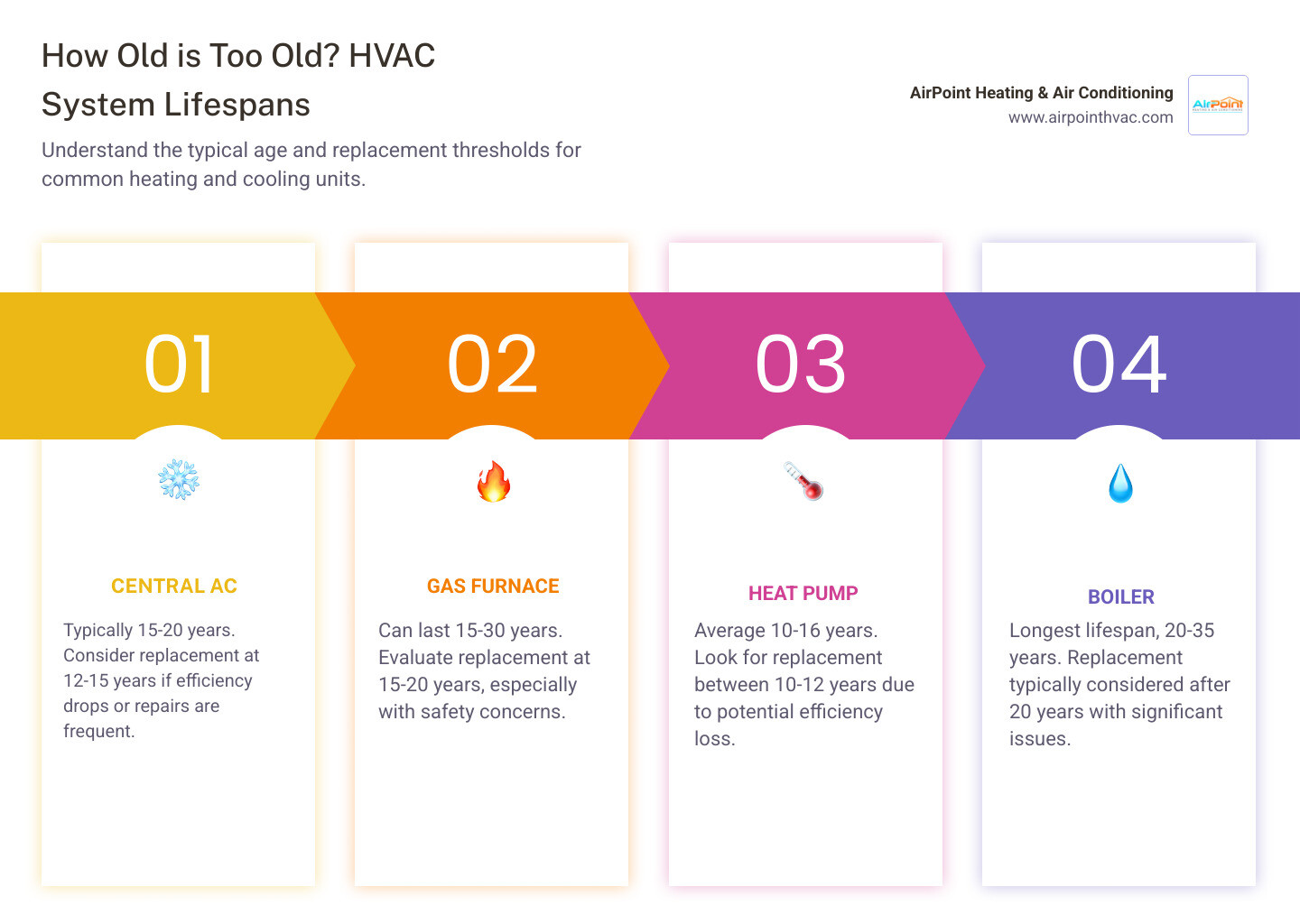
Understanding the Lifespan: How Old is Too Old for an HVAC System?
When we talk about the lifespan of your home’s climate control, we have to look at the individual components. As of April 2026, technology has moved fast, but the physical laws of wear and tear remain the same. A central air conditioner is essentially a high-performance machine that lives outside, exposed to the elements. In our local Orange County climate, units in coastal areas like Newport Beach or Huntington Beach often face a tougher life due to salt air, which can accelerate corrosion.
Typically, a central AC unit is designed to last between 15 and 20 years. However, the median service life often falls closer to the 12–15 year range for units that work hard during our long California summers. Gas furnaces have it a bit easier because they stay indoors, often lasting 15 to 30 years. Heat pumps, which handle both heating and cooling, tend to have shorter lifespans—usually 10 to 16 years—because they run year-round without the "off-season" a furnace might enjoy.
Knowing when to plan for HVAC replacement is about more than just checking a date on a sticker. It involves looking at the installation quality. A system that was poorly sized or improperly installed will struggle from day one, likely hitting the "too old" mark years before a correctly installed unit. For homeowners considering an HVAC Replacement in Orange County, CA, the decision often hinges on whether the unit can still keep up with the demand of 90-degree days without breaking the bank.
Why 15 Years is Often the "Too Old" Threshold
By the time a system hits 15 years, it has likely cycled on and off tens of thousands of times. This mechanical wear leads to component fatigue. Think of it like a car with 200,000 miles; even if it’s still running, the internal parts are thin, the seals are brittle, and the risk of a catastrophic failure—like a seized compressor—skyrockets.
Technology obsolescence is the other half of the 15-year wall. A system installed in 2011 is prehistoric compared to 2026 standards. It uses more energy, provides less comfort, and likely relies on outdated refrigerants. If you are looking for HVAC Replacement in Huntington Beach, CA, you'll find that modern systems offer humidity control and air filtration that simply wasn't available 15 years ago.
How Maintenance History Redefines How Old is Too Old for an HVAC System
We’ve seen 20-year-old systems that look and run like they’re five years old, and 8-year-old systems that are ready for the scrap heap. The difference? Precision tune-ups. Regular maintenance, such as cleaning the coils and checking refrigerant levels, prevents the system from overworking.
When a system is neglected, the blower motor has to work twice as hard to push air through a clogged filter or a dirty evaporator coil. This heat buildup shortens the life of electrical components. If you’ve stayed on top of your maintenance, you might be able to push that replacement date back. But if the unit has been ignored, you may need an HVAC Replacement in Garden Grove, CA much sooner than expected.
The Telltale Signs Your System is Reaching Retirement
Sometimes your HVAC system doesn’t just quit; it gives you a series of "hints" that it’s tired. One of the biggest red flags is frequent breakdowns. If you’ve had to call a technician twice in the last two years for different issues, your system is likely in a "death spiral" where one failing part puts stress on the next.
Rising utility bills are another silent indicator. If your usage habits haven't changed but your bills are 20% higher than they were three years ago, your system is losing its efficiency. Older units can lose 20–40% of their efficiency over their lifetime as motors wear down and coils become permanently pitted.
You might also notice:
- Uneven Temperatures: Some rooms are ice-cold while others stay warm.
- Strange Noises: Grinding, squealing, or banging sounds often indicate a failing motor or compressor.
- Excessive Dust: An aging system struggles to filter air and manage humidity, leading to a grittier home environment.
Recognizing these furnace replacement top signs can save you from a mid-winter emergency. Similarly, if your cooling isn't crisp, it might be time to replace your air-conditioning unit before the next heatwave hits. For residents needing HVAC Replacement in Irvine, CA, being proactive is always more cost-effective than a panicked emergency call.
Safety Risks and Efficiency Losses in Aging Units
As systems age, they don't just become expensive—they can become dangerous. This is especially true for gas furnaces. The heat exchanger is the component that keeps combustion gases (like carbon monoxide) separate from the air you breathe. Over 15 to 20 years, the constant expansion and contraction of metal can cause cracks. A cracked heat exchanger is a direct safety risk and usually mandates an immediate system shutdown.
There are many top reasons to consider furnace replacement, but safety is number one. On the AC side, the efficiency loss is staggering. A 12-year-old AC system can lose 20–30% of its efficiency, effectively dropping a 13 SEER unit down to a 9 or 10 SEER performance. If you're in Mission Viejo, CA, an HVAC replacement can often pay for itself through energy savings alone over a few seasons.
Determining if Your Current Unit is Too Old for an HVAC System Upgrade
Not every old unit needs to be hauled away immediately. A professional inspection can determine if your system has a few good years left. We look for airflow restrictions and check the integrity of your ductwork. Sometimes, a system feels "old" because the ducts are leaking 30% of the conditioned air into the attic.
However, if the core components like the compressor or the heat exchanger are failing, an upgrade is the only logical path. For those in Newport Beach, CA, HVAC replacement evaluations often include checking if the existing ductwork can handle the higher airflow and pressure of modern, high-efficiency blowers.
Repair vs. Replace: Using Industry Rules of Thumb
Deciding whether to invest in an old unit is a strategic choice. We often use industry "rules of thumb" to help homeowners make the call. One common method is to multiply the age of the system by the repair quote. If the total is high, replacement is often the smarter move.
The 50% Rule: If a single repair is more than half the value of a new system, it’s time to upgrade. Why spend significant funds on a "band-aid" for an old machine when you could have a brand-new unit with a full warranty?
Whether you are looking at HVAC Replacement in Downey, CA or Brea, CA, these rules help take the emotion out of the decision. Cumulative costs matter too; if you’ve spent a significant amount over the last few years on small fixes, you’re already well on your way to paying for a new system without getting the benefits of one.
Navigating the R-22 and R-410A Refrigerant Phase-Out
One of the biggest "deal-breakers" for old AC units is the type of refrigerant they use. If your system was built before 2010, it likely uses R-22 (Freon). The EPA banned the production and import of R-22 in 2020. Today, in 2026, finding R-22 is incredibly difficult and expensive. If an R-22 system develops a leak, the cost of the refrigerant alone can be astronomical.
Even R-410A, which replaced R-22, is currently being phased down to make room for newer, more environmentally friendly refrigerants. If your older R-410A unit has a major leak, we often recommend HVAC Replacement in West Garden Grove, CA because the industry is moving toward newer standards that are more sustainable and cheaper to maintain in the long run.
Efficiency Gains and Modern SEER2 Standards
The advantages of AC replacement go beyond just avoiding repairs. Modern systems must meet SEER2 standards, which are much more stringent than the ratings of a decade ago.
- Variable-Speed Compressors: Instead of being "all on" or "all off," these units can run at lower speeds to maintain a perfectly steady temperature.
- Two-Stage Heating: This allows your furnace to use less gas on milder days, saving you money.
- Smart Home Integration: Modern systems talk to your phone and learn your schedule, ensuring you never waste energy cooling an empty house.
The Benefits of Upgrading to a Modern HVAC System
Upgrading an aging system is an investment in your home’s value and your family’s comfort. Beyond the lower monthly bills, modern HVAC systems offer vastly improved indoor air quality. Newer units feature better filtration systems that can trap microscopic allergens, pet dander, and pollutants—a huge plus for families in Orange County.
There are also significant financial incentives available in 2026. Federal tax credits and local utility rebates are often available for high-efficiency heat pump installations and central AC or furnace upgrades. When you combine these incentives, the investment becomes much more manageable.
Whether you are deciding when to consider furnace replacement or looking for a full system overhaul for an HVAC Replacement in South County, CA, the result is a home that is quieter, more comfortable, and significantly cheaper to run. Modern blowers start up gradually and run so quietly you might not even notice they are on.
Frequently Asked Questions about HVAC Longevity
Can an HVAC system last 30 years?
While rare, some gas furnaces and boilers can reach the 30-year mark if they are high-quality units and have received impeccable annual maintenance. However, central air conditioners and heat pumps almost never reach 30 years because their outdoor components are subjected to much harsher conditions. Even if a system can run for 30 years, it will be so inefficient by year 20 that you would likely save money by replacing it.
Does a heat pump last as long as a central AC?
Generally, no. A central AC only runs during the cooling season. A heat pump works year-round to provide both heating and cooling. Because the compressor in a heat pump accumulates roughly double the run-hours of a standard AC compressor, its mechanical lifespan is typically 25–30% shorter, usually landing between 10 and 15 years.
When should I schedule a professional inspection for an old unit?
If your system is over 12 years old, you should have it professionally inspected once a year before the primary cooling or heating season begins. This "health check" allows us to catch small issues like a failing capacitor or a dirty sensor before they turn into a major system failure during a heatwave.
Conclusion
Deciding how old is too old for an hvac system doesn't have to be a guessing game. By looking at the 15-year threshold and keeping an eye on your energy bills, you can make an informed choice that protects your home and your wallet.
At AirPoint Heating & Air Conditioning, we pride ourselves on providing honest, expert advice to our neighbors in Los Alamitos and across Orange County. As a family-owned business, we understand that your home’s comfort is your top priority. Whether you need a precision tune-up to extend the life of your current unit or a full HVAC Replacement in La Palma, CA, our award-winning team is here to help with a 100% satisfaction guarantee.
Don't wait for your old system to leave you in the heat. Contact us today for a professional evaluation and discover how a modern, efficient system can transform your home comfort. Book your service online now for fast, reliable care!
Other Blogs
Latest Blog Posts
Heat Pump vs. Gas Furnace: Weighing Operating Costs Under Current California Utility Rates
Why DIY Mini Split Pre-Charged Lines Often Leak Refrigerant After the First Season
How to Inspect Your Attic Ductwork for Rodent Damage Before Winter Sets In

Customer Testimonials



I recommend Air Point for your HVAC needs."