






Upgrading Your Air Filtration System to Handle Fall Allergens in Los Alamitos
The Urgent Shift in Indoor Air Quality Before the Winds Arrive
September is just around the corner, which means the timeline for upgrading your air filtration system to handle fall allergens in Los Alamitos is rapidly closing. Before the first major weather shift hits, you have a critical decision to make about your home's defenses. At AirPoint Heating & Air Conditioning, our team sees it happen every year: the transition from summer into the September Santa Ana wind season brings an immediate, noticeable drop in indoor air quality across the homes we service. The familiar coastal marine layer is pushed out, replaced by dry, high-velocity winds that drive fine dust and particulate matter straight into your living spaces. If you find yourself constantly dusting furniture and suffering from seasonal allergies despite running your air conditioner around the clock, your current setup is likely overwhelmed. The core decision point comes down to this: you can continue swapping out standard 1-inch filters that quickly clog under the heavy dust load, or you can upgrade to a high-capacity media cabinet built to handle extreme particulate events.
If you are tired of battling poor indoor air quality every time the winds pick up, exploring professional HVAC services and dedicated indoor air quality solutions is the most effective way to prepare your home for the season ahead.
Why Fall Brings Unique Allergen Threats to Our Coastal Basin
When most people think of fall allergies, they picture the damp mold and ragweed common in other parts of the country. However, living in Southern California means facing a completely different set of environmental challenges. Our local fall allergy season is defined by a dry, high-velocity particulate load that behaves differently than standard pollen.
Because Los Alamitos is situated in a unique coastal basin, offshore seasonal winds act like a funnel. These winds gather inland vegetation particulate, dry soil, and urban dust, accelerating as they move toward the coast and pushing those contaminants directly into Los Alamitos residential neighborhoods. This microclimate reality means your home is subjected to concentrated bursts of poor air quality that standard HVAC setups were never designed to handle.
The microscopic threat to your home:
• PM10 particles: These are larger dust and pollen particles that irritate your eyes, nose, and throat. They are heavy enough to settle quickly, creating the layer of dust you constantly have to wipe off your tables and countertops.
• PM2.5 particles: These are fine, microscopic particles that bypass your body's basic defenses and travel deeply into your respiratory tract. They remain suspended in the air for hours, making them much harder to filter out.
• Desiccated plant matter: The dry heat of late summer leaves behind brittle vegetation that shatters into airborne allergens when the winds arrive.
During these events, the South Coast AQMD (Air Quality Management District) frequently issues dust advisories. These alerts serve as a clear benchmark for when local air quality plummets. When the air outside is thick with PM2.5 and PM10 particles, those contaminants will inevitably seek their way inside through drafty windows, opening doors, and your home's natural ventilation. Relying on basic filtration during these advisories leaves your indoor living space vulnerable to the exact same pollutants floating outside.
The Airflow Bottleneck: Why Standard 1-Inch Filters Fail Under Pressure
To understand why your home feels dusty even when the AC is running, you have to look at the mechanical limitations of standard 1-inch air filters. These basic filters have very limited surface area. Under normal conditions, they might last a month or two, but during the heavy dust loads of the September Santa Ana wind season, they clog rapidly. Once that limited surface is covered in debris, the filter stops acting like a net and starts acting like a wall.
Many homeowners try to solve this problem by purchasing high-MERV 1-inch filters at the hardware store. While these dense filters are excellent at trapping microscopic dust, their tight weave severely restricts the system's airflow from day one. When you combine a restrictive high-MERV rating with a heavy layer of wind-blown dust, you create a massive airflow bottleneck.
The cascading effects of restricted airflow:
1. Blower motor strain: Your HVAC system's blower motor has to work twice as hard to pull air through a clogged, dense filter, leading to overheating and premature wear.
2. Increased energy consumption: Because the system struggles to move air, it has to run longer cycles to reach your target temperature, driving up your monthly utility usage.
3. Reduced comfort: Weak airflow means uneven cooling and heating, leaving certain rooms stagnant and uncomfortable.
4. Constant replacements: To maintain any semblance of airflow during high-wind events, you have to change 1-inch filters constantly—sometimes every couple of weeks—which is frustrating and unsustainable.
Our technicians at AirPoint Heating & Air Conditioning see the consequences of neglected filtration and restricted airflow constantly. In fact, one local customer reached out to our team during a pre-heating-season tune-up regarding an older, run-down HVAC unit that was struggling to perform. The system had a leaky compressor and a deteriorating coolant pipe, but a major part of the complete tune-up involved replacing heavily soiled filters and thoroughly cleaning the internal components. Once the system was repaired and the airflow was restored, the unit became significantly more efficient. If you want to dive deeper into the mechanics of this issue, learning how high-MERV filters affect your air conditioner's airflow is a great next step.
How a Media Cabinet Upgrade Maximizes Surface Area and Filtration
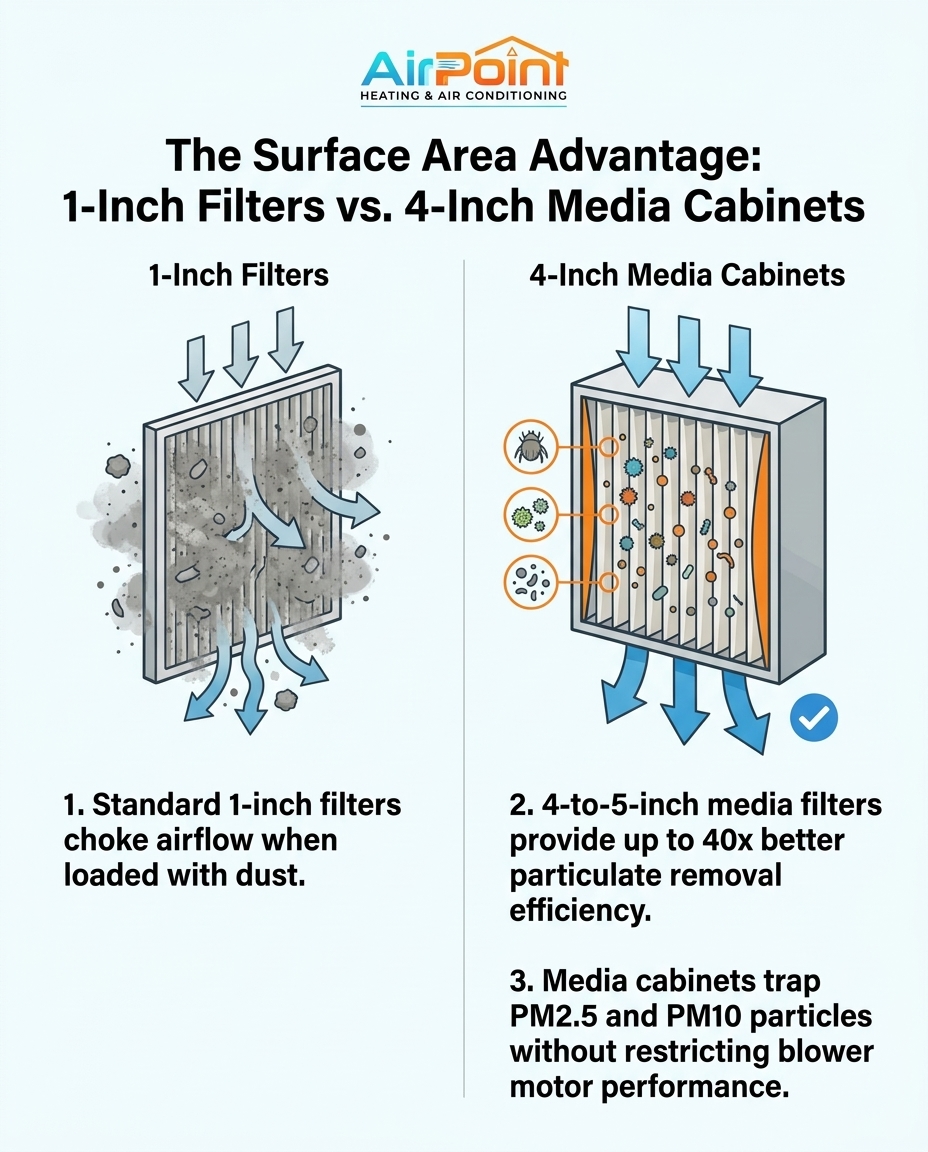
The definitive solution to the airflow and filtration dilemma is upgrading to a media cabinet. A media cabinet is a specialized housing installed directly into your HVAC system's ductwork that holds a much larger, 4-to-5-inch thick pleated filter. This upgrade fundamentally changes how your home handles airborne contaminants.
The secret to a media filter's success is its deep "accordion" design. By tightly pleating a massive amount of filtration material into a 4-inch frame, a media filter provides exponentially more surface area than a standard 1-inch filter. This expanded surface area allows the filter to achieve high-efficiency particulate trapping—often up to 40 times better than cheap fiberglass filters—without choking the system's airflow. The air has plenty of room to pass through, even as the filter begins to collect dust.
Based on our years of experience optimizing indoor air quality, we've found this specific upgrade is perfect for Los Alamitos residential neighborhoods because it effectively captures the fine dust and pollens driven by seasonal winds without straining your equipment. Instead of acting like a solid wall, the deep pleats distribute the dust load evenly.
• Surface Area — Standard 1-Inch Filter: Very limited; clogs rapidly — 4-Inch Media Cabinet Filter: Massive; deep pleats distribute dust load
• Airflow Impact — Standard 1-Inch Filter: High restriction when dirty — 4-Inch Media Cabinet Filter: Maintains strong airflow even when loaded
• Particulate Capture — Standard 1-Inch Filter: Basic dust and lint — 4-Inch Media Cabinet Filter: Traps PM2.5, PM10, and fine pollens
• Maintenance Schedule — Standard 1-Inch Filter: Every 1 to 3 months — 4-Inch Media Cabinet Filter: Every 6 to 12 months
Beyond the superior air quality, the most popular benefit of a media cabinet is its low-maintenance nature. Because of the vast surface area, media filters typically only need to be replaced once or twice a year, even in dusty environments. You gain peace of mind knowing your home is protected without the hassle of monthly filter swaps.
Integrating Media Cabinets: A Permanent Structural Enhancement
It is important to understand that adding a media cabinet is not a simple DIY filter swap; it is a permanent structural enhancement to your home's air distribution system. Upgrading to a media cabinet requires modifying the existing return air drop—the sheet metal ducting that connects to your furnace or air handler—to accommodate the wider, thicker housing.
Why professional installation is mandatory: Modifying ductwork requires precise metal fabrication and proper sealing. If a media cabinet is installed incorrectly, it can create air leaks. When your return duct leaks, it pulls unconditioned, unfiltered air directly from your attic or garage into your living space, completely defeating the purpose of the high-efficiency filter. A licensed professional ensures the cabinet is sealed tight and sized correctly to match your existing blower motor's static pressure requirements.
Proper airflow distribution is just as critical as the filtration itself. Our installation crew recently helped a local homeowner who reached out during an early fall heatwave because they were struggling with uneven temperature distribution—their home's upper level was significantly warmer than the rest of the house. Resolving this required a full system replacement, alongside extensive ducting upgrades with zoning. When you modify your system, whether to fix uneven temperatures or to install a media cabinet, professional ductwork services ensure the entire system breathes correctly.
Leveraging local HVAC expertise in Southern California microclimates is essential. A contractor who understands the extreme demands of the September Santa Ana wind season can tailor these ductwork and media cabinet upgrades to handle our specific environmental stressors, ensuring your system runs flawlessly when the dust storms hit.
Seasonal Steps to Protect Your Home's Air Quality This Fall
While upgrading your filtration hardware is the most impactful step you can take, managing indoor air quality also requires proactive habits. As the September Santa Ana wind season approaches, implementing a few seasonal strategies will help keep your indoor air clean and your HVAC system running smoothly.
Monitoring Local Air Quality Alerts
Staying ahead of the dust is half the battle. Use local weather apps and EPA guidelines to track PM2.5 levels in your area. When the South Coast AQMD issues high-wind or dust advisories, keep your windows and doors tightly closed to minimize particulate intrusion. If you have a media cabinet installed, consider adjusting your thermostat fan settings from "AUTO" to "ON" during these high dust events. This forces the system to continuously circulate and filter the air in your home, even when the cooling or heating cycle isn't actively running.
Pre-Season System Checks
Before the harsh winds arrive, it is vital to ensure your system is prepared to handle the load.
• Verify existing filters: Check that your current filters aren't already clogged from heavy summer use. Starting the fall with a dirty filter guarantees poor performance.
• Inspect return vents: Look for visible dust buildup on the grilles of your return vents. Heavy accumulation is a sign that your current filter is bypassing dust or is fully loaded.
• Schedule a professional inspection: Have a technician verify that your blower motor hasn't been damaged by past airflow restrictions.
• Consider duct cleaning: Pairing a new media cabinet installation with a comprehensive duct cleaning allows you to start the season with a completely clean slate, removing years of settled dust from your home's respiratory system.
Frequently Asked Questions About Managing Fall Dust and Pollen
Does a 4 inch media filter restrict airflow?
No, a 4-inch media filter actually improves airflow compared to a high-MERV 1-inch filter. Because the media filter is deeply pleated, it offers significantly more surface area for the air to pass through. This expansive surface allows the filter to trap microscopic dust and allergens without forcing the blower motor to struggle against a tight bottleneck.
How to filter dust from Santa Ana winds?
The most effective way to filter heavy dust from Santa Ana winds is by upgrading to a whole-home media cabinet. Standard filters clog too quickly during high-velocity wind events, leaving your home vulnerable. A media cabinet provides the necessary thickness and surface area to trap large volumes of PM10 and PM2.5 particles, especially when paired with keeping windows closed and running your HVAC fan continuously during advisories.
Are media air cleaners worth the upgrade?
Yes, media air cleaners are highly worth the investment for homeowners living in dusty microclimates or those who suffer from seasonal allergies. They require much less maintenance—often lasting 6 to 12 months between changes—and provide superior protection for both your lungs and your HVAC equipment. Over time, the reduction in blower motor strain can also extend the lifespan of your heating and cooling system.
What is the best air filter for fall allergies?
The best filter for heavy fall allergies in Los Alamitos residential neighborhoods is a 4-to-5-inch thick pleated media filter with an appropriate MERV rating (typically MERV 11 to 13). These thicker filters capture the fine pollens and desiccated plant matter blown in by seasonal winds without restricting the airflow that keeps your home comfortable.
Can a thicker filter damage my older HVAC unit?
When properly installed by a professional, a thicker media filter will not damage your older unit; in fact, it often protects it. The damage to older units usually comes from restrictive 1-inch high-MERV filters that choke the system. However, modifying the ductwork to fit a media cabinet must be done correctly to ensure the static pressure matches your specific blower motor's capabilities.
Secure Long-Term Relief from Airborne Particulates Today
At AirPoint Heating & Air Conditioning, we know that upgrading your air filtration system to handle fall allergens in Los Alamitos is the most proactive step you can take for your home's comfort and health. By replacing inadequate 1-inch filters with a high-capacity media cabinet, you gain a permanent, whole-home solution that effectively traps local allergens without damaging your existing HVAC equipment. You deserve the peace of mind that comes from knowing your indoor air is clean, no matter how hard the seasonal winds blow outside. Before the dust settles in your living room, take action and schedule HVAC service to explore professional installation options tailored to your home.
Other Blogs
Latest Blog Posts
The Essential Fall Home Maintenance Checklist: Decoding HVAC Startup Smells

Finding Your Efficiency Sweet Spot: Using a SEER Savings Calculator for HVAC Upgrades

Common Homeowner Questions Answered: Why Does My Heater Smell Like Burning Dust?

Customer Testimonials



I recommend Air Point for your HVAC needs."