






Identifying Pests That Seek Shelter in Your AC Unit as Summer Winds Down
When Cooling Evenings Bring Unwanted Guests to Your AC
The back-to-school season is just around the corner, and identifying pests that seek shelter in your AC unit as summer winds down is a critical step in preventing sudden system failures. As late-summer August evenings begin to offer a slight chill, our team at AirPoint Heating & Air Conditioning often sees the outdoor condenser sitting in your yard transform into an incredibly attractive, heated refuge for local wildlife. Rodents and insects naturally gravitate toward the residual warmth generated by your air conditioning equipment, often nesting directly inside the electrical compartments. This hidden intrusion creates a severe risk of sudden electrical shorts, chewed wiring, and catastrophic mechanical breakdowns just when you need consistent cooling during the heat of the day.
If you need immediate assistance evaluating the condition of your air conditioning systems, reach out to schedule HVAC service today.
Homeowners frequently mistake these sudden pest-induced electrical failures at the end of summer for standard wear-and-tear. Because the damage happens behind closed metal panels, the root cause goes unnoticed until the compressor refuses to turn on. The goal right now is learning how to safely recognize the early external signs of an infestation before the damage reaches the sensitive high-voltage components. By spotting the physical evidence early, you can take action to protect your equipment and avoid a completely preventable breakdown.
The Seasonal Shift: Why Your Condenser Becomes a Target
To understand why animals suddenly take an interest in your cooling equipment, you have to look at the environmental triggers. Southern California experiences a distinct diurnal temperature variation during this time of year. While the days remain intensely hot, requiring your air conditioner to run for hours, the late-summer temperature drops noticeably after sunset. This stark contrast between the cooling night air and the lingering heat of an actively used condenser creates a highly desirable artificial microclimate.
In our experience serving Los Alamitos, pests in these suburban neighborhoods are highly sensitive to these temperature shifts. As they begin preparing for the upcoming fall, they actively seek out warm, protected spaces to build nests. Your outdoor condenser unit offers the perfect combination of shelter from late-summer weather, protection from natural predators, and a reliable heat source.
1. The compressor's thermal mass: The heavy metal compressor inside the unit retains significant heat for hours after the system shuts off for the night, acting like a giant radiator for small animals.
2. Vibration and humming: Certain insects are drawn to the low-level hum and electromagnetic fields generated by the electrical contactors and capacitors.
3. Physical protection: The louvered metal exterior of the condenser protects against wind, rain, and larger predators, making the interior cavity an ideal, secure nesting site.
4. Proximity to resources: Condensers are often located near gardens, moisture sources (like the condensate drain line), and overgrown vegetation, providing easy access to food and water.
The Appeal of Residual Heat
The primary draw for these unwanted guests is the residual heat. Compressors work incredibly hard during the day, compressing refrigerant gas and generating high temperatures. Because the metal housing is thick, it cools down very slowly. For a mouse or rat navigating the cooler night air, that slow-release heat is a beacon. Similarly, electrical contactors emit a steady, low-level warmth that attracts specific types of swarming insects, leading them directly into the most sensitive areas of the machine.
Common Culprits: Rodents and Insects to Watch For
Different pests interact with your HVAC system in different ways, but all of them pose a threat to the mechanical and electrical integrity of the equipment. Knowing which local pests are most likely to invade during those late-summer August evenings helps you know what specific damage to look out for. Based on the service calls we handle at AirPoint Heating & Air Conditioning, here are the most frequent offenders:
• Mice and rats: Rodents have teeth that never stop growing, meaning they have a constant biological need to gnaw on hard materials. Unfortunately, the soft plastic insulation surrounding high-voltage copper wires is a prime target. They will quickly strip the insulation to use as nesting material, leaving bare wires exposed.
• Ants: Certain species of ants, particularly crazy ants and fire ants, are naturally drawn to electrical fields. They often swarm the electrical contactor—the switch that turns the compressor on and off. When they get crushed between the magnetic contacts, their bodies release pheromones that attract even more ants, eventually creating a physical barrier that stops the electrical connection from closing.
• Spiders and wasps: These insects prefer the sheltered, dry corners of the condenser cabinet to build webs and paper nests. While they don't typically chew wires, large nests can obstruct moving parts, such as the condenser fan motor, or block the airflow necessary to cool the coils.
• Snakes and lizards: While less common, reptiles will occasionally squeeze into the cabinet to hunt the insects and rodents already living there, or simply to bask in the heat of the compressor, potentially shorting out the capacitor if they bridge the electrical terminals.
Regardless of the specific culprit, the result is the same: foreign debris, biological waste, and physical damage introduced into a precision-engineered machine that requires clean, unobstructed operation to function safely.
Safe External Visual Signs of Pest Intrusion
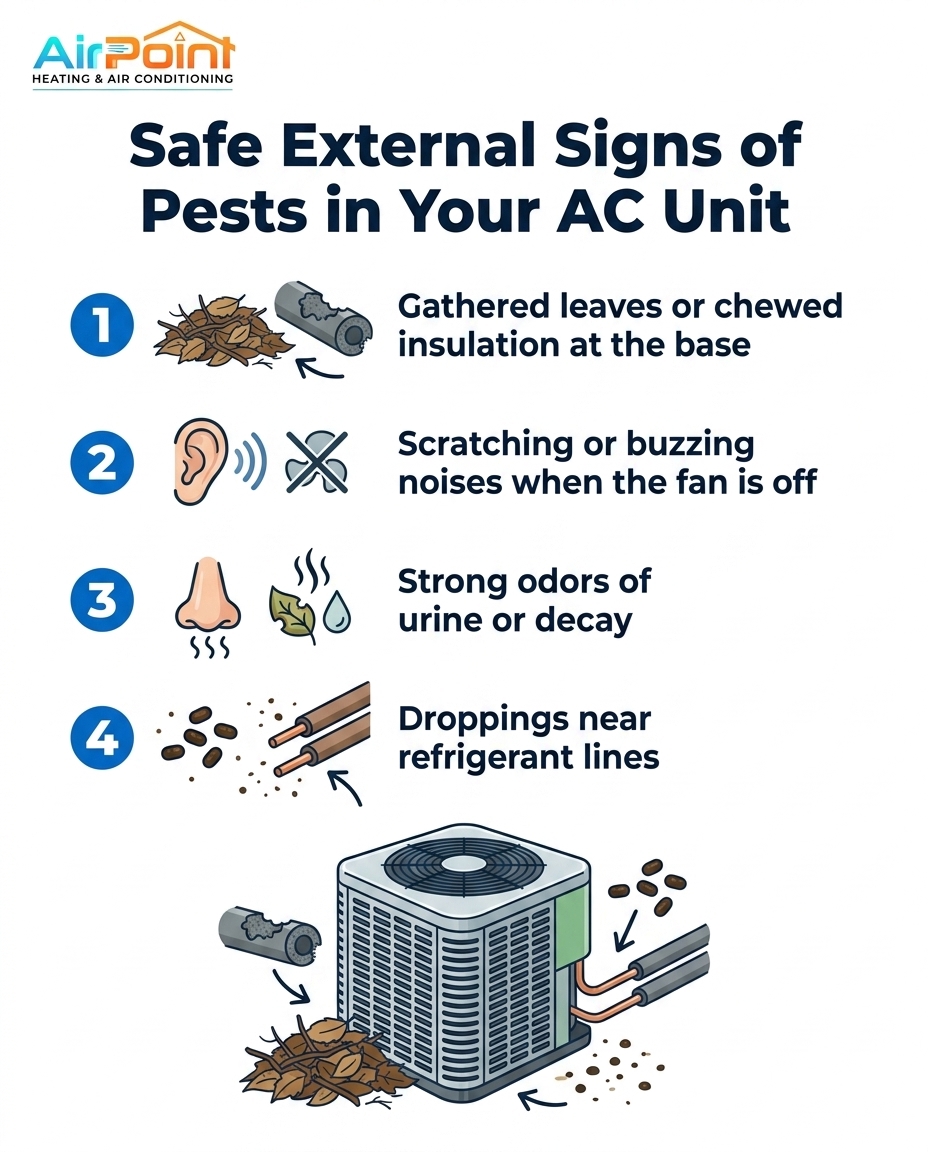
You do not need to open the electrical panel to determine if pests have moved into your unit. In fact, doing so is extremely dangerous without proper training. Instead, you can look for safe, external visual indicators that signal an active infestation in Los Alamitos suburban neighborhoods.
• Gathered nesting materials: Look for unnatural accumulations of leaves, twigs, dried grass, or shredded insulation pushed against the base of the unit or sticking out of the louvers.
• Unusual noises: Listen closely to the unit when the fan is completely off. Scratching, scurrying, or faint buzzing sounds coming from inside the metal cabinet are strong indicators of active pests.
• Foul odors: Notice any strong smells of urine, ammonia, or decay. These odors become especially pungent and noticeable when the unit turns on and begins blowing warm air out of the top.
• Chewed exterior components: Inspect the foam insulation wrapping the large copper refrigerant line outside the unit. If it looks jagged, torn, or gnawed, rodents are likely using it for nest building.
When cleaning debris from your AC condenser after a late-summer storm, pay attention to the pattern of the debris. Wind-blown leaves will be scattered randomly, while pest-gathered materials will be tightly packed into deliberate piles or shoved intentionally into gaps.
What to Look For Around the Base
The ground immediately surrounding the concrete or plastic condenser pad often holds the best clues. Look for small, dark droppings near the refrigerant lines or electrical conduit. Additionally, check the dirt beneath the pad itself for small burrow holes, which indicate rodents are tunneling underneath the unit to gain access from the bottom.
The Hidden Danger: Chewed Wires and Electrical Shorts
The most severe consequence of a pest invasion is the invisible damage done to the electrical system. Sudden electrical failures during late-summer August evenings are frequently misdiagnosed by homeowners as standard part fatigue. A capacitor dies, or a breaker trips, and the assumption is simply that the unit worked too hard all summer. However, if pests are the root cause, replacing the part without addressing the infestation guarantees the system will fail again.
• Tripped circuit breaker — Standard Wear-and-Tear Cause: Overheating compressor or failing capacitor — Pest-Induced Cause: Chewed insulation causing bare copper wires to arc and short out
• System won't turn on — Standard Wear-and-Tear Cause: Thermostat communication failure — Pest-Induced Cause: Ant swarms blocking the magnetic contactor from closing
• Loud grinding noise — Standard Wear-and-Tear Cause: Failing fan motor bearings — Pest-Induced Cause: Rodent nest obstructing the fan blade's rotation
• Refrigerant leak — Standard Wear-and-Tear Cause: Corrosion on the coils over many years — Pest-Induced Cause: Acidic animal urine rapidly corroding the copper lines
The fire hazard: According to National Fire Protection Association (NFPA) data, rodents are responsible for a significant percentage of undetermined electrical fires and equipment shorts. When a mouse chews through wire insulation, it exposes bare copper. If those wires touch the metal cabinet or each other, it creates an immediate, high-voltage short circuit. This not only destroys the expensive internal components of the air conditioner but also presents a genuine fire hazard to the surrounding property.
Why DIY Pest Control Can Damage Your Equipment
Discovering pests in your equipment often triggers a panic response, leading homeowners to reach for the nearest can of bug spray or rodent repellent. However, applying DIY pest control methods directly to an air conditioner is incredibly risky for both your safety and the longevity of the equipment.
Chemical damage: Spraying liquid pesticides, repellents, or foaming wasp killers into the electrical compartments is a recipe for disaster. These chemicals are highly conductive and can cause immediate electrical shorts if the unit turns on. Furthermore, the propellants and active ingredients are often corrosive. Over time, they will eat away at the copper coils and electrical connections, causing permanent damage that far exceeds the cost of the initial pest problem.
Electrical shock risk: Never attempt to remove the metal access panel to chase out a rodent or spray a nest. The capacitors inside store a massive, potentially lethal electrical charge, even when the power is completely shut off at the breaker. Opening the panel without proper training poses a severe risk of high-voltage electric shock.
Air quality concerns: Lingering pest debris, dried urine, and heavy applications of DIY chemicals can negatively impact your indoor air quality if the integrity of the ductwork or air handler is compromised. Instead of chemical deterrents, we always recommend physical exclusion—such as having a professional install specialized wire mesh or seal entry points—as a much safer and far more effective long-term solution for homes in Los Alamitos suburban neighborhoods.
The Value of a Professional End-of-Season Inspection
When you suspect an infestation, the safest course of action is to have the equipment evaluated by a licensed technician. A professional inspection by experienced local technicians who know exactly where to look for pest damage safely before it causes an unexpected system failure is the only way to guarantee the unit is electrically sound.
Experienced technicians approach the problem methodically. They begin by safely discharging the high-voltage capacitors before opening any panels. Once inside, they can test the electrical components with multimeters to confirm if a short was caused by a chewed wire, a swarming ant colony, or standard late-summer fatigue. A thorough preventative check includes carefully cleaning out all nested debris, sanitizing the compartment to remove pheromones that attract future pests, and repairing or replacing any compromised wiring.
For example, during a preventative check late last summer, our AirPoint Heating & Air Conditioning technicians were called by a local homeowner to evaluate their AC system after noticing poor performance. Our technician performed a thorough diagnostic check, cleaning out an early-stage rodent nest and explaining the potential electrical issues without pressuring the customer into unnecessary service. By addressing the small issues early, the homeowner was left completely confident in the system's smooth operation through the rest of the season. Catching pest damage during late-summer August evenings follows the exact same principle: it is always better to clean a nest and splice a wire today than to replace a blown compressor tomorrow.
Always schedule an HVAC inspection to secure the electrical safety of the equipment before calling a yard pest control service to handle the broader property.
Frequently Asked Questions About AC Pest Problems
What are the signs of mice in an AC unit?
The most obvious signs of mice in an AC unit are shredded insulation, gathered leaves around the base, and small, dark droppings near the refrigerant lines. You may also hear faint scratching or scurrying noises coming from the metal cabinet when the fan is not running. If the mice have chewed wires, you might experience sudden, unexplained electrical shorts or a tripped circuit breaker.
Can insects cause an AC to stop working?
Yes, insects can absolutely cause an AC unit to stop working, most commonly by swarming the electrical contactor. Ants are attracted to the warmth and electrical fields of this component, and when they get trapped between the magnetic contacts, they create a physical barrier that prevents electricity from flowing to the compressor. Wasps and spiders can also build large nests that obstruct the fan blades.
Why do pests nest in air conditioners?
Pests nest in air conditioners because the outdoor condenser provides a warm, dry, and highly protected environment away from natural predators. The metal housing blocks wind and rain, while the compressor itself retains significant residual heat long after it shuts off. In Los Alamitos suburban neighborhoods, this makes the unit a perfect artificial shelter as evening temperatures begin to drop.
How do I keep mice out of my air conditioner?
The safest way to keep mice out of your air conditioner is through physical exclusion and maintaining a clean perimeter. Keep grass, bushes, and vegetation trimmed at least two feet away from the unit to remove hiding spots. A professional HVAC technician can also install specialized wire mesh around vulnerable entry points without restricting the necessary airflow the system needs to operate efficiently.
Will bugs in my AC unit ruin it?
Bugs will not immediately ruin the heavy mechanical parts, but they can easily destroy the sensitive electrical components if left unchecked. Ant swarms can permanently damage contactors, while acidic insect waste can corrode copper wiring and circuit boards over time. Prompt professional cleaning is required to remove the bugs and the pheromones they leave behind.
Is it safe to spray bug spray inside an AC condenser?
No, it is never safe to spray bug spray, wasp killer, or rodent repellent inside an AC condenser. These chemicals are often highly conductive and can cause immediate electrical shorts, while the propellants can corrode the copper coils and wiring. Always rely on a professional to safely clean the interior and address the infestation without damaging the equipment.
Protect Your Comfort Before Fall Arrives
Catching pest issues early is the single best way to prevent a minor nuisance from turning into a major, expensive electrical repair. While safe external visual checks are an excellent first step for any homeowner, a professional evaluation is absolutely required to assess and repair internal damage safely. If you have noticed gathered debris, strange noises, or sudden electrical hiccups during these late-summer August evenings, do not wait for the system to fail completely. Take action now to safely confirm the root cause, clear out the intruders, and schedule HVAC service to ensure your equipment runs flawlessly straight through the transition into fall.
Other Blogs
Latest Blog Posts
The Essential Fall Home Maintenance Checklist: Decoding HVAC Startup Smells

Finding Your Efficiency Sweet Spot: Using a SEER Savings Calculator for HVAC Upgrades

Common Homeowner Questions Answered: Why Does My Heater Smell Like Burning Dust?

Customer Testimonials



I recommend Air Point for your HVAC needs."