






Upgrading Decades-Old Ductwork in Downey Tract Homes to Handle Modern Airflow
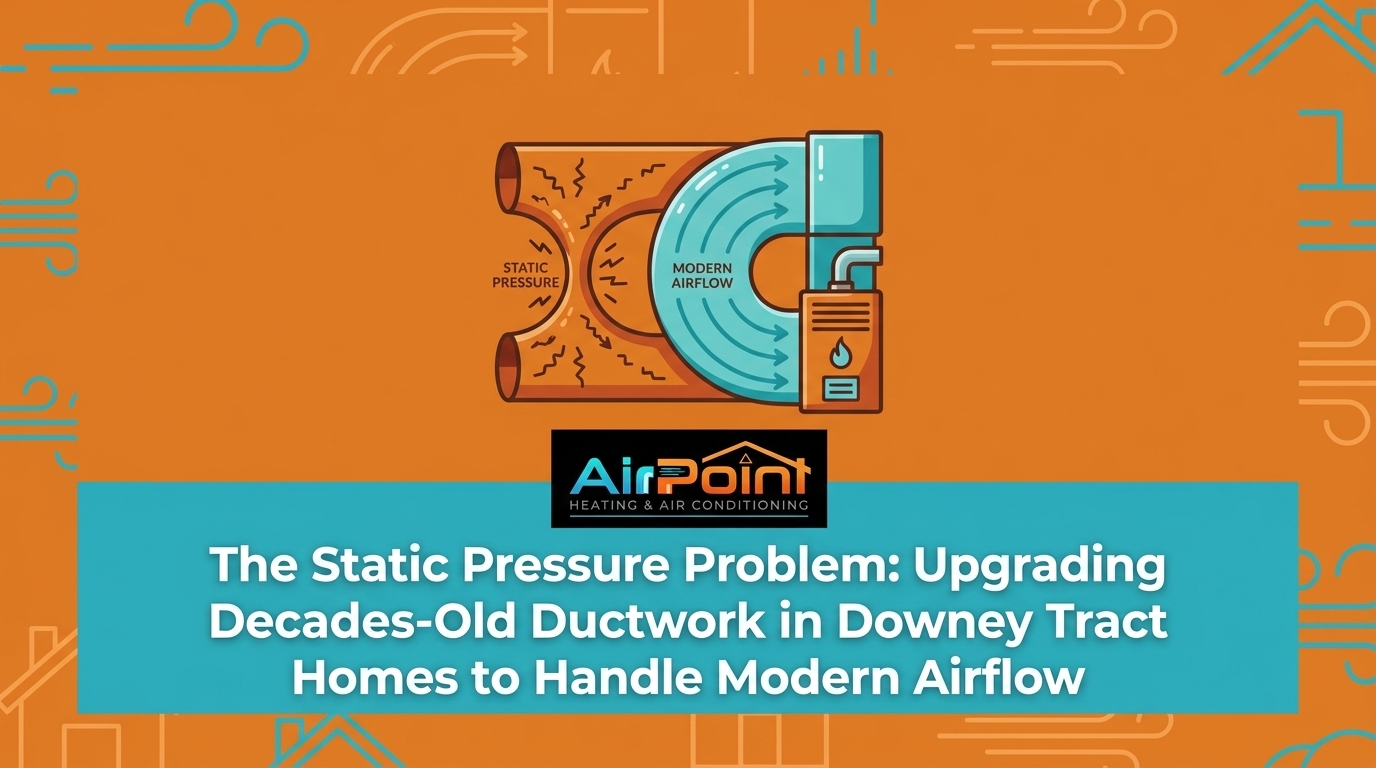
The Hidden Trap of Upgrading Your AC in Late Summer
As late-summer heat lingers and families settle into the back-to-school routine, your air conditioner might be running continuously while the house still feels uncomfortably warm. At AirPoint Heating & Air Conditioning, our team frequently sees homeowners facing this frustrating scenario. We always emphasize that upgrading decades-old ductwork in Downey tract homes to handle modern airflow is the critical step most people overlook. Homeowners often rush to replace failing AC units during peak August cooling demand, expecting immediate relief from the heat. However, as our technicians regularly witness in the field, simply dropping a brand-new system onto original infrastructure rarely delivers the comfort you are paying for.
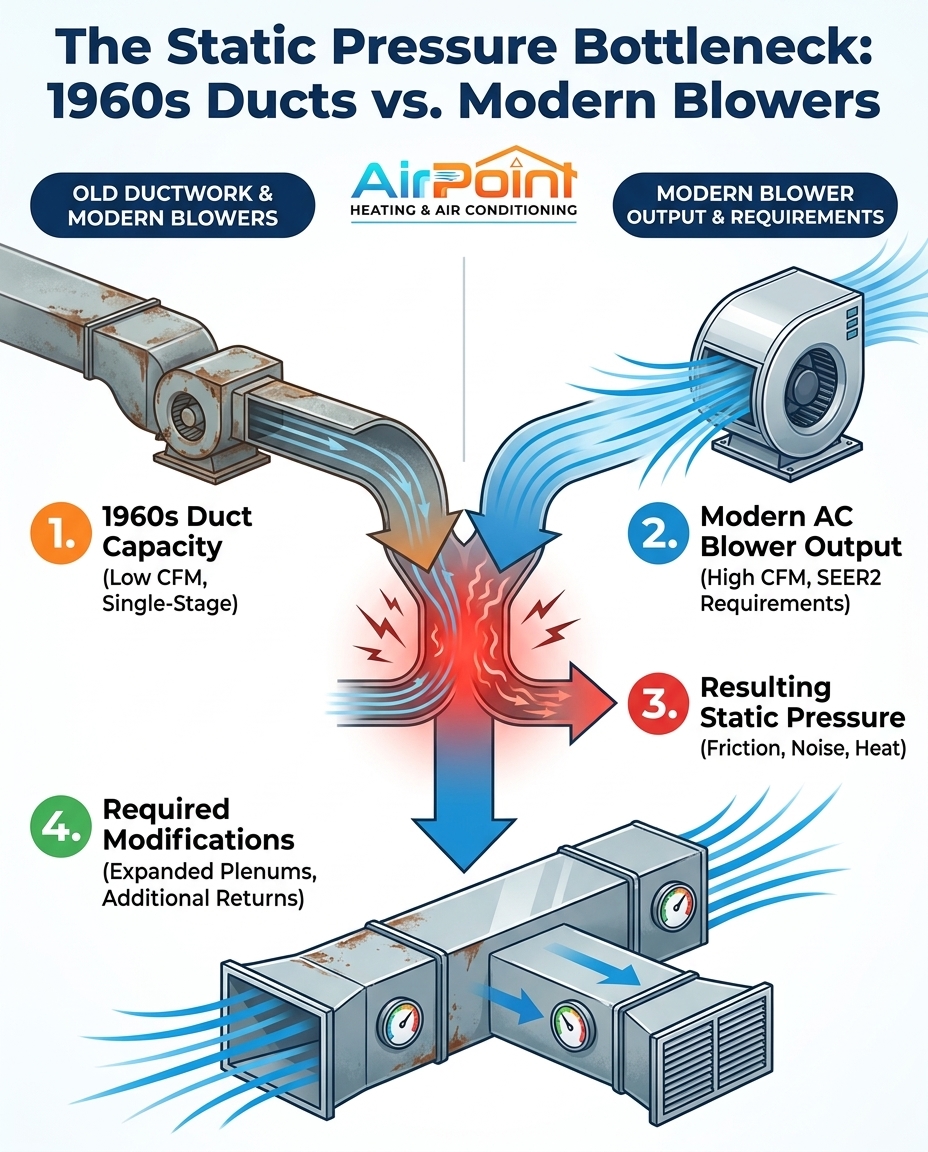
Connecting a modern, high-efficiency SEER2 blower directly to original, undersized ductwork creates a severe bottleneck. Today's air conditioners push a massive volume of air compared to older models. When that powerful airflow hits narrow, restrictive pathways, it creates immediate operational strain, entirely defeating the purpose of an energy-efficient upgrade. This leaves homeowners facing a critical decision: risking premature wear on an expensive new air conditioner, or properly assessing and modifying the home's infrastructure first. Taking the time to let our professionals evaluate your ductwork installation and upgrades ensures your new cooling system can actually breathe.
The Architectural Reality of 1960s Downey Tract Homes
The post-war housing boom in Southern California prioritized rapid construction to meet soaring demand. In our years of servicing this area, we've found that builders during the 1960s utilized ductwork designed specifically for lower-capacity, single-stage blowers. These original metal ducts were perfectly adequate for the equipment of the era, which moved air at a much slower, less demanding pace.
Today, those original ducts are significantly narrower than what modern HVAC codes require. While structurally sound and a testament to the durability of mid-century building materials, a pattern we see often is that these designs simply cannot accommodate the massive cubic feet per minute (CFM) output of today's high-efficiency systems. A modern multi-stage or variable-speed blower requires wide, clear pathways to distribute conditioned air without resistance.
• 1960s Original — Typical Blower Capacity: Single-stage, low velocity — Ductwork Characteristics: Narrow branches, small return drops — Airflow Dynamics: Slow, steady, low resistance
• Modern SEER2 — Typical Blower Capacity: Variable-speed, high CFM — Ductwork Characteristics: Requires wide plenums, multiple returns — Airflow Dynamics: High volume, requires rapid displacement
Upgrading the mechanical equipment without addressing this architectural legacy is a recipe for system failure. Forcing a 2026-standard blower to operate within 1960s structural constraints guarantees that the system will never reach its advertised efficiency ratings, costing you more in both utility bills and inevitable repair costs.
Understanding High Static Pressure in Narrow Ducts
To understand why old ducts ruin new air conditioners, we always teach our customers about static pressure. In plain terms, static pressure is the resistance to airflow within the ductwork system. Every turn, every narrow branch, and every register creates a certain amount of pushback against the air your blower is trying to move.
Our technicians often compare modern airflow in narrow ducts to trying to breathe through a thin coffee stirrer while running a marathon. Your lungs have the capacity to take in oxygen, but the tiny straw severely restricts the volume you can move. When an HVAC system faces high static pressure, the blower motor is forced to work substantially harder to push the required amount of air through the restricted space.
The mechanical toll: This excessive resistance forces the blower motor to pull more electricity and generate excess heat. Modern ECM (Electronically Commutated Motors) are designed to ramp up their speed to overcome resistance, meaning they will literally work themselves to death trying to push air through a bottleneck. This mechanical strain leads directly to premature wear on expensive new equipment, turning a high-efficiency investment into a noisy, failing liability.
Warning Signs Your Original Ductwork is Choking Your System
If your home is suffering from a static pressure mismatch, the system will exhibit clear, observable symptoms. Recognizing these warning signs early can save your equipment from catastrophic failure.
• Excessive operational noise: A loud whistling sound at the registers or a "jet engine" roar near the return vent usually means the blower is struggling against immense resistance.
• Uneven cooling throughout the house: When airflow is restricted, the rooms furthest from the indoor unit will remain hot, while rooms closest to the equipment might feel freezing.
• Frequent system short-cycling: If the AC turns on and off rapidly, the system is likely overheating and shutting itself down as a safety precaution.
• Unexplained utility spikes: Energy bills that remain high despite running a brand-new, supposedly efficient unit indicate the motor is drawing maximum amperage to fight static pressure.
Just recently, our team helped a local Downey homeowner who experienced this exact issue when their system developed a loud, high-pitched noise and the fan stopped turning entirely. After our thorough assessment, the solution went beyond just addressing the broken AC—it required installing additional intake vents and adjusting the duct routing. Once the airflow was corrected, the house cooled down much faster, and their previously uncomfortable great room finally became a pleasant living space.
The Cost of Ignoring Airflow Restrictions
Failing to address these symptoms when installing high-efficiency air conditioning systems carries severe consequences. While generally applicable energy rebates or federal tax credits may apply to qualifying heat pump and AC installations (we always recommend verifying current programs with your utility provider or a tax professional), those potential savings are quickly erased by repair bills if static pressure remains unchecked. Blower motor burnout is incredibly common under these conditions. Furthermore, restricted airflow prevents enough warm air from passing over the indoor evaporator coil, causing the coil to freeze solid. Perhaps most importantly, operating a new system outside of the manufacturer's specified static pressure limits will frequently void the warranty, leaving you responsible for the cost of replacement parts.
How Coastal Moisture Exacerbates Poor Airflow
Poor airflow doesn't just affect the temperature inside your home; it severely limits the system's ability to dehumidify the air. An air conditioner cools your home by removing heat, but it also acts as a massive dehumidifier, extracting moisture as air passes over the cold evaporator coil.
Downey's specific late-summer climate—where warm extended August days meet creeping coastal moisture—creates a uniquely uncomfortable environment when tract home ducts lack the ventilation power to dehumidify. When this coastal moisture creeps inland, sluggish airflow traps the humidity inside the living space. The air feels heavy, sticky, and warmer than the thermostat indicates.
Our technicians recently worked with another area family who struggled with uneven temperature distribution, where the upper level of their home was noticeably warmer and more humid than the rest of the house. A full system replacement by our team that included updated ducting and a zoning system with a second thermostat solved the problem, resulting in wonderfully regulated temperatures and proper moisture control throughout the entire home.
This trapped moisture can also lead to condensation forming within the narrow, aging ducts, creating secondary air quality issues over time. Properly sized ductwork ensures enough air volume circulates to effectively strip moisture from the indoor environment. If you are struggling with a damp, clammy home, exploring professional indoor air quality solutions and understanding our strategies for managing Downey's coastal moisture are essential steps toward total home comfort.
Retrofitting Mid-Century Homes for High-Efficiency Cooling
The prospect of modifying ductwork often sounds intimidating, but we assure our customers that ductwork upgrades don't necessarily mean tearing down walls or ruining the aesthetic of your home. Strategic modifications to the most restrictive points in the system often resolve static pressure issues completely.
Our team's deep local expertise at AirPoint in retrofitting Southern California's mid-century residential architecture ensures that these upgrades are performed without compromising the home's original structural integrity. We focus on smart, targeted improvements rather than complete demolition.
1. Expanding the Plenum: The box immediately attached to your furnace or air handler (the plenum) is often too small. Expanding this allows air to properly pressurize before entering the branch ducts.
2. Adding Return Air: A system can only blow out as much air as it can pull in. Adding additional intake vents dramatically reduces system noise and improves overall distribution.
3. Adjusting Duct Routing: Straightening out kinked flexible ducts or replacing sharp 90-degree metal elbows with gradual turns heavily reduces friction loss.
Professional modifications by our licensed experts ensure the new system operates exactly at its advertised SEER2 efficiency rating. These targeted upgrades preserve the aesthetic of your 1960s Downey tract home while delivering reliable, quiet, 21st-century comfort.
The Importance of ACCA Manual D Sizing Standards
Our installation team relies on strict engineering principles, specifically ACCA Manual D calculations, to match duct size precisely with blower performance for code-compliant HVAC installations. Guessing duct sizes based on the square footage of the home is an outdated practice that leads directly to the static pressure problems we see in older tract homes.
Manual D calculations account for a variety of complex factors:
• Friction loss: The resistance created by the material of the ductwork itself (metal vs. fiberglass vs. flex duct).
• Equivalent length: Factoring in how every turn, bend, and register adds resistance equivalent to feet of straight pipe.
• CFM requirements: The specific volume of air the chosen equipment needs to move to operate safely.
A proper engineering assessment prevents the guesswork that leads to noisy, inefficient systems. We highly recommend that homeowners always verify their installation team performs these load and friction calculations before attaching a new AC to old ducts. Without this mathematical proof, you are simply hoping the old infrastructure can handle the new power.
Frequently Asked Questions About Ductwork and Airflow
What happens if ductwork is too small for a new AC?
In our experience, if ductwork is too small, it creates high static pressure that restricts airflow. This leads to loud operation, frozen evaporator coils, and premature blower motor failure as the system works overtime to push air. Ultimately, it prevents the new AC from cooling your home efficiently.
Do I need to replace ductwork when getting a new AC?
Ductwork is not always completely replaced, but modifications are often required for older homes. Expanding plenums, widening trunk lines, or adding return vents are common retrofits our team performs. A professional assessment will determine if your existing ducts can handle modern airflow requirements.
Why is my new air conditioner so loud inside the house?
Excessive noise at the vents is usually a sign of high static pressure caused by a powerful blower forcing air through restrictive, undersized ducts. It sounds like a rushing wind or a high-pitched whistle because the air is moving at a velocity the ducts were not designed to handle.
Can old ductwork handle a modern high-efficiency HVAC system?
Old ductwork can rarely handle a modern high-efficiency system without modifications. Modern SEER2 systems require specific airflow volumes that older, narrower ducts weren't designed to support, making retrofitting a necessary step for proper operation.
How do I know if my Downey home has original 1960s ductwork?
You can often identify original ductwork by looking for narrow metal pipes or a lack of modern, thick insulation in the attic or crawlspace. The most reliable method is to consult a local HVAC professional, like our team at AirPoint, for a thorough inspection and static pressure test.
Secure Your Home's Comfort with Expert Ductwork Modifications
Matching your home's ductwork capacity to modern AC power is the only way to guarantee quiet, efficient, and reliable cooling. Upgrading decades-old ductwork in Downey tract homes to handle modern airflow isn't just an optional add-on; it is a fundamental requirement to protect the investment of a new HVAC system. Don't let original infrastructure bottleneck your modern comfort. Schedule a professional assessment of your tract home's ductwork with our team today and ensure your next cooling upgrade is backed by professional HVAC services that prioritize proper airflow.
Other Blogs
Latest Blog Posts

The Essential Fall Home Maintenance Checklist: Decoding HVAC Startup Smells

Finding Your Efficiency Sweet Spot: Using a SEER Savings Calculator for HVAC Upgrades

Common Homeowner Questions Answered: Why Does My Heater Smell Like Burning Dust?

Customer Testimonials



I recommend Air Point for your HVAC needs."