






Why Setting Your Thermostat to 60 Degrees Won't Cool Your House Any Faster
Is Lowering the Thermostat the Fastest Way to Cool Your Home?
Have you ever walked into a sweltering living room, immediately dropped the dial, and wondered why setting your thermostat to 60 degrees won't cool your house any faster? It is a completely natural reaction. When August late-summer heatwaves hit Los Alamitos CA, returning to an 85-degree house feels unbearable. The psychological urge to force the system to blast freezing air is incredibly strong. You want relief, and you want it right now.
However, understanding why this common habit fails to speed up the cooling process is the first step to achieving true indoor comfort without destroying your equipment. A standard air conditioning system does not operate like the gas pedal in your car. Pushing the target temperature lower does not force the machinery to work harder, blow faster, or produce colder air. If your system is genuinely failing to blow cold air no matter where you set the dial, you may need to schedule HVAC service to address an underlying mechanical failure.
The Thermostat 'Gas Pedal' Myth Explained
The core misconception driving this behavior is what HVAC professionals call the "gas pedal" myth. Most homeowners assume that the thermostat controls the intensity of the cooling process. If 72 degrees gives you a moderate breeze, the logic suggests that 60 degrees should unleash a blizzard of maximum-strength cold air. This simply is not how the technology is built.
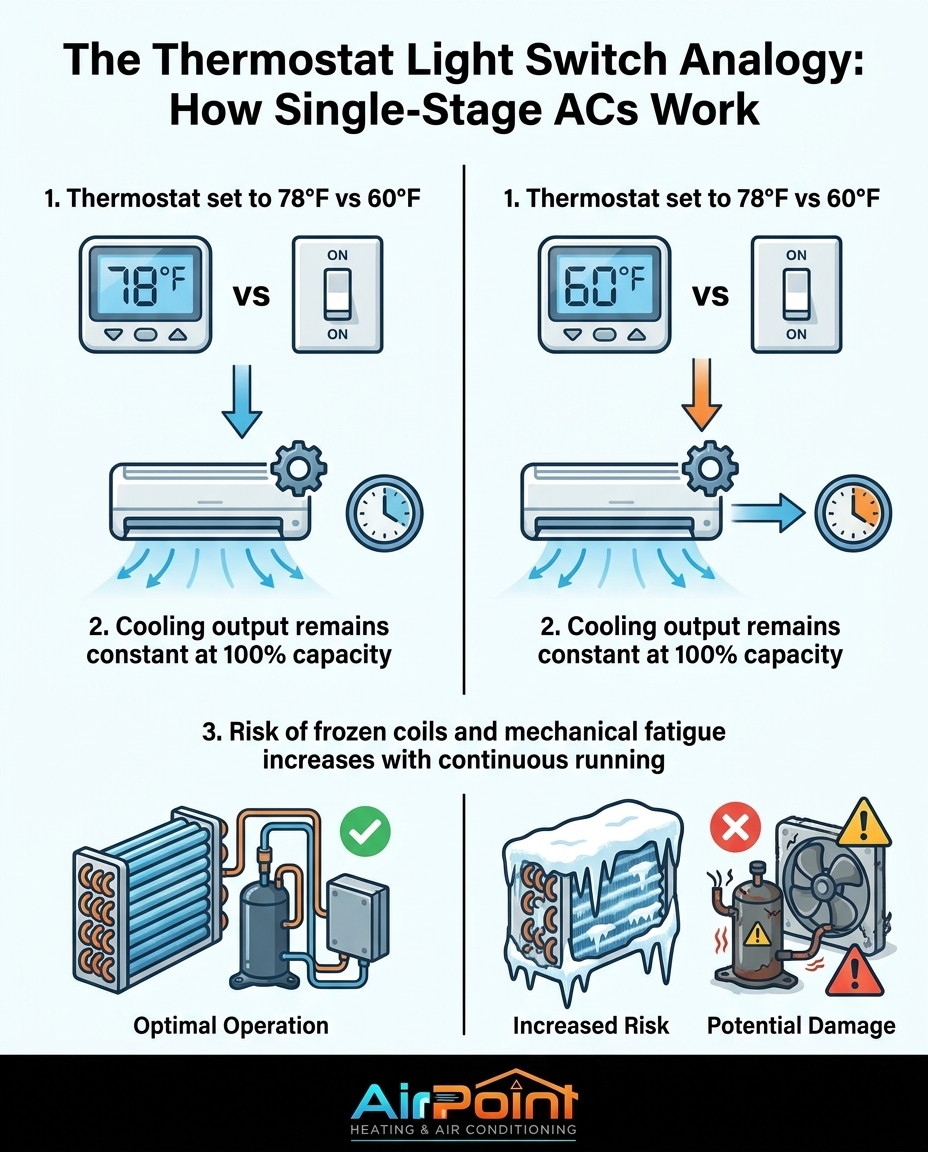
To understand the reality, you have to trade the gas pedal analogy for a light switch versus volume dial comparison. A volume dial allows for incremental adjustments—you can turn the music up a little or a lot. A light switch, on the other hand, only has two states: ON and OFF. Your thermostat acts as a temperature-activated light switch for your single-stage compressor.
When you lower the temperature setting, you are just moving the finish line. The air coming out of your supply vents remains at a constant temperature, typically about 15 to 20 degrees cooler than the warm air it pulled in from your hallways. Setting the dial lower does not change the temperature of that air; it only tells the system to stay turned on for a longer period of time.
• Setting it lower increases the cooling speed. — The Reality (Light Switch): The cooling speed remains 100% constant.
• The AC blows colder air at 60°F than at 72°F. — The Reality (Light Switch): The supply air temperature is identical in both scenarios.
• The system works "harder" to reach low numbers. — The Reality (Light Switch): The system works for a longer duration, not at a higher intensity.
The bottom line: A thermostat is a boundary marker, not a throttle. It communicates when the cooling cycle should begin and when the room has reached the target temperature, signaling the equipment to power down.
How a Single-Stage Compressor Actually Operates
To fully grasp why the 60-degree strategy fails, we have to look past the digital screen on your wall and examine the heavy machinery sitting outside your home. Most residential homes rely on a single-stage compressor to manage their indoor climate.
The 100% Capacity Rule
A single-stage compressor operates exactly as its name implies: it has one stage of operation. When the thermostat detects that the indoor temperature has risen above your set point, it sends a 24-volt signal to the control board. The system powers up and immediately runs at 100% capacity. There is no 50% "maintenance" mode, and there is no 110% "turbo" mode. It is either completely off, or it is working as hard as it possibly can.
The Heat Extraction Cycle
Air conditioners do not actually "create" cold air; they extract heat. The indoor blower fan pulls warm air from your rooms and forces it across the indoor evaporator coil. Inside that coil, cold liquid refrigerant absorbs the heat from the air, turning into a warm gas. The newly cooled air is then pushed back through your ductwork into your living spaces. This heat extraction process happens at a steady, unchangeable rate based on the physical size of your equipment.
The Target Stopping Point
Because the heat extraction rate is fixed, setting your thermostat to 60 degrees only changes the target stopping point. If your house is 80 degrees and you set the thermostat to 72 degrees, the single-stage compressor turns on at 100% capacity until the house hits 72, then it shuts off. If you set it to 60 degrees, the exact same compressor turns on at the exact same 100% capacity. The only difference is that the system will now attempt to run continuously for hours—or even days—trying to reach an impossible target.
The Mechanical Dangers of Forcing Your AC to 60 Degrees
When you demand a temperature that your home's insulation and local weather make impossible to achieve, you are effectively demanding that your air conditioner never turn off. This continuous operation introduces severe mechanical risks, especially during the peak of August late-summer heatwaves when equipment is already operating under maximum thermal stress.
1. Continuous Compressor Strain: The compressor is the heart of your cooling system, responsible for pressurizing the refrigerant. It is designed to run in cycles, typically 15 to 20 minutes at a time, followed by a rest period. Forcing it to run for hours without a break causes internal temperatures to spike, degrading the lubricating oils and wearing down the motor windings.
2. Evaporator Coil Freezing: As the system runs endlessly, it continually strips humidity from the indoor air. If the system never cycles off, the condensation forming on the cold evaporator coil does not have a chance to drain away. Eventually, that condensation drops below freezing, encasing the coil in a solid block of ice. Once the coil freezes, airflow is completely blocked, and the system will blow warm air even though the machinery is running.
3. End-of-Season Mechanical Fatigue: By the time late summer arrives, your single-stage compressor has already logged hundreds of hours of heavy use. Pushing a fatigued system to its absolute limits often triggers a catastrophic failure.
One local homeowner reached out during the summer when their AC unit started making a high-pitched squealing noise and the fan stopped turning entirely. The unit was essentially burning up from being overworked. After diagnosing the issue over the phone, a technician arrived to assess the overall system efficiency. The damage required installing a brand-new condensing unit, adding additional intake vents, and adjusting the duct routing to finally provide the faster, quieter cooling the home needed. This is exactly the kind of severe breakdown that continuous, strained operation can cause.
Why Pushing for 60 Degrees Causes Premature System Failure
Beyond the immediate threat of a frozen coil or a tripped breaker, the true cost of the 60-degree myth is a drastically shortened system lifespan. Residential HVAC systems are a major investment, designed to last 12 to 15 years under normal conditions. However, that lifespan is calculated based on normal cycling behavior.
The Cumulative Toll of Unnecessary Strain
Every mechanical component has a finite number of operating hours. When a single-stage compressor is forced to run continuously because the thermostat is set to an unreachable number, it burns through those operating hours at an accelerated rate. The contactors become pitted from excessive electrical loads, the capacitor degrades faster due to sustained heat, and the blower motor bearings wear down prematurely.
Honest Homeowner Education Matters
Providing honest homeowner education about these mechanical limits is the best way to prevent unnecessary wear-and-tear and maximize your system's lifespan. Much like the energy-saving myth of closing vents—which actually increases static pressure and damages blower motors—misunderstanding your thermostat leads to expensive consequences. A system that is operated correctly, with realistic temperature goals, will always outlast a system that is constantly pushed to the breaking point.
When you set the dial to 60 degrees, you are trading long-term reliability for a psychological sense of control. The cooling cycle does not happen any faster, but the breakdown of your equipment certainly does.
Smarter Strategies for Cooling a Hot House Quickly
If dropping the thermostat to 60 degrees is a mechanical hazard, how should you handle a sweltering house? The goal is to bring the temperature down efficiently while protecting the equipment. Here are the smartest, most effective strategies for managing indoor heat.
• Set the actual desired temperature immediately: The U.S. Department of Energy recommends setting your thermostat to 78 degrees during the summer for an optimal balance of comfort and efficiency. If you prefer 72 degrees, set it exactly to 72 degrees. Let the system run its normal cycle to get there.
• Create a wind-chill effect with ceiling fans: Your air conditioner lowers the air temperature, but moving air cools the people inside the room. Turn on ceiling fans (ensuring they rotate counter-clockwise in the summer) to push air straight down. This evaporates moisture from your skin, making the room feel up to 4 degrees cooler without lowering the thermostat.
• Block solar heat gain: Close blinds, shades, and curtains on south- and west-facing windows during the hottest parts of the day. Preventing the sun's radiant heat from entering the home drastically reduces the thermal load the AC has to fight against.
• Avoid heat-generating appliances: Delay using the oven, stove, or clothes dryer until the evening. These appliances dump massive amounts of heat into the home, forcing the AC to run longer just to maintain the current temperature.
• Keep up with preventative maintenance: A system struggling to cool might just be dirty. Clogged air filters restrict airflow, slowing down the heat extraction process. Schedule professional cooling services to ensure your refrigerant levels are correct and your coils are clean.
Another local customer struggled with a home that was never the perfect temperature, even on the hottest days of the year, despite constantly adjusting the thermostat. The solution was not forcing the old system to run longer, but having a properly sized AC and heating unit installed with exceptional workmanship. Once the right equipment was in place, the home maintained the perfect temperature effortlessly, without ever needing to drop the dial to extremes.
Frequently Asked Questions About AC Cooling Speeds
Does turning the AC down make it cool faster?
No. Setting a thermostat to 60 degrees does not speed up cooling because single-stage air conditioners cool at a constant rate regardless of the temperature setting. The thermostat only dictates when the system should turn off, not how hard or fast it works while it is running.
What happens if I set my AC to 60?
The AC will run continuously in an attempt to reach 60 degrees, which wastes energy, strains the compressor, and increases the risk of a frozen evaporator coil. Because most homes lack the insulation to achieve 60 degrees during summer heat, the system will simply never shut off, leading to severe mechanical fatigue.
Why is my AC running but not cooling the house?
If the system is running constantly but the house remains hot, it may be suffering from frozen coils, low refrigerant, or severe mechanical fatigue from being overworked. A clogged air filter can also severely restrict airflow, preventing the cold air from making it out of your vents and into your living spaces.
How long does it take to cool a hot house?
A properly sized AC unit typically drops the indoor temperature by about 1 to 2 degrees per hour, depending on outdoor heat and home insulation. If your home is 85 degrees, it will take several hours of steady, normal operation to reach a comfortable 72 degrees.
Will setting my thermostat lower cause the AC to freeze?
Yes, forcing the system to run without cycling off can cause condensation on the evaporator coil to freeze, eventually blocking airflow entirely. When the system never gets a chance to rest, the coil temperature drops too low, turning normal moisture into a solid block of ice.
Protect Your Equipment and Stay Comfortable All Summer
The secret to surviving the hottest days of the year is patience. Understanding that your single-stage compressor operates at a fixed capacity empowers you to make smarter choices for your home. By setting your thermostat to a realistic, comfortable temperature, you allow the system to cycle normally, extract heat efficiently, and rest when necessary. This approach prevents unnecessary wear-and-tear and protects you from the nightmare of a mid-August breakdown.
Ultimately, knowing why setting your thermostat to 60 degrees won't cool your house any faster saves you from skyrocketing energy bills and premature system failure. If you have set a reasonable temperature but your home is still struggling to stay comfortable, the equipment likely needs professional attention. Do not wait for a complete breakdown; schedule HVAC service today to ensure your system is running efficiently and reliably all season long.
Other Blogs
Latest Blog Posts
The Essential Fall Home Maintenance Checklist: Decoding HVAC Startup Smells

Finding Your Efficiency Sweet Spot: Using a SEER Savings Calculator for HVAC Upgrades

Common Homeowner Questions Answered: Why Does My Heater Smell Like Burning Dust?

Customer Testimonials



I recommend Air Point for your HVAC needs."