






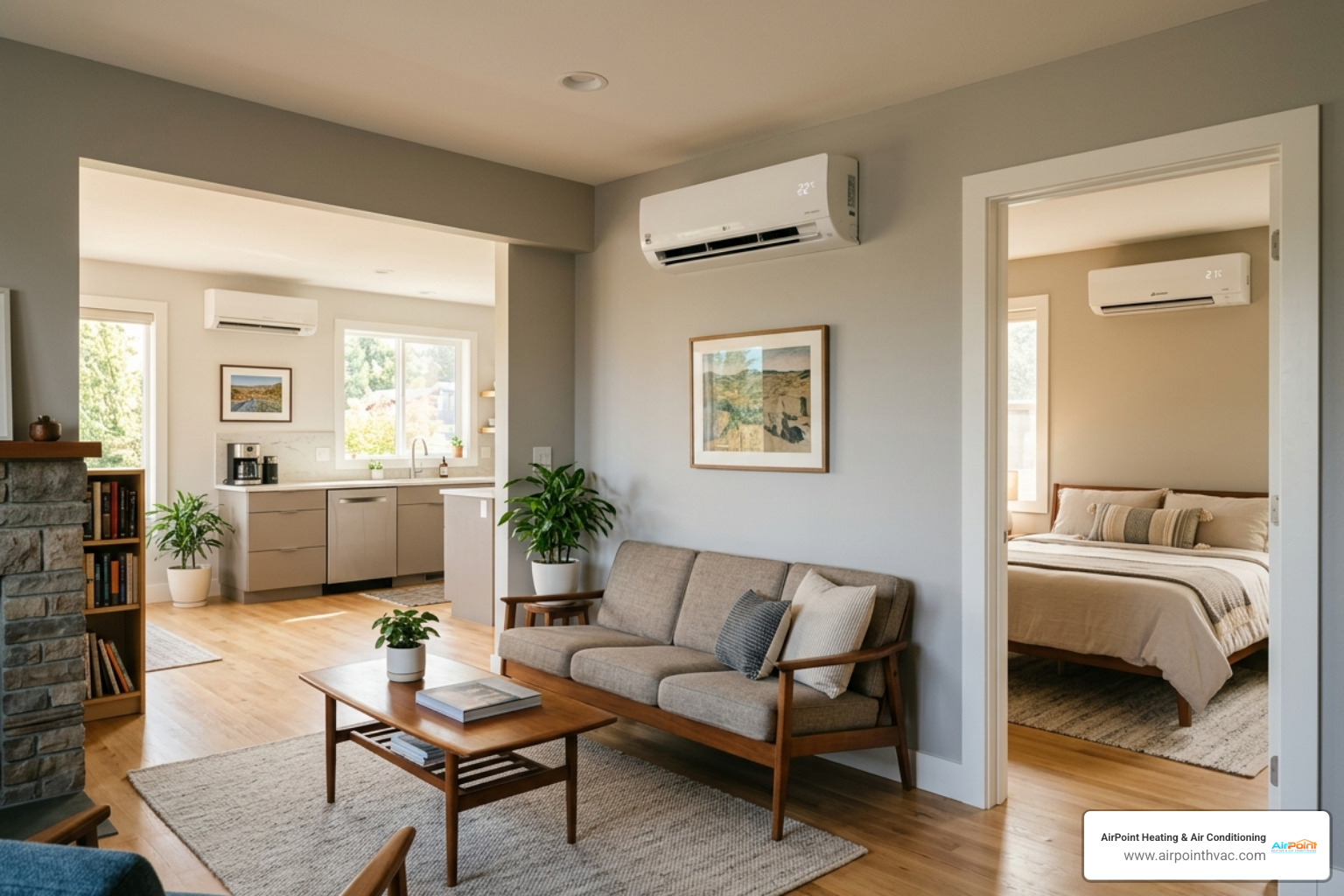
How Many Mini Split Heads Do I Need? Here's What Homeowners Should Know First
How many mini split heads do i need is one of the most common questions homeowners ask before upgrading to a ductless system — and the short answer depends on your home's layout, room configuration, and how you want to control comfort in each space.
Here's a quick-reference breakdown to get you started:
| Home Layout | Recommended Number of Heads |
|---|---|
| Single room or studio | 1 head |
| Open-concept floor (living/dining/kitchen) | 1-2 heads |
| 2-bedroom home | 2-3 heads |
| 3-bedroom home | 3-4 heads |
| Multi-story home | 1+ head per floor, plus bedrooms |
| Whole home (4+ bedrooms) | 4-8 heads |
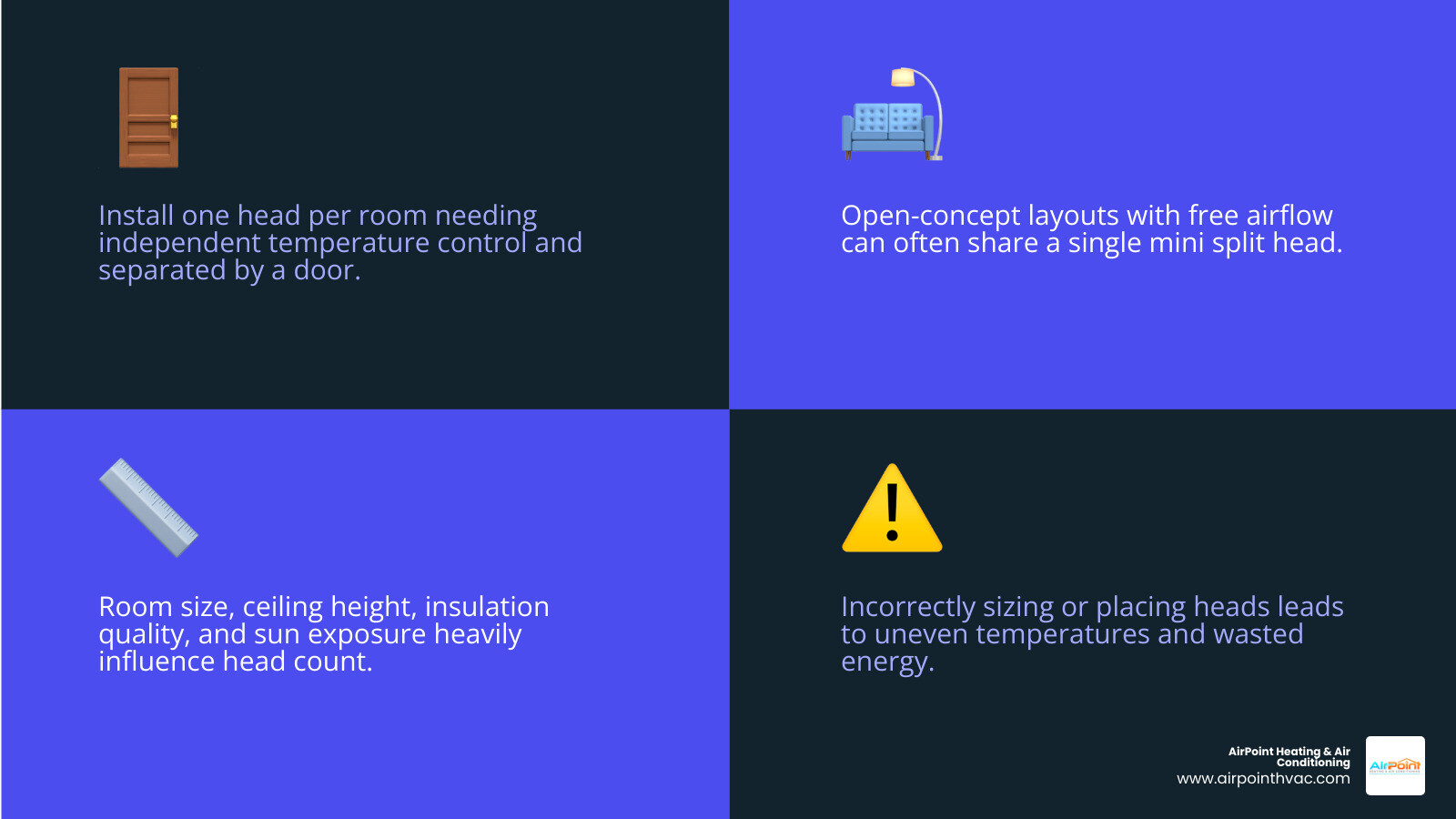
The general rule: Install one head per room that is separated by a door and needs independent temperature control. Bathrooms are typically excluded. Open-concept spaces with free airflow can often share a single head.
For most homes in Los Alamitos and the greater Orange County area, a properly planned multi-zone mini split system with anywhere from two to five indoor heads connected to one outdoor unit handles whole-home comfort efficiently. One outdoor condensing unit can support up to eight indoor air handlers depending on the system.
The challenge is that no two homes are exactly alike. Room size, ceiling height, insulation quality, sun exposure, and how your family actually uses each space all play a role in how many heads you truly need. Getting this wrong — either too few or too many — leads to uneven temperatures, wasted energy, and a system that works harder than it should.
That's exactly what this guide is here to help you figure out.
Understanding the Basics: What is a Mini Split Head?
Before we dive into the math, let's clarify what we mean by a "head." In HVAC, a mini split head is the indoor air handler. While traditional central air systems hide the machinery in an attic or closet and push air through dusty ducts, a Ductless system places the air handler directly in the room it is cooling or heating.
Each head contains an evaporator coil and a fan. It is connected to the outdoor unit via small refrigerant lines, suction lines, and a power cable that pass through a tiny three-inch hole in your wall. This design allows for whisper-quiet operation because the noisy compressor stays outside.
The real magic of these heads is independent temperature control. Because each head has its own thermostat, you can keep your bedroom at a crisp 68 degrees for sleeping while leaving the living room at a comfortable 72. Most homeowners opt for wall-mounted units, but floor-mounted and ceiling-cassette options are also available to fit your home's aesthetic.
How Many Mini Split Heads Do I Need for My Home?
Determining the right number of heads requires looking at your home as a series of "zones" rather than just a total square footage. At AirPoint Heating & Air Conditioning, we often suggest starting with the "Door Rule."
The Door Rule is simple: if a room is separated by a permanent door that you keep closed (like a bedroom or a home office), it likely needs its own head. Airflow doesn't travel well through doorways or down narrow hallways. If you try to cool three bedrooms with one head in the hallway, you'll end up with a freezing hallway and three stuffy bedrooms.
Determining the Number of Heads for Open-Concept Areas
In many modern homes in Irvine, CA, the first floor consists of a large, open-concept living room, dining area, and kitchen. In these cases, you don't necessarily need a head for every "room" because there are no walls to block the air.
One high-capacity head can often cover an entire open floor. However, we have to account for kitchen heat gains. Ovens and stovetops generate significant heat, so we might recommend a slightly larger unit or a second head if the space exceeds 800–1,000 square feet. This ensures that the cool air reaches the dining room even when the Sunday roast is in the oven.
Why You Might Need a Mini Split Head in Every Room
While open areas can share, privacy often dictates the need for more heads. If you have a home in Cypress, CA with three separate bedrooms, each one will require a dedicated head to ensure comfort.
Sealed-off zones like a basement or a converted garage also require their own units. Heat stratification is another factor; since heat rises, multi-story homes almost always need at least one head per floor to combat the natural temperature differences between the upstairs and downstairs.

Key Factors That Influence Your Head Count and Sizing
It isn't just about the number of rooms; it’s about the "load" of those rooms. A room with floor-to-ceiling windows facing the afternoon sun in Lakewood, CA will need more cooling power than a shaded room on the north side of the house.
| Room Type | Avg. Square Footage | Recommended BTU Capacity |
|---|---|---|
| Small Bedroom | 150 - 250 sq. ft. | 6,000 - 9,000 BTU |
| Master Suite | 250 - 450 sq. ft. | 9,000 - 12,000 BTU |
| Living Room | 400 - 650 sq. ft. | 12,000 - 18,000 BTU |
| Open Floor Plan | 800 - 1,200 sq. ft. | 24,000 - 36,000 BTU |
Other factors we consider include:
- Insulation Quality: Older homes with thin insulation lose conditioned air faster, requiring more BTUs.
- Ceiling Height: If your ceilings are higher than 8 feet, you need to add 10-20% to your BTU calculation.
- Local Climate: Our April 2026 climate in Southern California demands high-efficiency cooling, but we also look for units with "Hyper-Heat" technology if you want reliable warmth during our rare chilly nights.
Calculating BTUs to Decide How Many Mini Split Heads You Need
A common rule of thumb is the "20 BTU per square foot" rule. For example, a 500-square-foot room in Long Beach, CA would need approximately 10,000 BTUs.
However, we don't just guess. We perform a Manual J load calculation. This is the professional standard that accounts for every window, the direction your house faces, and even how many people typically occupy the room. We also add roughly 4,000 BTUs for kitchens to account for appliance heat. This precision prevents "short-cycling," which happens when a unit is too large and turns on and off too frequently, leading to high humidity and wear.
Single-Zone vs. Multi-Zone System Configurations
Once you know how many heads you need, you have to choose the outdoor unit.
- Single-Zone: One outdoor unit connects to one indoor head. This is perfect for a sunroom or a garage.
- Multi-Zone: One outdoor unit powers multiple indoor heads (typically up to 5 or 8).
Modern inverter technology allows for "load diversity." This means your total indoor BTU capacity can actually exceed the outdoor unit's capacity by up to 30%. Why? Because you rarely run every single head at maximum power at the same time. During the day, you're in the living room; at night, you're in the bedrooms. The system shifts the power where it's needed most.
If you are doing a large-scale Mini Split Installation in College Park, CA, we ensure the outdoor unit has enough expansion ports to handle your planned head count.
Using Slim-Ducted Units to Reduce How Many Mini Split Heads You Need
If you love the efficiency of a mini split but don't want a "white box" on every wall, slim-ducted units are a fantastic alternative. These are concealed air handlers hidden in an attic or crawlspace.
A single slim-ducted unit can use short duct runs to cover two or three small adjacent rooms, like a cluster of bedrooms. This is a popular choice for Ductless Air Conditioners in Rossmoor, CA because it maintains the home's clean aesthetic while providing the zoned comfort of a ductless system.
Frequently Asked Questions About Mini Split Head Placement
Do I need a mini split head in my bathroom?
Generally, no. Bathrooms are small, and the airflow from an adjacent bedroom is usually enough to keep them comfortable. Additionally, the high steam and humidity in bathrooms can interfere with the unit’s sensors. If you have a massive master bath in Newport Beach, CA, we might discuss specific ventilation, but a dedicated head is rarely necessary.
Can I add more heads to my system later?
This depends entirely on your outdoor unit. If you install a 3-zone outdoor unit but only use two heads, you can add a third later. However, if your outdoor unit is at its port or BTU limit, you would need to add a second outdoor condenser. We always recommend "future-proofing" your Yorba Linda, CA installation by choosing an outdoor unit with an extra port if you think you might expand.
How many heads can one outdoor unit support?
Most residential multi-zone condensers support between two and five heads. However, high-capacity systems can support up to eight indoor air handlers. If your home in Laguna Beach, CA requires more than eight zones, we typically install two separate outdoor units to ensure the system isn't overtaxed.
Conclusion
Deciding how many mini split heads do i need doesn't have to be a guessing game. By looking at your home’s layout, following the "Door Rule," and accurately calculating your BTU needs, you can create a climate control system that is both incredibly comfortable and highly efficient.
At AirPoint Heating & Air Conditioning, we believe "comfort is happiness." As a family-owned business serving Los Alamitos and the surrounding Orange County communities, we take pride in offering honest, expert advice tailored to your specific home. Whether you're in Seal Beach or Huntington Beach, our certified technicians are ready to help you plan the perfect ductless layout. We back all our work with a 100% satisfaction guarantee.
Ready to stop the thermostat wars and start enjoying personalized comfort in every room? Book your expert ductless consultation now for fast, reliable service!
Other Blogs
Latest Blog Posts

Troubleshooting Heating Startup Smells: Is Your Furnace Safe for Fall?

Fall Home Maintenance Tips: Troubleshooting Heating Odors and Using a SEER Savings Calculator
Home Maintenance Tips: Troubleshooting a Burning Smell During Your Fall Heating Startup

Customer Testimonials



I recommend Air Point for your HVAC needs."