





I'm looking to maximize my hvac replacement return on investment. Who in Los Alamitos can help?
hvac replacement return on investment is one of the smartest financial questions a homeowner can ask — and the numbers make a strong case for acting sooner rather than later.
Here's a quick snapshot of what you can expect:
| ROI Factor | What to Expect |
|---|---|
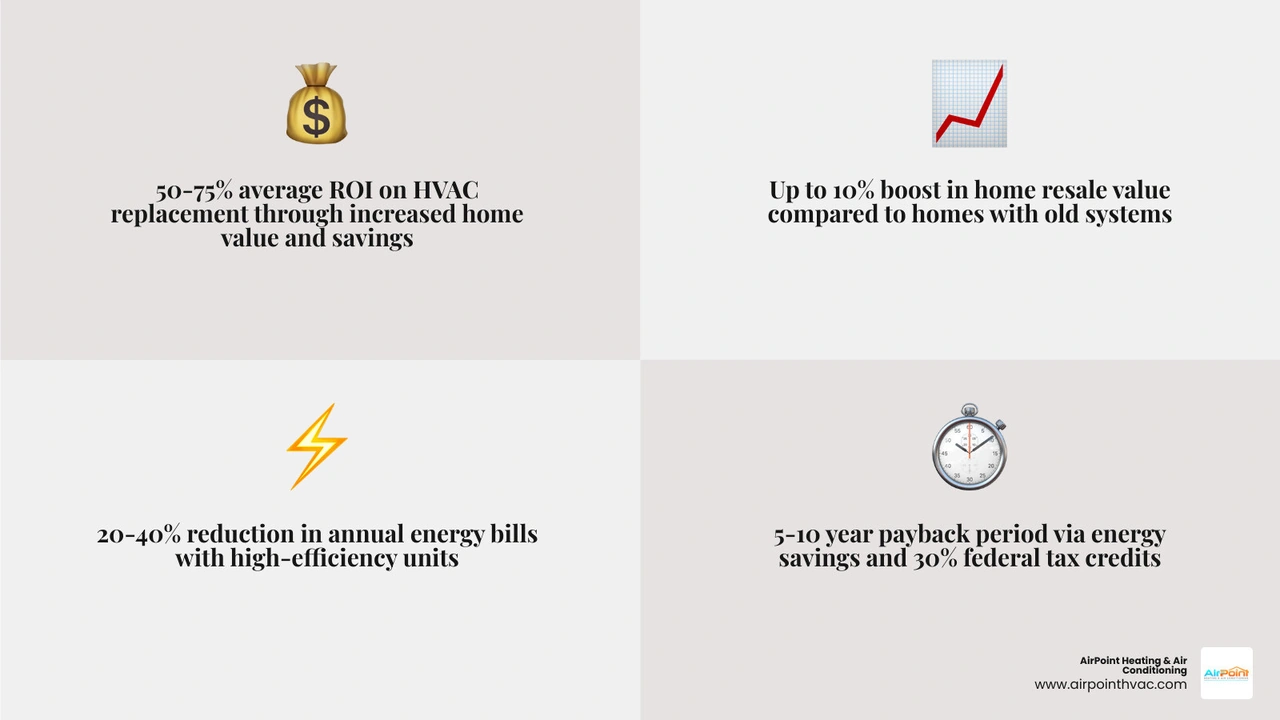
| Average overall ROI | 50–75% depending on system type |
| Home resale value increase | Up to 10% more than comparable homes |
| Annual energy bill savings | 20–40% with a high-efficiency system |
| Typical payback period | 5–10 years through energy savings |
| Federal tax credit (IRA) | Up to 30% of installed cost |
| Cost recovery at resale | 25–50%, averaging around 30–35% |
If your system is aging, running up high energy bills, or struggling to keep your Orange County home comfortable, a replacement isn't just a maintenance expense — it's a financial decision with measurable returns.
About half of every household's annual energy budget goes toward heating and cooling. That means an outdated, inefficient system is quietly draining money every single month. Upgrading to a modern, high-efficiency unit cuts that waste significantly — and in a competitive market like Southern California, a new HVAC system also makes your home more attractive to buyers and appraisers alike.
This guide walks you through exactly how to calculate your personal returns, what factors drive the biggest savings, and how to make the most of every dollar you invest in your home's comfort.
Understanding the HVAC Replacement Return on Investment
When we talk about the hvac replacement return on investment, we are looking at two primary financial streams: the immediate increase in your home’s equity and the long-term reduction in your monthly overhead.
In the real estate world, a functional and efficient HVAC system is considered a "baseline" necessity. According to data from the National Association of Realtors, HVAC upgrades can yield returns as high as 71%. Most homeowners can expect an average ROI of 50% to 75% on the installation. This means that if you invest in a high-quality system, a significant portion of that cost is immediately reflected in your home's market value.
Beyond just the numbers, there is the "marketability" factor. In cities like La Mirada, CA, a new HVAC system acts as a powerful tie-breaker. When a buyer is choosing between two similar homes, the one with a brand-new, energy-efficient system will almost always win. Real estate experts note that homes with updated systems can sell for 5% to 8% more than comparable properties with aging equipment.
Appraisers also take note. An aging system can lead to lower home appraisals, while a modern unit is a major selling point that provides "peace of mind" to buyers who want to avoid immediate repair costs after moving in. You can learn more about this in our guide on How a New HVAC System Increases Home Value.
How to Calculate Your Personal HVAC Financial Returns
Calculating your personal ROI doesn't require a degree in finance, but it does require looking closely at your utility bills and the efficiency ratings of your potential new system.

To get a clear picture, you need to understand three key ratings:
- SEER2 (Seasonal Energy Efficiency Ratio): This measures cooling efficiency. The higher the number, the less electricity the unit uses to cool your home.
- AFUE (Annual Fuel Utilization Efficiency): This is for furnaces. It represents the percentage of fuel that is converted into actual heat rather than being wasted.
- HSPF (Heating Seasonal Performance Factor): This measures the efficiency of heat pumps during the heating season.
If you are considering an HVAC Replacement in Cypress, CA, comparing these ratings against your current 15-year-old unit will show you exactly where your money is going.
Estimating hvac replacement return on investment through energy savings
The most consistent part of your ROI comes from consumption reduction. Modern Energy Star-rated systems can save homeowners between 20% and 40% on their annual heating and cooling costs.
In our coastal California climate, where we use our systems nearly year-round, these savings stack up quickly. To estimate your savings, look at 12 months of utility bills to establish a baseline. If you move from an old 10 SEER unit to a modern 18 SEER2 unit, your cooling costs could drop by nearly half.
| System Efficiency | Estimated Annual Savings |
|---|---|
| Old Unit (10 SEER) | Baseline |
| Standard Modern (14-15 SEER2) | 15–20% Savings |
| High Efficiency (18+ SEER2) | 30–40% Savings |
Maximizing hvac replacement return on investment with tax credits and rebates
One of the biggest boosters for your hvac replacement return on investment in May 2026 is the availability of federal and local incentives. Under the Inflation Reduction Act (IRA), homeowners can often claim a tax credit of up to 30% for qualifying high-efficiency equipment, with annual limits that vary depending on the system type.
Additionally, local utility companies in areas like Yorba Linda, CA often offer rebates for installing Energy Star-certified heat pumps or furnaces. When you combine a federal tax credit with a local utility rebate, the "net cost" of your investment drops significantly, which shortens your payback period and increases your total ROI.
Strategic Factors That Maximize Your System’s Value
Simply buying a new box and putting it outside isn't enough to guarantee a high ROI. The quality of the installation is what actually delivers the promised efficiency.
We always emphasize a few critical steps to ensure you get the most out of your investment:
- Manual J Load Calculation: Your system must be sized correctly for your specific home. An oversized unit will "short-cycle," turning on and off too frequently, which wastes energy and wears out the parts. An undersized unit will run constantly and never reach the desired temperature.
- Duct Sealing: Even the most efficient AC unit in Long Beach, CA will underperform if 30% of the cold air is escaping through leaks in the attic ducts. Sealing and insulating ducts can improve efficiency by up to 20%.
- Smart Thermostats: Integrating a smart thermostat allows the system to learn your preferences and adjust for when you are away, which can add another 10-15% in annual energy savings.
- Indoor Air Quality (IAQ): Adding advanced filtration or UV lights during a replacement doesn't just improve your health; it keeps the internal components of your new HVAC cleaner, which maintains high efficiency for a longer period.
When to Choose Replacement Over Costly Repairs
At some point, continuing to repair an old system becomes a "false economy." If your system is between 15 and 20 years old, you are likely on borrowed time.
In Southern California, the salt air and humidity can take a toll on outdoor condensers. You can read more about How Long Does an HVAC System Last in Coastal California to see where your system stands. If you are facing a repair that costs more than 30% of a new system, or if you've noticed the Furnace Replacement Top Signs like strange noises or rising bills, it's time to plan.
We often tell our neighbors that there are Consider Furnace Replacement Top Reasons beyond just a total breakdown. If you are seeing Signs It's Time to Say Goodbye to Your Old Heater, replacing it proactively allows you to choose the best system for your budget rather than making a rushed "emergency" purchase when the unit dies during a heatwave. Check out our guide on When to Plan for HVAC Replacement to stay ahead of the curve.
Frequently Asked Questions about HVAC ROI
What is the typical payback period for a new system?
For most homeowners in our service area, the payback period — the time it takes for energy savings and tax credits to "pay back" the initial investment — is typically between 5 and 10 years. This varies based on your usage patterns and how much utility rates rise over time.
Does a new HVAC system add more value in Orange County?
Yes. Because of our climate, air conditioning is not seen as a luxury but as a necessity. Buyers in the Southern California real estate market expect high-performing systems. A home without a modern HVAC system is often viewed as a "fixer-upper," leading to lower offers.
Is a heat pump a better investment than a furnace?
In our moderate climate, heat pumps often offer the highest ROI, sometimes reaching 65% to 75%. Because they provide both heating and cooling using electricity, they are incredibly efficient. Modern heat pumps can be 150% to 300% efficient because they move heat rather than generating it.
Conclusion
Investing in a new HVAC system is about more than just staying cool in the summer; it’s about making a strategic financial move for your home’s future. Between the immediate boost in resale value and the decade of energy savings that follow, the hvac replacement return on investment is one of the most reliable "wins" in home improvement.
At AirPoint Heating & Air Conditioning, we are proud to be a family-owned, award-winning business serving Los Alamitos and the surrounding Orange County communities. We believe that "comfort is happiness," and we back every installation with a 100% satisfaction guarantee and honest, transparent service.
Whether you are in Huntington Beach, Irvine, or Yorba Linda, our licensed and certified technicians are ready to help you maximize your home's value and efficiency.
Ready to start saving? Book Now for fast, expert HVAC solutions you can trust.
Other Blogs
Latest Blog Posts
Common Homeowner Questions Answered: Is That Fall Heater Burning Smell Normal?
Common Homeowner Questions Answered: Why Does My Heater Smell Like Burning?

Why Is My Heater Smelling or Clicking? A Fall Startup Troubleshooting Guide

Customer Testimonials



I recommend Air Point for your HVAC needs."