





Should I Repair or Replace My Furnace or AC? Here's How to Decide
Figuring out should I repair or replace my furnace or AC is one of the most stressful decisions a homeowner can face — especially when your system breaks down in the middle of a hot Los Alamitos summer or a chilly winter night. The wrong call can mean throwing money at a system that's already on its way out, or paying for a full replacement you didn't actually need yet.
Here's a quick answer based on the most widely used industry guidelines:
Repair your system if:
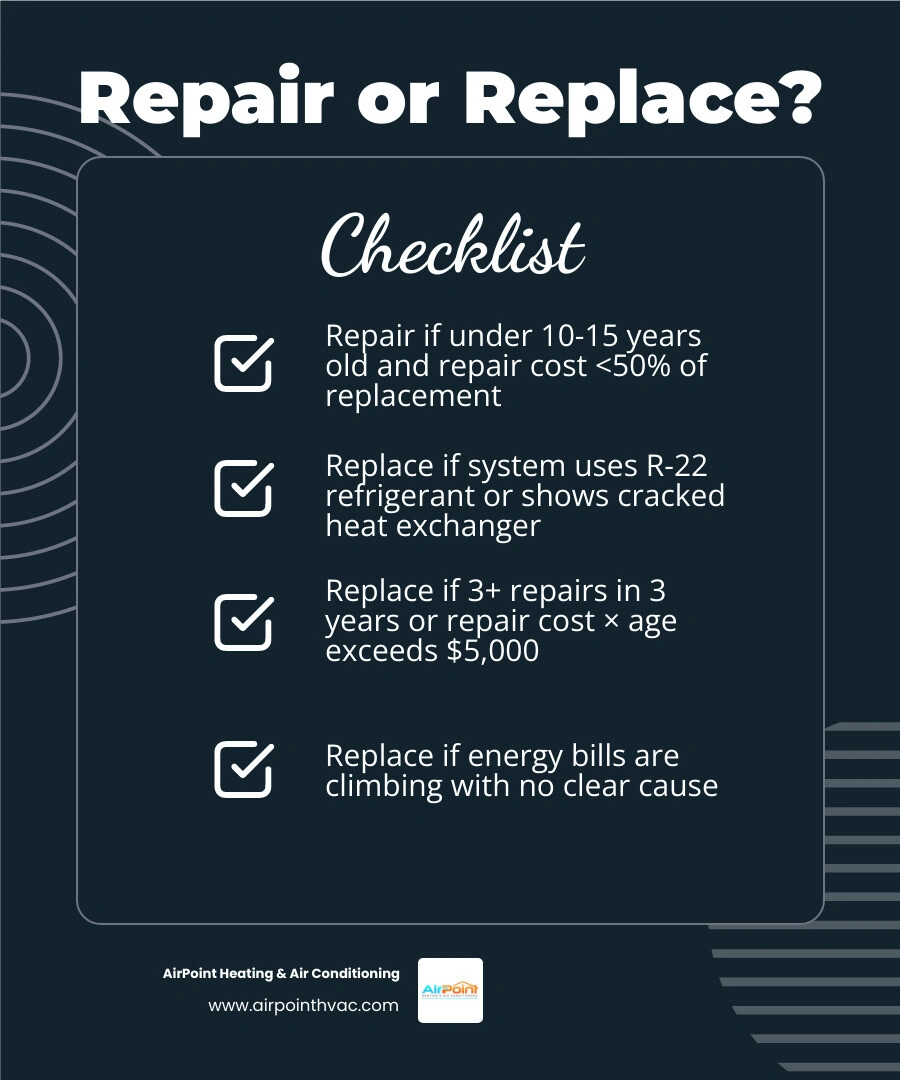
- It is less than 10 years old (AC/heat pump) or less than 15 years old (furnace)
- The repair cost is less than 30–50% of the price of a new system
- You have had only one or two repairs in the past few years
- The system is still under manufacturer warranty
Replace your system if:
- Your AC is 12–15+ years old or your furnace is 15–20+ years old
- The repair cost multiplied by the system's age exceeds $5,000 (the "$5,000 Rule")
- You have needed three or more repairs in the past three years
- Your system uses R-22 refrigerant, has a cracked heat exchanger, or shows signs of carbon monoxide risk
- Your energy bills have been steadily climbing with no obvious cause
For most Orange County homeowners, the decision comes down to a handful of clear factors: system age, repair cost, repair history, safety, and efficiency. This guide walks through each one so you can make a confident, informed choice — not just a reactive one made under pressure.
Key Factors: Should I Repair or Replace My Furnace or AC?

When your heating or cooling system starts acting up, it is easy to feel overwhelmed by the potential options. Should you call for a quick fix, or is it time to invest in a brand-new setup? To make the best financial and practical decision for your home, you need to look at the system as a whole.
We always recommend starting with a balanced assessment of the unit's age, the immediate cost of the repair, and how often the system has broken down recently. By looking at these three elements, you can easily determine How to Decide Between Repair and Replacement without relying on guesswork.
How Old is Too Old for an HVAC System?
Age is the natural starting point for any HVAC decision. No matter how well you maintain your equipment, mechanical parts eventually wear out. In our local Southern California climate, coastal salt air in places like Seal Beach and Huntington Beach can accelerate wear on outdoor condenser coils, while inland heat in Irvine and Yorba Linda keeps air conditioners running nonstop for months.
Understanding the expected lifespan of your specific equipment helps you put a single repair quote into perspective:
- Central Air Conditioners: Typically last 12 to 15 years. In mild coastal zones, they might push slightly longer, but systems older than 15 years are usually operating at significantly degraded efficiency.
- Gas Furnaces: Typically last 15 to 20 years. Because we experience relatively mild winters in Orange County, a well-maintained furnace can sometimes last up to 25 years, but the risk of critical safety issues increases dramatically after year 15.
- Heat Pumps: Typically last 10 to 15 years. Since heat pumps handle both heating and cooling duties year-round, they accumulate double the runtime of a standalone furnace or AC, leading to a slightly shorter overall lifespan.
If your system is rapidly approaching or has already passed these milestones, even a relatively minor repair might just be a temporary band-aid on a system nearing retirement. To learn more about how age impacts your system's reliability, read our detailed guide on How Old is Too Old for an HVAC System?
How the $5,000 Rule Helps Decide If I Should Repair or Replace My Furnace or AC
If you are looking for a concrete, mathematical way to take the emotion out of the decision, the industry-standard $5,000 Rule is an incredibly helpful tool. This simple formula multiplies the age of your system by the written repair quote to help determine if a repair is a sound investment.
Here is how the math works:$$\text{Age of the System (in years)} \times \text{Cost of the Repair} = \text{Decision Score}$$
- If the result is under $5,000, repairing the unit is generally the smarter choice.
- If the result is over $5,000, you should strongly consider replacing the system.
For example, if you have an 8-year-old air conditioner in Cypress that needs a fan motor replaced, and the repair quote is a few hundred dollars, multiplying those numbers will give you a score well under $5,000. Repairing the unit is highly cost-effective because the system still has plenty of useful life ahead.
Conversely, if you have a 14-year-old furnace in Fullerton that needs a major control board or blower motor replacement, multiplying that higher repair cost by 14 will easily push your score past the $5,000 threshold. In this scenario, replacing the system is the wiser long-term financial decision.
In addition to the $5,000 rule, we also look at the 50% Rule. If any single repair quote approaches or exceeds 50% of the cost of a brand-new, modern system, upgrading is almost always the better choice. Spending half the price of a new unit to patch up an old, out-of-warranty system simply delays the inevitable and leaves you with an inefficient system that is still prone to breaking down again.
Tracking Repair Frequency and System Decline
A single breakdown is an inconvenience; a pattern of breakdowns is a clear warning sign. When evaluating should i repair or replace my furnace or ac, you must look at your system's recent repair history.
If you find yourself calling an HVAC technician multiple times a year, you are caught in what we call a "repair spiral." A great rule of thumb is that three or more repairs in a three-year span strongly indicate systemic decline.
When one major component begins to fail due to old age, it often places extra stress on the surrounding parts, leading to a chain reaction of failures. Tracking your system's repair history helps you see if you are throwing good money after bad. If your system is constantly demanding attention, upgrading to a modern, reliable unit will save you from ongoing stress, repeat service call fees, and unexpected summer breakdowns.
Technical and Environmental Indicators for Replacement
Beyond simple age and repair calculations, there are several technical, regulatory, and safety factors that can make replacement the only logical choice. Modern advancements in HVAC technology have changed how systems operate, meaning older units are not just inefficient — they are increasingly difficult and expensive to support.
The R-22 Refrigerant Phase-Out and Your AC
If your air conditioning system was installed before 2010, there is a very high probability that it uses R-22 refrigerant (commonly known as Freon). Because R-22 contains ozone-depleting substances, the U.S. Environmental Protection Agency (EPA) completely phased out its production and import.
Today, the supply of R-22 is extremely limited, consisting entirely of reclaimed or recycled gas. As a result, the cost to recharge an R-22 system has skyrocketed. If your older air conditioner develops a refrigerant leak, attempting to repair the leak and refill the system can be incredibly costly.
Investing in an expensive chemical recharge for a system that is already past its prime is rarely a good investment. Upgrading to a modern system that uses environmentally safe, readily available refrigerants eliminates this financial risk entirely. For a deeper look at how refrigerant issues affect your air conditioner, check out our article on how to Know When to Replace Your AC.
Safety Risks: Cracked Heat Exchangers and Carbon Monoxide
While a broken air conditioner is uncomfortable, a failing furnace can be downright dangerous. The most critical safety concern in any gas furnace is the heat exchanger — the metal chamber that prevents combustion gases, including deadly carbon monoxide (CO), from mixing with the clean air blown into your home.
Over decades of constant heating and cooling, the metal in the heat exchanger expands and contracts. Eventually, this stress can cause the metal to crack. A cracked heat exchanger is an immediate, non-negotiable safety hazard that can vent carbon monoxide directly into your home's living spaces.
If a licensed technician discovers a cracked heat exchanger during a routine maintenance visit or service call, they are legally obligated to shut down the system to protect your family. Because replacing a heat exchanger is an incredibly complex job that requires dismantling the entire furnace, it is rarely cost-effective on an older unit. In this situation, a full furnace replacement is the only safe and sensible path forward. To learn more about identifying these hazards, read our guide on the Signs It's Time to Say Goodbye to Your Old Heater.
Evaluating Efficiency: Should I Repair or Replace My Furnace or AC for Energy Savings?
Even if your older HVAC system is still running, it might be costing you a fortune on your monthly utility bills. Modern HVAC systems are engineered to meet strict energy standards, making them vastly superior to units built just ten to fifteen years ago.
When comparing your current system to a new one, pay attention to these industry-standard efficiency ratings:
- SEER2 (Seasonal Energy Efficiency Ratio 2): Measures the cooling efficiency of air conditioners and heat pumps. Older systems in Orange County homes often operate at SEER ratings as low as 8 or 10. Today's standard high-efficiency systems feature SEER2 ratings ranging from 14 to over 22.
- AFUE (Annual Fuel Utilization Efficiency): Measures how efficiently a furnace converts gas into heat. Older conventional furnaces often have AFUE ratings around 80%, meaning 20% of the heat is wasted up the flue. Modern high-efficiency furnaces can reach up to 95% to 98% AFUE.
- HSPF2 (Heating Seasonal Performance Factor 2): Measures the heating efficiency of heat pumps. Higher numbers mean less electricity is required to keep your home warm during our cooler winter nights.
Replacing an outdated SEER 10 system with a standard high-efficiency model can reduce your cooling energy consumption by 20% to 40%. Additionally, choosing ENERGY STAR qualified models can provide even greater savings—ENERGY STAR furnaces are up to 15% more efficient than standard models, and qualified heat pumps can save up to 20% on your annual heating and cooling costs. Over the lifespan of the new equipment, these monthly utility savings can offset a significant portion of your initial replacement investment.
Practical Considerations for Orange County Homeowners
Making the decision to repair or replace is not just about the machinery itself; it is also about your personal situation, your home, and your future plans. Here is a quick comparison to help you weigh the practical benefits of each path:
| Factor | Repairing Your Current System | Replacing with a New System |
|---|---|---|
| Upfront Cost | Lower immediate out-of-pocket expense | Higher initial investment |
| Monthly Energy Bills | Remains high (or continues to rise) | Decreases immediately by 20% to 40% |
| Warranty Protection | Limited or no coverage on older units | 10+ year parts warranty for peace of mind |
| Home Resale Value | No impact (can be a negative flag in inspections) | Increases home appeal and asking price |
| Reliability & Comfort | Risk of recurring breakdowns and hot spots | Consistent temperatures and whisper-quiet operation |
How Long Do You Plan to Stay in Your Home?
Your long-term housing plans play a major role in this decision. If you plan to sell your home in Newport Beach, Irvine, or Huntington Beach within the next year or two, you might lean toward repairing your system to keep your immediate expenses low.
However, you should keep the home inspection process in mind. In today's competitive real estate market, an active home buyer's inspector will immediately flag a 20-year-old furnace or a failing AC unit. This can lead to difficult negotiations, where buyers demand a hefty price reduction or insist that you replace the system before closing anyway.
On the other hand, if you plan to stay in your home for the next five, ten, or twenty years, investing in a high-efficiency system makes perfect sense. You will get to enjoy the improved comfort, lower monthly energy bills, and quiet operation for years to come, fully maximizing your return on investment.
Is Your System Still Under Warranty?
Before approving any major repair, always check your system's warranty status. Most major HVAC manufacturers offer a standard 5-to-10-year parts warranty on equipment that was properly registered after installation.
- If your system is under warranty: The manufacturer will cover the cost of replacement parts (such as a compressor, coil, or control board). While you will still be responsible for the cost of professional installation labor, having the parts covered makes repairing the system highly practical.
- If your system is out of warranty: You are responsible for both the parts and the labor. On an older system, paying out-of-pocket for major components is rarely a wise investment, as other aging parts are likely to fail soon after.
Why Replacing Both the Furnace and AC at the Same Time Makes Sense
If your air conditioner has failed but your furnace is still working, you might wonder if you can get away with replacing just the AC. While this is technically possible, we strongly advise against mixing old and new equipment.
An HVAC system is designed to work as a matched pair. The indoor furnace contains the blower motor that pushes air through your air conditioner's indoor evaporator coil. If you pair a brand-new, high-efficiency AC with an old, single-speed furnace blower, the system will struggle to perform.
Here is why replacing both units simultaneously is highly beneficial:
- Matched System Performance: Modern multi-stage and variable-capacity air conditioners require a compatible, variable-speed furnace blower motor to manage airflow correctly. Matching your equipment ensures you actually achieve the system's rated energy efficiency.
- Installation Labor Savings: Installing both systems at the same time is much more efficient for our installation team. By combining the jobs, we can pass significant labor savings on to you, making a dual replacement much more cost-effective than doing the jobs separately a few years apart.
- Synchronized Warranties: Replacing both units ensures your entire HVAC system starts fresh with matching, long-term manufacturer warranties, giving you complete peace of mind.
To explore this topic in greater detail, read our guide on When to Consider Furnace Replacement.
Financial Incentives and Rebates in 2026
If you decide that replacing your aging system is the right move, you will be happy to know that there are more financial incentives available in 2026 than ever before. Federal, state, and local utility programs are actively encouraging homeowners to upgrade to clean, high-efficiency systems.
Federal Tax Credits and Local Utility Rebates
Upgrading your home comfort system can qualify you for substantial financial incentives that offset your initial investment:
- Federal Energy Efficiency Tax Credits: Under current federal guidelines, homeowners can claim tax credits for qualifying high-efficiency HVAC equipment. For instance, installing an energy-efficient heat pump can qualify you for a tax credit of up to 30% of the total installation cost (up to a maximum of $2,000).
- Southern California Edison (SCE) Rebates: SCE offers excellent rebates for homeowners who upgrade to high-efficiency air conditioning systems or clean electric heat pumps, helping to reduce your electricity consumption during peak summer heat.
- SoCalGas Incentives: If you are installing a high-efficiency gas furnace, SoCalGas provides generous rebates for qualifying models that meet strict AFUE standards.
Our team at AirPoint Heating & Air Conditioning stays up to date on all local and federal programs, and we will gladly help you identify every rebate and tax credit you qualify for to maximize your savings.
Long-Term Savings with High-Efficiency Systems
Modern high-efficiency systems do more than just lower your monthly bills; they transform how your home feels. Older systems utilize single-stage compressors, which operate on an "all-or-nothing" basis—they turn on at 100% capacity, blast cold air until the thermostat is satisfied, and then shut off. This leads to annoying temperature swings and high energy spikes.
In contrast, modern systems feature variable-speed compressors and blower motors. These systems act like a smooth accelerator on a car, adjusting their output in tiny increments to match your home's exact cooling or heating needs. By running continuously at lower, whisper-quiet speeds, they use a fraction of the energy, eliminate hot and cold spots, and provide superior humidity control. Plus, they integrate seamlessly with modern smart thermostats, allowing you to monitor and control your home comfort directly from your smartphone.
Frequently Asked Questions about HVAC Repair and Replacement
Is it best to replace my furnace when I replace my AC?
Yes, in the vast majority of cases, it is highly recommended to replace both systems at the same time. Because your furnace and air conditioner share the same ductwork and indoor blower motor, pairing a brand-new AC with an old, inefficient furnace can prevent the new system from reaching its rated efficiency. Replacing both units simultaneously ensures matched system performance, saves you money on installation labor, and synchronizes your manufacturer warranties so you do not have to worry about sudden breakdowns down the road.
How do I know if my system uses R-22 refrigerant?
You can easily check your system's refrigerant type by looking at the manufacturer's data plate on your outdoor condenser unit. This metal label lists technical specifications, including the model number, serial number, and the type of refrigerant used. If you see "R-22" or "HCFC-22," your system uses the older, phased-out refrigerant. If it lists "R-410A" or another modern refrigerant, your system is newer and much easier to service. If the label has worn off, any system installed before 2010 is highly likely to use R-22.
What are the immediate red flags that mean I should replace my system?
The most critical red flags that demand an immediate system replacement include:
- A cracked heat exchanger: This is a severe safety hazard that can leak deadly carbon monoxide into your home.
- A failed compressor on an out-of-warranty system: The compressor is the heart of your AC, and replacing it is one of the most expensive repairs possible.
- A major refrigerant leak on an R-22 system: Because R-22 is phased out, repairing the leak and recharging the system is rarely a practical investment.
- Frequent, recurring breakdowns: If your system has needed three or more repairs in the last three years, it is in a state of systemic decline.
Conclusion
Deciding whether to repair or replace your heating and cooling system is a major decision, but you do not have to make it alone. At AirPoint Heating & Air Conditioning, we believe that comfort is happiness. As a locally owned, family-operated business serving Los Alamitos and communities across Orange County—from Huntington Beach and Seal Beach to Cypress, Garden Grove, and Irvine—we are dedicated to providing honest, transparent advice.
Our licensed, certified technicians will perform a comprehensive, on-site evaluation of your system's age, safety, and performance. We will present you with clear, upfront options for both repair and replacement, backed by our 100% satisfaction guarantee. Whether you need a precision tune-up to extend your system's life or a complete, high-efficiency upgrade to lower your energy bills, we are here to help.
Don't wait for an unexpected system breakdown to disrupt your peace of mind. Schedule expert service with AirPoint Heating & Air Conditioning to keep your home comfortable all year round!
Other Blogs
Latest Blog Posts
Do UV Light Purifiers Actually Neutralize Fall Mold Spores in Your HVAC System?
Diagnosing Short-Cycling in Oversized Furnaces Installed During the 90s Housing Boom
Retrofitting La Mirada Mid-Century Homes with Zoning Systems for Better Temperature Control

Customer Testimonials



I recommend Air Point for your HVAC needs."