







Why Coastal Fog and Humidity Are a Real Comfort Problem for Orange County Homeowners
How coastal fog and humidity affect indoor comfort is something every Southern California homeowner eventually experiences — and usually on a morning when the marine layer has rolled in thick overnight, leaving windows damp and rooms feeling clammy before the day even starts.
Here is a quick summary of how coastal fog raises indoor moisture and what it means for your home:
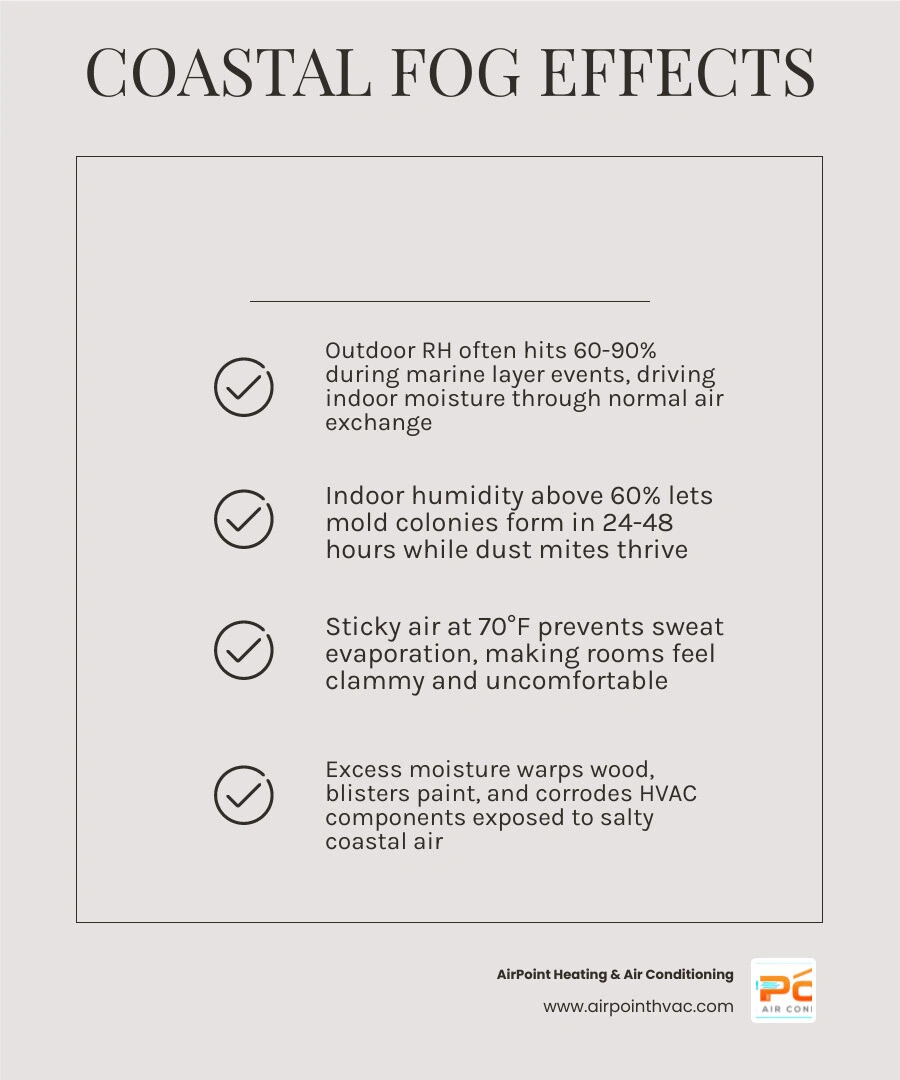
- Outdoor humidity spikes - During marine layer events, outdoor relative humidity along the Southern California coast commonly reaches 60-90%, and that moisture finds its way inside through gaps, cracks, and normal air exchange.
- Indoor air feels heavy - Even at moderate temperatures (low-to-mid 70s°F), high indoor humidity prevents sweat from evaporating properly, making the air feel sticky and uncomfortable.
- Health risks increase - Indoor humidity above 60% creates conditions where mold colonies can establish within 24-48 hours, and dust mite populations thrive.
- Your home takes damage - Excess moisture warps wood floors and furniture, blisters paint, and accelerates corrosion on window hardware and HVAC components exposed to salty coastal air.
- Your HVAC works harder - Systems forced to manage both temperature and elevated moisture simultaneously run longer cycles, driving up energy use and wear.
The challenge is that coastal humidity is not a constant — it follows a daily rhythm. Fog rolls in overnight and during the morning hours, then the marine layer often burns off by afternoon as temperatures climb. This creates a back-and-forth swing of damp and dry air that standard HVAC systems and basic ventilation habits are not always set up to handle well.
In Orange County communities like Los Alamitos, Seal Beach, Huntington Beach, and Newport Beach, this pattern is especially pronounced during spring — the season locals know as "May Gray" and "June Gloom." But the effects on indoor comfort last well beyond any single season, quietly affecting your family's health, your home's structure, and your monthly energy bills year-round.
This guide breaks down exactly what is happening, why it matters, and what you can do about it.
How coastal fog and humidity affect indoor comfort definitions:
How Coastal Fog and Humidity Affect Indoor Comfort in Southern California

To truly understand how coastal fog and humidity affect indoor comfort, we have to look at the physics of how our bodies interact with the surrounding air. In places like Newport Beach and Huntington Beach, we are blessed with mild temperatures, but that mild weather hides a high-moisture reality.
When coastal fog rolls inland, it brings outdoor relative humidity levels that frequently hover between 60% and 90%. As this damp air infiltrates our homes, it shifts the indoor climate, making spaces feel cool yet incredibly sticky—a sensation often described as "clammy."
This clamminess is directly related to how temperature, humidity, and the dew point interact. The dew point is the temperature at which air becomes fully saturated with water vapor, leading to condensation. When indoor relative humidity climbs, the dew point rises closer to the actual room temperature.
This environment alters your air conditioner’s Sensible Heat Ratio (SHR)—the ratio of sensible cooling (lowering air temperature) to latent cooling (removing moisture). In a dry climate, an air conditioner easily lowers the temperature. In our high-humidity coastal zones, however, the system must expend a massive amount of energy just to condense water vapor out of the air before you feel a single degree of actual temperature drop.
When your home has high humidity, you might find yourself constantly lowering your thermostat settings just to feel comfortable. This "overcooling" wastes energy and makes the air feel cold and drafty rather than truly fresh.
Understanding these dynamics is a key part of learning How Coastal California Climate Affects Your HVAC System, as our coastal weather demands a completely different approach to indoor climate management than inland areas.
Understanding How Coastal Fog and Humidity Affect Indoor Comfort During Spring
Spring in Southern California is defined by highly predictable, yet challenging, diurnal cycles. During the late evening and early morning, the marine layer pushes a thick blanket of fog over coastal neighborhoods. As the sun rises, this fog slowly retreats, burning off by the early afternoon to reveal clear skies and warm sunshine.
This daily rollercoaster creates a massive swing in both temperature and humidity. On a typical June Gloom morning in Seal Beach or Rossmoor, the outdoor relative humidity can easily sit at 90% with a cool 58°F temperature. By 2:00 PM, the sun is out, the temperature has jumped to 74°F, and the outdoor humidity has dropped to 50%.
Inside our homes, this cycle causes a constant tug-of-war. During the damp mornings, moisture migrates into the structure. Some building materials, such as standard gypsum board (drywall), act as natural moisture buffers. In marine climates, these porous materials absorb moisture when relative humidity is high and release it back into the air as the indoor environment dries out.
Research shows that moisture-buffering materials can reduce indoor relative humidity fluctuations by over 50% under constant ventilation, and more than double that under time-controlled ventilation. However, if your home is poorly ventilated or lacks active humidity control, this buffering capacity gets overwhelmed, leaving your rooms permanently damp.
The Science of Marine Layer Moisture and Thermal Comfort
Human comfort is not just about temperature; it is heavily dependent on evaporative cooling. Our bodies naturally release sweat, which evaporates into the air to cool us down. However, when the surrounding air is already saturated with moisture, sweat cannot evaporate efficiently. This leaves us feeling hot, sticky, and restless, even if the thermostat reads a modest 72°F.
In the HVAC industry, comfort is scientifically measured using the Predicted Mean Vote (PMV) index, which factors in temperature, humidity, air velocity, clothing, and activity levels. When relative humidity rises above 60%, the PMV index shifts toward "warm" and "stuffy" even at lower dry-bulb temperatures.
Conversely, when relative humidity is kept in the ideal 30% to 50% RH range, sweat evaporates naturally, and our comfort levels soar. In fact, lowering your indoor relative humidity often allows you to raise your thermostat by 2 degrees while maintaining the exact same level of comfort. This simple adjustment can trim your cooling energy use by approximately 6% to 10%!
While we focus heavily on keeping humidity down during damp coastal seasons, maintaining a healthy, balanced indoor environment is a year-round job. To learn more about how humidity balance works across different seasons, check out The Benefits of Humidification and discover how to maximize your Homes Comfort with Proper Humidification when the weather occasionally turns dry.
The Hidden Risks of High Indoor Humidity in Coastal Homes
When high outdoor humidity constantly leaks into your living spaces, it does more than just ruin your comfort. It creates a breeding ground for biological pests, damages the structural integrity of your home, and degrades your heating and cooling equipment.
If you ignore persistent indoor dampness, you are inviting a host of expensive problems that are much harder to resolve once they take root. Understanding these risks is the first step in learning How Coastal Humidity Creates Mold Risk in Southern California homes.
Biological Hazards: Mold and Dust Mites
Microscopic mold spores naturally exist in indoor air at low, harmless counts. However, when indoor relative humidity consistently crosses the 60% RH threshold, these dormant spores find the moisture they need to germinate. Within 24 to 48 hours of sustained high humidity, mold colonies can establish themselves on porous surfaces like drywall, carpet, wallpaper, and the back of closets.
Alongside mold, dust mites thrive in damp environments. These microscopic pests are one of the most common indoor allergen triggers, and their populations virtually explode when relative humidity stays above 50%.
For family members with asthma, allergies, or compromised respiratory systems, this biological buildup can lead to chronic coughing, sneezing, and breathing difficulties. To protect your family, it is critical to combine humidity control with high-efficiency filtration.
Implementing the Best Home Air Filtration standards in your home helps capture these tiny spores and allergens, while a comprehensive system for Whole House Air Purification ensures that your indoor air remains clean, fresh, and free of biological contaminants.
Structural Damage: Wood Rot and Salt Air Corrosion
The combination of high humidity and salty marine air is incredibly destructive to physical structures. When humid air enters hidden wall cavities, attics, or crawlspaces, it condenses on cooler surfaces. Over time, this chronic condensation triggers wood rot, softens drywall, causes paint to blister or peel, and warps expensive hardwood flooring and wooden furniture.
Furthermore, coastal homes in areas like Newport Beach and Seal Beach face the constant threat of salt air corrosion. Salt particles carried by coastal fog are highly hygroscopic, meaning they naturally attract and hold moisture. When these salty, humid drafts settle on metal surfaces, they trigger galvanic corrosion—an electrochemical reaction that rapidly degrades metals.
This corrosion targets window hardware, structural fasteners, door hinges, and, most notably, your outdoor air conditioning condenser coils. Left unprotected, corroded coils develop tiny leaks, restrict airflow, and suffer severe efficiency loss, leading to premature system failure. Regular coastal HVAC maintenance is absolutely essential to wash away these corrosive salt deposits before they cause permanent damage.
Ventilation and Dehumidification Strategies for Marine Climates
Managing indoor air quality and moisture in a coastal home requires a careful balance. Under modern building standards like ASHRAE 62.2 and California Title 24, homes are built tighter to conserve energy, which means they require mechanical ventilation to bring in fresh outdoor air.
However, in a marine climate, simply bringing in outdoor air can import a massive amount of moisture, especially during foggy mornings. To keep your home comfortable and healthy, you need a smart strategy that coordinates ventilation, air conditioning, and dedicated dehumidification.
For many homeowners in high-humidity areas like La Palma, installing a system for Whole House Dehumidification is the most reliable way to maintain perfect moisture control year-round.
HRV vs. ERV: Which Performs Better in Coastal Fog?
When designing a mechanical ventilation system for an Orange County home, you will likely choose between a Heat Recovery Ventilator (HRV) and an Energy Recovery Ventilator (ERV). Both systems exchange stale indoor air for fresh outdoor air while recovering energy from the departing air stream, but they handle moisture very differently.
- Heat Recovery Ventilators (HRVs) transfer heat between the incoming and outgoing air streams but do not transfer moisture.
- Energy Recovery Ventilators (ERVs) transfer both heat and moisture, theoretically keeping outdoor humidity from entering your home during the summer.
In our unique Southern California coastal climate, however, an ERV can sometimes be counterproductive during heavy marine layer events. Because the outdoor temperature is often cool while the humidity is extremely high, an ERV may inadvertently import moisture into your home.
To prevent this, we highly recommend installing ventilation systems equipped with an outdoor humidity lockout. This smart feature automatically pauses mechanical ventilation or switches modes when outdoor relative humidity spikes beyond a set threshold, protecting your indoor spaces from sudden moisture surges.
| Feature / Performance Metric | Heat Recovery Ventilator (HRV) | Energy Recovery Ventilator (ERV) |
|---|---|---|
| Moisture Transfer | None (only transfers sensible heat) | Transfers both heat and moisture |
| Best Performance Window | Cooler, high-humidity mornings (when paired with a lockout) | Warm, moderately humid afternoons |
| Risk in Heavy Coastal Fog | Low risk of importing moisture if controlled properly | High risk of saturating the core and importing moisture |
| Ideal Coastal Setup | Excellent when integrated with a whole-house dehumidifier | Requires advanced sensors and bypass controls to prevent dampness |
Dehumidifiers vs. Air Conditioning Dry Mode
Many homeowners ask: Can't I just use my air conditioner to control humidity?
While standard air conditioners naturally remove moisture as they cool, they are designed to prioritize temperature control over humidity control. During mild, foggy spring days in coastal Orange County, your home’s sensible cooling load is very low. Because it isn't hot outside, your AC will only run for short cycles. These short cycles do not give the cooling coils enough time to condense and drain away significant amounts of indoor moisture.
If you try to dehumidify your home using a standard AC under these conditions, you will likely end up overcooling your living spaces, leaving you cold, clammy, and shivering.
Modern variable-speed compressors and systems with a dedicated "dry mode" help by running longer, slower cycles to maximize moisture removal. However, for true, year-round comfort, nothing beats a dedicated dehumidifier.
While portable units can help control moisture in a single room, they are noisy, require constant manual draining, and lack the capacity to treat your entire home. A whole-house dehumidifier integrates directly with your existing ductwork, pulling moisture from the air quietly and efficiently, then draining it away automatically without you ever lifting a finger.
Practical Steps to Optimize Your Coastal Home's Climate
Achieving perfect indoor comfort in a coastal environment requires a combination of smart habits, modern technology, and building envelope improvements. By taking a proactive approach, you can dramatically reduce the impact of the marine layer on your daily life.
To explore a complete range of systems designed to keep your indoor air clean, dry, and healthy, take a look at our Indoor Air Quality Solutions Complete Guide.
Actionable Ways to Control How Coastal Fog and Humidity Affect Indoor Comfort
You don't have to wait for a major equipment upgrade to start improving your home's indoor climate. Here are several practical daily habits and low-cost steps you can take to manage moisture:
- Monitor with a hygrometer: Place a few inexpensive digital hygrometers in your main living areas, bedrooms, and closets. Track your indoor relative humidity daily to see how it responds to the morning fog.
- Time your natural ventilation: Avoid opening windows during foggy mornings or late evenings when the marine layer is thick. Instead, open your windows in the afternoon when the sun is out, the fog has cleared, and outdoor humidity is at its lowest.
- Use exhaust fans strategically: Always run your bathroom and kitchen exhaust fans during moisture-producing activities like showering or cooking. Leave them running for 20 to 30 minutes afterward to ensure all localized moisture is fully vented outdoors.
- Keep closet doors open: Closets built against cooler exterior walls are high-risk zones for mold. Keep closet doors slightly open to encourage airflow, and avoid storing clothes or shoes directly on the floor where cool, damp air tends to pool.
- Set your HVAC fan to "Auto": Never run your HVAC fan continuously in the "On" position during humid weather. Doing so will blow the moisture that just condensed on your AC coils right back into your living spaces before it has a chance to drain away.
Smart Controls and Building Envelope Improvements
To build a truly resilient coastal home, you need to seal out the damp marine air. Improving your building envelope is one of the most effective ways to reduce humidity infiltration.
Start by inspecting the weatherstripping around your doors and windows, replacing any worn or cracked seals. If you have a raised foundation, enclosing and encapsulating your crawlspace with a thick vapor barrier and a dedicated crawlspace dehumidifier will prevent ground moisture from rising through your floorboards.
Next, upgrade your home's brain with smart controls. Modern smart thermostats equipped with built-in humidity sensors can automatically coordinate your heating, cooling, and dehumidification systems.
By setting up an "outdoor humidity lockout," your smart system will monitor local weather data and automatically shut off fresh-air ventilation intakes when the morning fog is at its thickest, reopening them only when the air outside has dried out.
Special Considerations for Coastal Condos and HOAs
If you live in a coastal condo or a townhome with Homeowners Association (HOA) restrictions in communities like Huntington Beach or Newport Beach, managing humidity can feel a bit more complicated. Shared walls limit cross-ventilation, and HOAs often have strict rules regarding where you can place outdoor equipment, cut penetrations for ventilation ducts, or run condensate drain lines.
Fortunately, there are several highly effective, HOA-friendly ways to manage indoor moisture:
- In-wall or ceiling-recessed dehumidifiers: These compact, dedicated units fit between standard wall studs or ceiling joists, draining directly into your existing plumbing lines without requiring any exterior wall cuts or outdoor footprint.
- High-performance portable dehumidifiers: Quality, quiet portable units can be placed in high-risk areas like master bedrooms or walk-in closets. Many models can be set up to drain continuously into a nearby bathroom sink or shower drain.
- Upgrading to ductless mini-splits: If your HOA restricts traditional ducted system upgrades, a ductless mini-split system is an excellent alternative. The outdoor units have an incredibly small footprint, run quietly, and feature highly effective "dry modes" that excel at localized moisture removal.
Frequently Asked Questions about Coastal Humidity
What indoor relative humidity target should coastal homeowners aim for?
For optimal comfort, health, and home protection, public health organizations and HVAC experts recommend maintaining indoor relative humidity between 30% and 50%. Keeping your home below 50% RH virtually eliminates dust mite populations and prevents condensation on windows and walls.
While a slightly higher limit of 55% to 60% is acceptable during peak cooling periods to help save energy, allowing indoor humidity to rise above 60% for more than 24 hours significantly increases the risk of mold germination and makes your home feel sticky and uncomfortable.
Do I need a dedicated dehumidifier if I already have air conditioning?
In coastal Southern California, the answer is often yes, especially during the mild spring and autumn shoulder seasons. Because our coastal temperatures are generally comfortable, your air conditioner does not need to run very often to keep your home cool.
However, the outdoor air remains highly saturated. Without a dedicated dehumidifier, your indoor humidity will rise because your AC isn't running long enough to remove the moisture. A dedicated system handles this "latent load" independently, keeping your home dry and fresh without overcooling your rooms.
How does poor HVAC maintenance worsen indoor humidity problems?
Your heating and cooling system cannot manage moisture effectively if it is neglected. Several common maintenance issues directly destroy your system's dehumidification capacity:
- Dirty evaporator coils: A buildup of dust and grime on your indoor coils acts as an insulating blanket, preventing the refrigerant from cooling the metal surfaces enough to condense water vapor out of the air.
- Clogged condensate drains: If your drain line is choked with algae or mineral deposits, the water removed from your air cannot drain away. It pools in the drain pan, evaporating back into your ductwork and raising indoor humidity.
- Low refrigerant levels: Incorrect refrigerant charge prevents the evaporator coil from reaching the optimal temperature needed to hit the dew point, resulting in poor moisture removal.
- Restricted airflow: Clogged air filters reduce the volume of air passing over the cooling coils, causing uneven system operation and preventing proper whole-home dehumidification.
Conclusion
Living along the Southern California coast is a dream, but the beautiful morning fog and cool ocean breezes bring unique indoor comfort challenges. Managing how coastal fog and humidity affect indoor comfort requires specialized local expertise, high-quality equipment, and a commitment to proactive home care.
At AirPoint Heating & Air Conditioning, we operate on a simple philosophy: comfort is happiness. As a family-owned, award-winning local business, we are proud to provide fast, expert HVAC and indoor air quality solutions to our neighbors across Orange County.
Our licensed, certified technicians are ready to help you find the perfect balance for your home. Whether you need a precision tune-up to protect your system from salt air corrosion, a high-efficiency air filter upgrade, or a state-of-the-art whole-house dehumidifier installation, we back all of our work with honest communication, prompt same-day service, and a 100% satisfaction guarantee.
Don't let "June Gloom" ruin your indoor comfort. Visit our AirPoint Heating & Air Conditioning Huntington Beach location page to book your fast, reliable service now!
Other Blogs
Latest Blog Posts

HVAC Repair: Decoding Fall Furnace Smells and Startup Issues

Home Maintenance Tips and Troubleshooting: Decoding Fall Heating Startup Symptoms

The Truth About Smart Thermostat Auto-Switch Features During Unpredictable Fall Weather

Customer Testimonials




I recommend Air Point for your HVAC needs."