






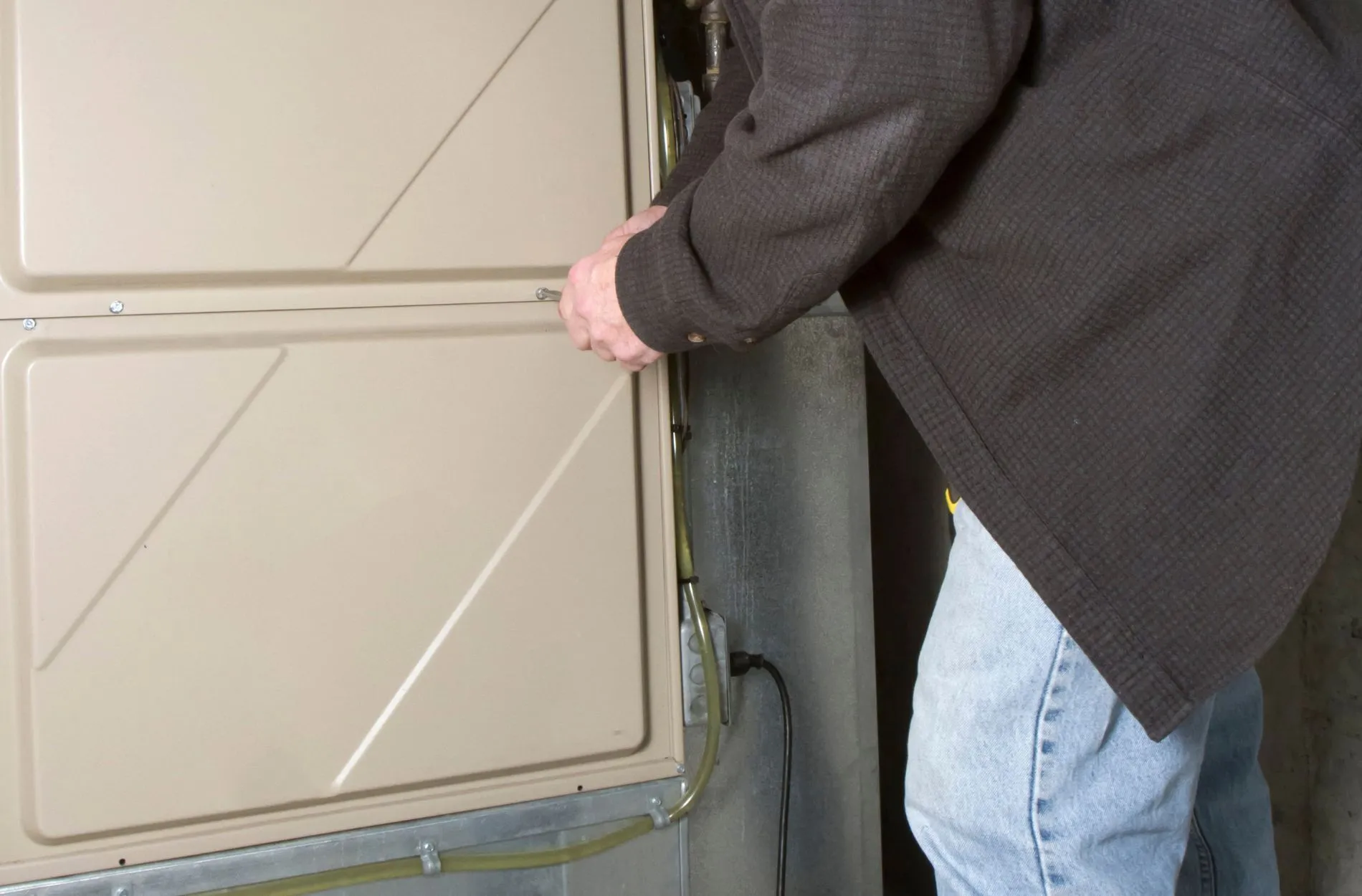
When to Repair vs Replace Your HVAC System: What Most Homeowners Get Wrong
Knowing when to repair vs replace your HVAC system can be the difference between a smart investment and throwing money at a unit that's already on its way out. If your system is breaking down, driving up your energy bills, or leaving rooms in your Los Alamitos home too hot or too cold, you're probably asking yourself that exact question right now.
Here's a quick answer before we go deeper:
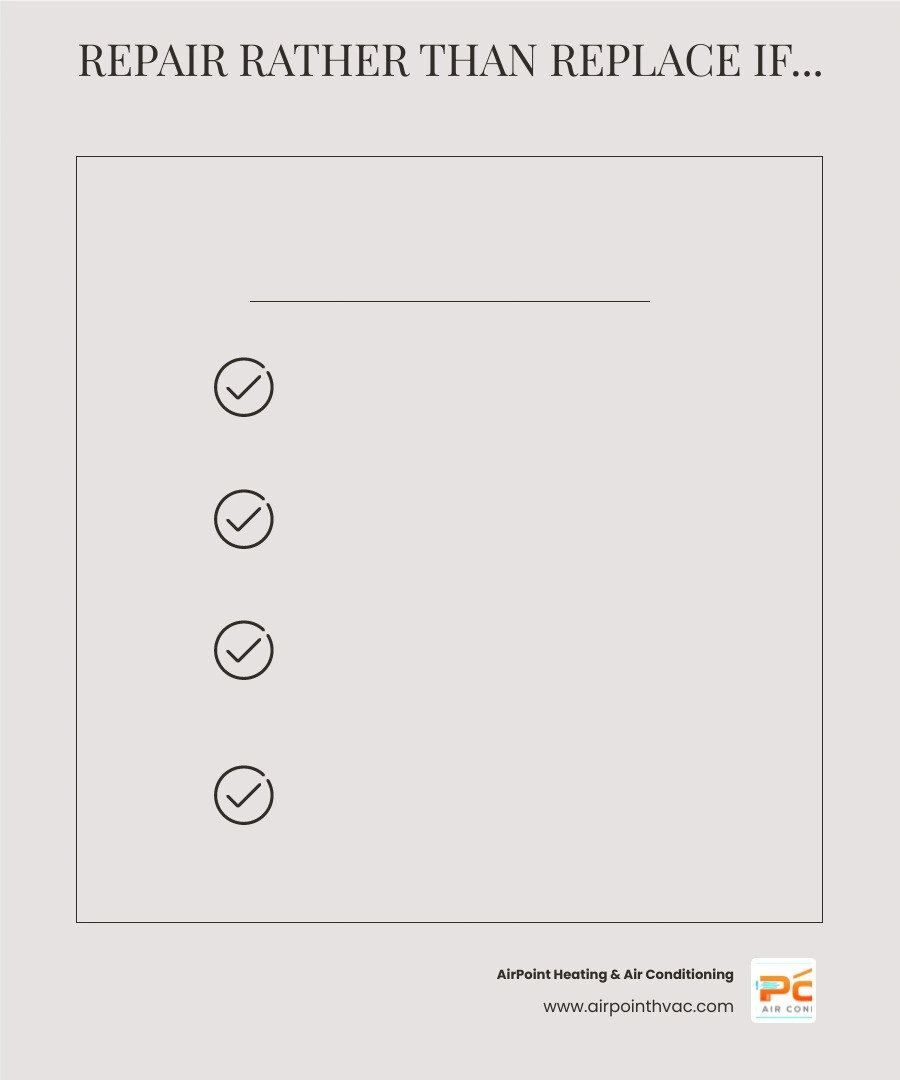
Repair your HVAC system if:
- The system is under 10 years old (AC/heat pump) or under 15 years (furnace)
- The repair is minor and costs less than 50% of a new system
- You've had few or no major repairs in the past 2-3 years
- The system is still under warranty
Replace your HVAC system if:
- Your AC or heat pump is over 10-15 years old, or your furnace is over 15-20 years old
- Repair costs multiplied by system age exceed $5,000 (the "$5,000 rule")
- The repair would cost more than 50% of what a new system costs
- You have a cracked heat exchanger, compressor failure, or R-22 refrigerant system
- You've had 3 or more repairs in the past 3 years
- Your energy bills keep climbing despite normal use
Most homeowners face this decision during an emergency — when it's the middle of summer, the AC is down, and a technician hands them a repair quote. That pressure makes it easy to make the wrong call. This guide gives you a calm, clear framework so you can decide with confidence, not stress.
Similar topics to when to repair vs replace your hvac system:
Understanding System Lifespans in Coastal California
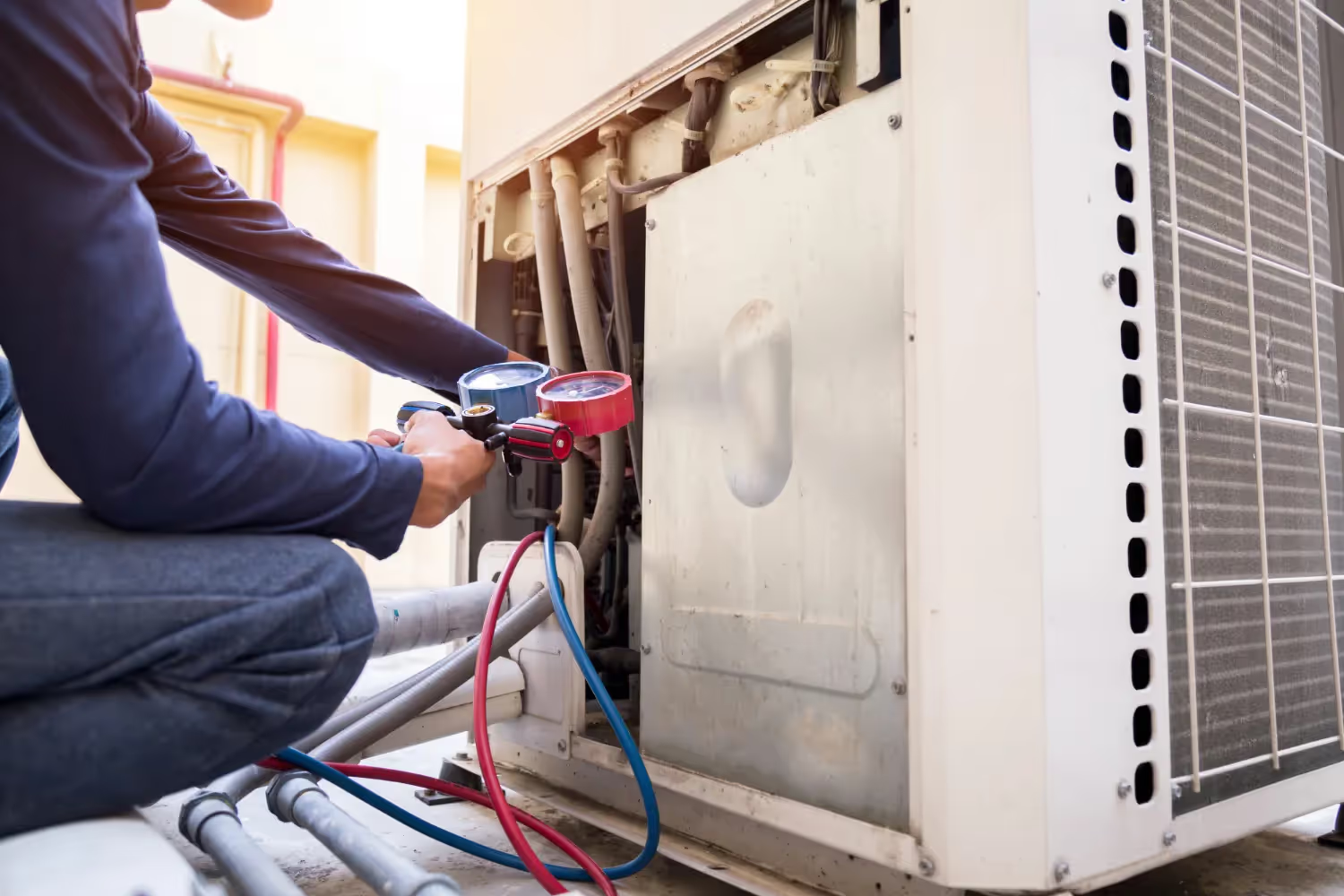
Before we can weigh the financial wisdom of a repair, we must understand the natural lifespan of our home comfort equipment. Just like any mechanical system, your heater and air conditioner have an expiration date. However, living in coastal California introduces unique environmental factors that can accelerate this timeline.
In a perfect climate, a standard central air conditioner or heat pump might last 15 to 20 years. But in our service areas—stretching from coastal gems like Newport Beach, Huntington Beach, and Seal Beach to inland communities like Irvine and Yorba Linda—the rules are slightly different.
Here is what you can realistically expect for equipment lifespans in coastal and near-coastal California:
- Air Conditioners (10–15 Years): The outdoor condenser unit bears the brunt of our local climate. While we enjoy beautiful coastal breezes, the salt-laden air and high humidity can cause premature corrosion on the aluminum fins and copper coils. If you live within a few miles of the ocean, your AC's lifespan may lean closer to 10 to 12 years.
- Heat Pumps (10–15 Years): Because heat pumps provide both heating in our mild winters and cooling in our warm summers, they operate year-round. This dual-duty cycle means they accumulate mechanical wear faster than standalone systems, typically requiring replacement after 12 to 15 years.
- Gas Furnaces (15–20 Years): Furnaces generally last longer because they are installed indoors (usually in an attic, closet, or garage) and are shielded from the elements. Additionally, Southern California winters are mild, meaning our furnaces run far less than those in colder states.
- Boilers (20–30 Years): Though less common in newer Orange County developments, older homes in historic neighborhoods may utilize boilers. These heavy-duty systems can easily last over two decades if properly maintained.
To understand how our unique geography impacts your system's longevity, check out our guide on How Long Does an HVAC System Last in Coastal California. Salt air corrosion, high coastal humidity, and dust from inland winds all play a role in how gracefully your system ages.
The Mathematical Rules: $5,000 Rule vs. 50% Rule
When emotion and summer heat are clouding your judgment, math is your best friend. The HVAC industry relies on two primary financial formulas to remove the guesswork from the decision: the $5,000 Rule and the 50% Rule.
Learning How to Decide Between Repair and Replacement starts with applying these simple calculations to your technician's written quote.
The $5,000 Rule
This is a quick, time-tested industry filter. To use it, you multiply the age of your system (in years) by the total cost of the proposed repair.
- If the result is under $5,000, repairing the unit is generally the smarter financial move.
- If the result is over $5,000, you should strongly consider replacing the system.
Example A: You have an 8-year-old air conditioner that needs a moderate repair. When you multiply the system's age (8) by the repair cost, the result is well below the $5,000 threshold. In this scenario, repairing the unit is highly recommended.
Example B: You have a 13-year-old AC unit that needs a major part replaced. Multiplying the age (13) by this larger repair cost easily pushes the total over $5,000. Because the system is nearing the end of its lifespan, investing that money into a brand-new, efficient system is the better long-term decision.
The 50% Rule
The 50% Rule is even simpler. It states that if the cost of repairing your current system exceeds 50% of the cost of a brand-new replacement system, you should automatically choose replacement.
Why? Because spending more than half the value of a new machine on an old, out-of-warranty unit leaves you vulnerable to "the repair spiral"—where you fix one part today, only for another aging component to fail next season.
| Financial Rule | How It Works | Best For | When It Falls Short |
|---|---|---|---|
| The $5,000 Rule | Age of system $\times$ Repair cost. Replace if $> 5,000$. | Mid-aged systems (6–12 years old) experiencing their first major breakdown. | Extremely old systems with minor repairs, or very young systems with high labor costs. |
| The 50% Rule | Replace if the repair cost is $> 50\%$ of a brand-new system. | Systems of any age facing catastrophic failures (e.g., failed compressor). | Does not account for cumulative efficiency losses or refrigerant phase-outs. |
Key Indicators for When to Repair vs Replace Your HVAC System
While mathematical formulas are incredibly helpful, they don't tell the whole story. Deciding when to repair vs replace your HVAC system requires looking at the big picture. We recommend evaluating three key indicators: repair frequency, the severity of the failed component, and your current warranty status.
If you are asking yourself, Is It Worth Fixing an Old HVAC System, look at your system's recent history.
- Repair Frequency: A single, isolated breakdown on an 8-year-old system is perfectly normal. However, if you have had to call a technician three or more times over the last three years, your system is signaling that its components are failing in a chain reaction.
- Minor vs. Major Failures: Some parts are cheap and easy to swap out. Replacing a run capacitor, a contactor, a thermostat, or a flame sensor is almost always worth doing, even on an older system. These are minor wear-and-tear parts. Conversely, major component failures—like a seized compressor, a failed blower motor, or a leaking evaporator coil—are major surgeries that usually warrant system replacement.
- Warranty Status: Most reputable manufacturers offer a 5-to-10-year parts warranty. If your system is still covered, the cost of the repair will be significantly lower because you will only be responsible for labor. Once the warranty expires, you bear the full brunt of both parts and labor, making replacement much more attractive.
How to Decide When to Repair vs Replace Your HVAC System Based on Age
Age is the ultimate equalizer in HVAC decisions. Even if a system has been meticulously maintained, the materials inside degrade over time.
If your air conditioner or heat pump is past the 10-year mark, or your furnace is past the 15-year mark, you are entering the replacement zone. According to ENERGY STAR guidelines, upgrading at these thresholds can prevent sudden emergency breakdowns during peak weather.
When your heating system starts acting up in the winter, you'll want to review the specific criteria for When to Consider Furnace Replacement to ensure you aren't pouring money into an obsolete heating unit. For more guidance on age thresholds, read our breakdown on How Old Is Too Old for an HVAC System.
Red Flags and Safety Risks in Aging Systems
While financial considerations are important, safety is non-negotiable. There are certain critical red flags that demand immediate system replacement, regardless of what the mathematical rules tell you.
The most dangerous safety risk in a heating system is a cracked heat exchanger. The heat exchanger is the metal chamber where natural gas is burned to create heat. If this metal cracks due to years of expanding and contracting, toxic combustion gases—including lethal carbon monoxide—can leak directly into your home's breathing air.
If our technician discovers a cracked heat exchanger during an inspection, we are legally and ethically required to shut down the gas supply to the unit to protect your family. Because replacing a heat exchanger is an incredibly labor-intensive and expensive process, a crack almost always means it is time for an immediate furnace replacement.
To protect your household, familiarize yourself with the Furnace Replacement Top Signs and consult our Comprehensive Heating Repair Guide to recognize the warning signs of carbon monoxide leaks, such as soot buildup, a flickering yellow burner flame, or physical symptoms like unexplained headaches and nausea.
Environmental and Efficiency Factors in 2026
As we navigate June 2026, the landscape of home heating and cooling is vastly different than it was just a few years ago. Environmental regulations and technological leaps have shifted the economics of the repair-versus-replace decision.
The Refrigerant Reality
If you own an air conditioner or heat pump installed before 2010, it likely runs on R-22 refrigerant (commonly known as Freon). The EPA completely phased out the production and import of R-22 due to its ozone-depleting properties. Today, servicing an R-22 system is incredibly expensive. If your older system has a refrigerant leak, recharging it can cost an exorbitant amount because the remaining supply of R-22 is scarce. Any major repair on an R-22 system is a clear sign that you should replace the unit.
Furthermore, we are currently experiencing the phase-down of R-410A, the refrigerant that replaced R-22. Under the AIM Act, the industry is transitioning to newer, environmentally friendly, low-GWP (Global Warming Potential) refrigerants like R-454B and R-32. While R-410A remains legal to own and service, the cost of repairing leaks on R-410A systems will steadily rise as supply limits take effect. Upgrading to a modern system ensures you are compatible with future refrigerant standards and won't face inflated repair costs down the road.
Energy Efficiency and Rising Utility Bills
Older HVAC systems are energy hogs. A system installed 10 to 15 years ago might have a SEER (Seasonal Energy Efficiency Ratio) rating of 10 or less. Today, modern minimum-efficiency systems start at 14 or 15 SEER2, with high-efficiency variable-speed models reaching well over 20 SEER2.
According to the Department of Energy, a new HVAC system can save you 20% to 40% on your monthly energy costs compared to an older unit. Additionally, choosing an ENERGY STAR certified model guarantees an extra 15% in energy savings over standard new units, while an ENERGY STAR qualified furnace is 15% more efficient than a conventional model. If you've noticed your Southern California Edison or San Diego Gas & Electric bills creeping upward despite using your system the same amount, your system's efficiency is degrading, making replacement the more financially sound choice.
What Role Does Climate Play in When to Repair vs Replace Your HVAC System?
Our local microclimates heavily influence this decision. In coastal neighborhoods like Seal Beach, Huntington Beach, and Newport Beach, the marine layer brings heavy moisture and corrosive salt air. This environment rusts outer casings and degrades outdoor coils much faster than in dry, inland areas like La Mirada or Whittier.
If you live near the coast, a system showing signs of severe rust and reduced airflow should be replaced rather than repaired, as the structural integrity of the unit has likely compromised its performance.
Inland areas like Anaheim, Fullerton, and Yorba Linda experience much hotter summer temperatures. In these communities, systems run longer and harder, making energy efficiency a much higher priority. Upgrading to a high-efficiency system in a hot inland climate will yield a much faster return on investment through lower monthly utility bills than it would in a mild coastal zone.
Financial Benefits of Upgrading Your System
When you replace an old, failing system, you shouldn't view it purely as an expense. It is a long-term investment in your home.
By analyzing the HVAC Replacement Return on Investment, you will find that the upfront cost of a new system is offset by several financial advantages:
- Lower Utility Bills: You will immediately slash your monthly cooling and heating costs by 20% to 40%.
- State and Federal Incentives: While federal tax credits have evolved, there are still excellent local utility rebates and state-specific programs (such as the HEAR rebates in California) that offer substantial financial incentives for upgrading to energy-efficient heat pumps.
- Increased Home Value: A brand-new HVAC system with a transferable warranty is a massive selling point for potential buyers, often allowing you to recoup a high percentage of the installation cost if you decide to sell your home.
How to Apply the 2026 Framework to Your Home
To make the final decision, look at your personal timeline and your home's infrastructure.
- Home Ownership Duration: If you plan on moving within the next 1 to 2 years, a minor-to-moderate repair may make sense just to keep the system running for the sale. However, if you plan to stay in your home for 5 years or longer, upgrading now allows you to enjoy the comfort, lower utility bills, and warranty peace of mind.
- Professional Load Calculations: Never let a contractor simply install the exact same size unit as your old one. A professional must perform a Manual J load calculation to size your new system based on your home's square footage, insulation, window types, and local climate. An oversized system will cycle on and off constantly, wearing out prematurely, while an undersized system will run non-stop.
- Ductwork Assessment: A brand-new HVAC system attached to old, leaky ducts is a waste of money. If your home has excessive dust or uneven temperatures across rooms, leaky ducts are likely pulling in dirty air from your attic or crawlspace.
Before you commit to any repair or replacement, be sure to read our checklist on Signs Your HVAC Needs Replacing Not Just Fixing to ensure you are addressing the root cause of your comfort challenges, rather than just putting a band-aid on a failing system.
Frequently Asked Questions About HVAC Decisions
What is the $5,000 rule for HVAC systems?
The $5,000 rule is a simple mathematical formula used to evaluate whether to repair or replace your heating and cooling equipment. You multiply the age of your system in years by the cost of the proposed repair. If the resulting number is greater than $5,000, the industry recommendation is to replace the system. If the result is less than $5,000, proceeding with the repair is typically the more cost-effective choice.
Should I replace my furnace and AC at the same time?
In most cases, yes. If both your air conditioner and furnace are over 12 years old, replacing them together is highly recommended.
First, it saves you a significant amount of money on labor costs, as our technicians only have to install the indoor and outdoor components once. Second, modern HVAC systems are designed to work as matched systems. If you pair a brand-new, high-efficiency AC condenser with an old, inefficient furnace blower motor, the system won't achieve its rated SEER2 efficiency, and you will put unnecessary strain on the new compressor.
How does the R-22 refrigerant phase-out affect my decision?
Because the EPA has banned the production and import of R-22 refrigerant, the cost of repairing leaks on pre-2010 air conditioners has skyrocketed. If your system runs on R-22 and experiences a refrigerant leak or a compressor failure, repairing it is financially unwise. The money spent on a single R-22 recharge is better spent as a down payment on a modern, reliable, and highly efficient system that utilizes eco-friendly refrigerants.
Conclusion
Making the choice between repairing and replacing your heating and cooling system doesn't have to be overwhelming. By analyzing your system's age, tracking its repair history, applying the $5,000 and 50% rules, and considering modern efficiency standards, you can make a logical, stress-free decision that protects both your family's comfort and your hard-earned money.
At AirPoint Heating & Air Conditioning, we believe that "comfort is happiness." As a family-owned, award-winning business serving Los Alamitos and communities across Orange County, we are dedicated to providing honest communication, expert workmanship, and prompt same-day service. Whether you need a precision repair to get your system through the season or a complete, high-efficiency upgrade backed by our 100% satisfaction guarantee, our licensed and certified technicians are here to help.
Don't let an inefficient, breaking-down system compromise your peace of mind. Book fast, reliable HVAC services today to schedule a professional assessment of your system. We will give you a clear, honest evaluation so you can make the right choice for your home and family.
Other Blogs
Latest Blog Posts

Using a SEER Savings Calculator: Balancing Efficiency Upgrades with Fall HVAC Prep

Troubleshooting Heating Startup Smells: Is Your Furnace Safe for Fall?
Fall Home Maintenance Tips: Troubleshooting Heating Odors and Using a SEER Savings Calculator

Customer Testimonials



I recommend Air Point for your HVAC needs."