





Is Your HVAC Trying to Tell You Something? The Warning Signs Homeowners Miss
The signs your HVAC needs replacing not just fixing are often easy to overlook — until a breakdown leaves your Los Alamitos home sweltering in the middle of an Orange County summer. Most homeowners only think about their HVAC system when something goes wrong, but by then, the cost of waiting is already adding up. Whether it's a steady climb in your energy bills, rooms that never quite reach the right temperature, or a repair truck showing up more often than it should, your system may be sending clear signals that a repair simply won't solve the problem anymore.
Quick answer: Key signs your HVAC needs replacing, not just fixing:
- System age — 10+ years for AC/heat pumps; 15+ years for furnaces
- Frequent breakdowns — Multiple repairs in a single season
- Rising energy bills — Unexplained increases of 15–25% or more
- R-22 refrigerant — Phased out in 2020; expensive and hard to source
- Uneven temperatures — Hot and cold spots throughout your home
- Short cycling — System turns on and off rapidly without completing a full cycle
- Unusual noises or smells — Grinding, banging, burning, or musty odors
- Repair costs exceed the 50% rule — If repairs cost more than half the price of a new system, replace it
Understanding these warning signs early can save you from emergency breakdowns, inflated utility bills, and the compounding cost of patching an aging system that's already past its prime.
The Age Factor: When Your System Hits the Double Digits
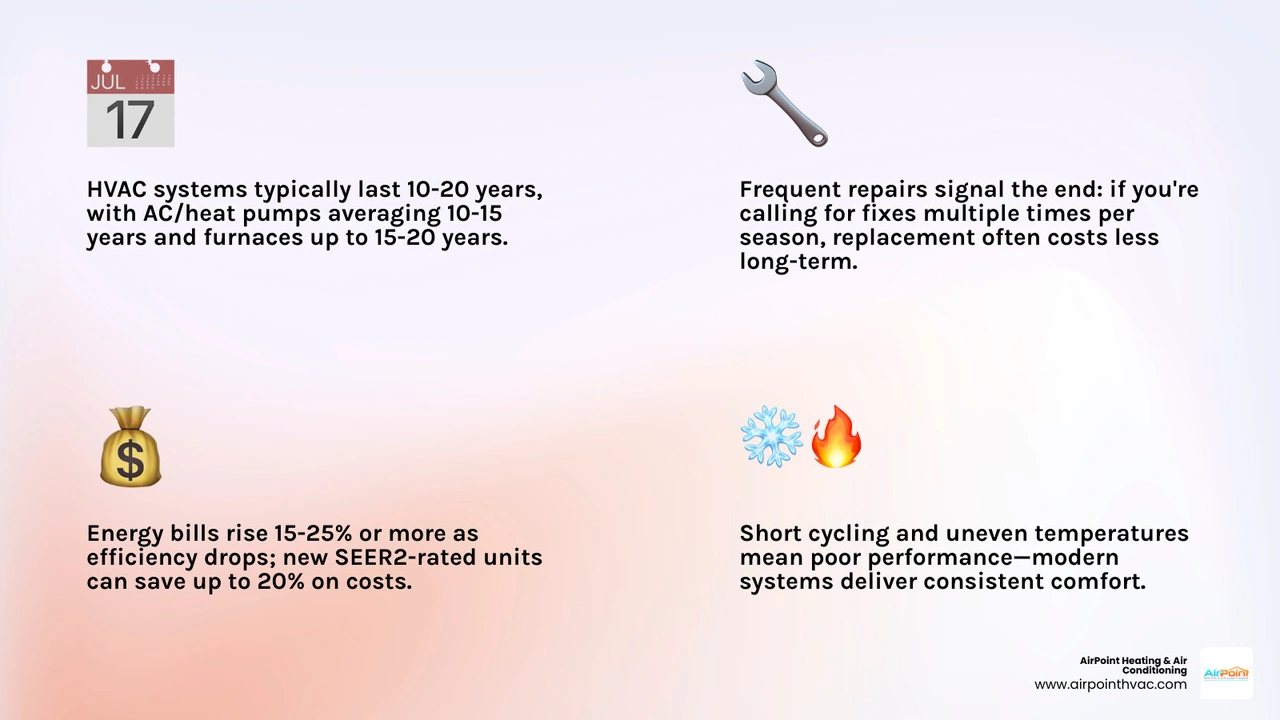
One of the most objective ways to tell if your system is nearing its end is by checking the calendar. While we all want our appliances to last forever, mechanical systems have a finite lifespan. In the mild but demanding climate of Orange County — where we rely heavily on AC in places like Huntington Beach and heating during those chilly Seal Beach nights — wear and tear happens faster than you might think.

The 10-Year Threshold for AC and Heat Pumps
If your air conditioner or heat pump is more than 10 years old, it’s time to start thinking about its successor. According to ENERGY STAR, replacing a unit that has hit the decade mark with a newer, high-efficiency model can save you up to 20% on your cooling costs. As systems age, they naturally lose efficiency due to dirt buildup and internal corrosion. Even with perfect maintenance, a 10-year-old unit simply cannot compete with modern SEER2 standards. For those using modern heating technology, it is helpful to know when to consider heat pump replacement before the system leaves you stranded.
The 15-Year Furnace Limit
Furnaces generally have a slightly longer lifespan, often lasting between 15 and 20 years. However, once a furnace crosses the 15-year line, its risk profile changes significantly. Older furnaces are more likely to develop cracked heat exchangers — a serious safety hazard that can lead to carbon monoxide leaks. If your heating system is approaching its late teens, it's often more strategic to replace it than to wait for a total failure on the coldest night of the year.
7 Critical Signs Your HVAC Needs Replacing Not Fixing
Beyond age, there are physical symptoms that indicate the "internal organs" of your HVAC are failing. We often see systems that technically still run but are working so hard they are essentially on life support.
Short Cycling and Constant Running
Does your HVAC turn on and off every few minutes? This is called short cycling. It puts immense pressure on the compressor and fan motor, leading to premature burnout. Conversely, if your system runs constantly without ever reaching the temperature set on the thermostat, it has lost its cooling or heating capacity. This often happens because the system is undersized for the home or the internal components have degraded to the point where they can no longer move heat effectively. If you're noticing these patterns, you should check out these furnace replacement top signs to see if your heater is struggling.
Airflow Failure and Mechanical Obsolescence
Weak airflow from your vents can signal that the blower motor is dying or that your ductwork is failing. When major parts like the compressor (the "heart" of the AC) or the heat exchanger fail on an old unit, the system is considered "mechanically obsolete." Investing in a major repair for an obsolete system is like putting a new engine in a car with 300,000 miles — it’s usually not the best use of your home improvement budget.
Frequent Repairs: A Sign Your HVAC Needs Replacing Not Fixing
If you know your HVAC technician's first name because they’ve been to your house three times this season, that’s a red flag. Minor repairs like a capacitor or a fan belt are normal. However, recurring breakdowns are signs your hvac needs replacing not just fixing. When you find yourself paying for the same issue repeatedly, or when one fix leads to another part breaking, the system's reliability is gone. You can learn more about when to consider furnace replacement if your repair bills are starting to stack up.
The R-22 Refrigerant: A Major Sign Your HVAC Needs Replacing Not Fixing
If your system was manufactured before 2010, there is a high chance it uses R-22 refrigerant (commonly known as Freon). The EPA completely phased out the production and import of R-22 in 2020 to protect the environment. Because the supply is now limited to recycled quantities, the cost of a simple recharge can be astronomical — sometimes costing as much as a significant portion of a new unit. If your older R-22 system has a leak, replacing the unit is almost always the smarter financial move than trying to patch and refill it with "liquid gold."
The Math of Comfort: Using the $5,000 and 50% Rules
When you are staring at a repair estimate, it can be hard to think clearly. We recommend using two industry-standard "math rules" to take the emotion out of the decision.
| Factor | Repair It | Replace It |
|---|---|---|
| The $5,000 Rule | Age x Repair Cost < $5,000 | Age x Repair Cost > $5,000 |
| The 50% Rule | Repair is < 50% of new unit cost | Repair is > 50% of new unit cost |
| Energy Bills | Stable or minor increases | 20%+ increase year-over-year |
| System Age | Under 10 years | Over 12-15 years |
The $5,000 Rule
Multiply the age of your equipment by the repair estimate. If the total exceeds 5,000, the math suggests that replacement is the better long-term investment.
The 50% Rule
This one is simpler: if the cost of the repair is 50% or more of the value of a brand-new system, don't throw good money after bad. A new system comes with a fresh warranty, significantly higher SEER2 efficiency ratings, and the peace of mind that it won't break down next month.
Upgrading to a high-efficiency unit can reduce your cooling energy consumption by roughly 37% if you are moving from an old 10-SEER unit to a modern 16-SEER unit. In cities like Irvine or Yorba Linda, where summer utility rates can spike, those savings add up significantly every year.
Performance Red Flags: Why Your Orange County Home Feels Less Comfortable
Sometimes the signs aren't on a bill or a serial number; they are in the air you breathe. Your HVAC system is responsible for more than just temperature; it also manages humidity and air quality.
Humidity and "Sticky" Air
A properly functioning AC unit acts as a dehumidifier. If your home feels "sticky" or muggy even when the air is blowing, your system is likely failing to remove moisture. This often happens with oversized systems that short cycle, turning off before they can complete the dehumidification process. In coastal areas like Newport Beach, managing indoor humidity is vital to preventing mold and protecting your home's interior.
Unusual Noises: What Is Your System Saying?
Your HVAC should be a background hum, not a heavy metal concert. Listen for these red flags:
- Grinding or Screeching: Often indicates failing bearings or a dying motor.
- Banging or Clanking: Suggests a loose or broken part inside the compressor or blower.
- Hissing: A classic sign of a refrigerant leak.
Warning Smells: Don't Ignore Your Nose
- Burning Smell: If it’s the first time you’ve turned on the heater in winter, it might just be dust. If it persists, it could be an electrical failure.
- Rotten Eggs: This is a sign of a natural gas leak. Turn off the system and leave the house immediately.
- Moldy or Musty Odors: Often called "dirty sock syndrome," this indicates biological growth on your coils or inside your ductwork.
Frequently Asked Questions about HVAC Replacement
How do I know if my system uses outdated R-22 refrigerant?
You can usually find this information on the nameplate attached to your outdoor condenser unit. Look for the "Refrigerant" section. If it says R-22 or HCFC-22, your system uses the phased-out gas. Most units built after 2010 use R-410A, which is the current standard, though even newer eco-friendly refrigerants are now entering the market.
Is it worth replacing my HVAC if it is still running?
Yes, in many cases. If your system is over 15 years old, it is likely running at a fraction of its original efficiency. You might be paying significantly more each year in wasted energy costs. Replacing a "working" but inefficient system allows you to plan the installation on your own terms (like during the mild spring or fall) rather than being forced into an emergency replacement during a heatwave when prices are higher and schedules are packed.
What are the financial benefits of upgrading to a high-efficiency unit?
Beyond the immediate drop in your monthly utility bills (often 20% or more), a new HVAC system is a major selling point that increases your home's resale value. Additionally, many high-efficiency replacements qualify for federal tax credits or local utility rebates in Orange County, helping to offset the initial investment.
Conclusion
Recognizing the signs your hvac needs replacing not just fixing is the first step toward a more comfortable, efficient home. At AirPoint Heating & Air Conditioning, we believe that "comfort is happiness." As a family-owned business serving Los Alamitos and the surrounding Orange County communities, we pride ourselves on honest communication. We won't sell you a new system if a simple fix will do, but we will always give you the facts you need to make the best decision for your family's budget and safety.
If your system is making strange noises, your energy bills are skyrocketing, or you're tired of the "one more repair" cycle, let our award-winning team provide a professional evaluation. We offer expert solutions in Mission Viejo, Newport Beach, Huntington Beach, and beyond.
Don't wait for a total system failure. Book Now for fast, reliable service to schedule your precision tune-up or replacement consultation today.
Other Blogs
Latest Blog Posts

Why Does My Furnace Smell Like Burning? Fall Heating Startup FAQ

Using a SEER Savings Calculator: Balancing Efficiency Upgrades with Fall HVAC Prep

Troubleshooting Heating Startup Smells: Is Your Furnace Safe for Fall?

Customer Testimonials



I recommend Air Point for your HVAC needs."