





Calculating the True Payback Period of a Variable-Speed Compressor in Southern California
The Myth of Generic ROI: Why Southern California Demands a Different Calculation
Most online HVAC calculators rely on flat national averages that simply do not apply to a unique coastal-adjacent climate. Calculating the true payback period of a variable-speed compressor in Southern California requires a completely different approach. Generic calculators often assume a home experiences three months of extreme summer heat followed by nine months of freezing winter temperatures. If you base your replacement decision on those flawed metrics, the estimated time-to-break-even will be wildly inaccurate. The reality is that our local climate demands a much more nuanced evaluation based on sustained efficiency percentages, not just generic dollar amounts.
If you are facing an urgent late-summer replacement, evaluating your options means looking closely at how different air conditioning systems perform under local operational hours. Using a reliable SEER savings calculator provides a much clearer picture of your potential percentage-based energy reductions over the lifespan of the equipment.
The core differences in calculating local ROI:
• Operating hours over intensity: National calculators weigh peak extreme temperatures heavily. Here, your system runs for many more months out of the year, but often at a lower cooling demand.
• Sustained efficiency metrics: True payback is measured in how well a system reduces your overall monthly energy consumption percentage, not just how it handles a single 105-degree afternoon.
• Time-to-break-even: The calculation must factor in how quickly the percentage savings offset the initial premium of the technology, measured in years and months.
To fully grasp why Los Alamitos and coastal-adjacent Southern California require a tailored calculation, you first have to understand the mechanical reality of how these advanced systems operate compared to standard units.
How Variable-Speed Compressor Technology Actually Works
The foundation of any payback calculation begins with understanding the physical mechanics of the equipment. Traditional air conditioners operate on a very simple premise: they are either running at maximum capacity, or they are completely turned off. Variable-speed compressor technology rewrites those rules entirely by operating dynamically based on the exact needs of your home at any given moment.
Rather than blasting cold air at full force until the thermostat clicks off, a variable-speed unit can adjust its cooling output in tiny increments. Depending on the model, these compressors can often run at capacities as low as 25% to 30%. This continuous, low-speed operation is the primary driver behind the significant percentage drop in annual cooling energy consumption.
The Hidden Cost of Single-Stage Cycling
A standard single-stage air conditioner forces your home into a relentless cycle of hard starts and abrupt stops. Every time that compressor kicks on, it requires a massive surge of electricity to get the heavy mechanical components moving.
The drawbacks of standard cycling include:
• High start-up surges: The initial electrical draw at start-up is the most energy-intensive part of the cooling cycle.
• Increased mechanical wear: Constant starting and stopping puts immense stress on the compressor, motor, and electrical relays.
• Delayed break-even points: Because single-stage systems waste so much energy simply turning themselves on, the time it takes to see a return on your efficiency investment is significantly longer.
The Efficiency of Precision Cooling
Variable-speed units solve the start-up surge problem by simply avoiding it. Once the system turns on, it ramps up slowly and then dials its capacity back to match the exact cooling load of the house. If the outdoor temperature drops slightly as the sun goes down, the compressor slows down with it. By eliminating the constant on-and-off cycling, the system drastically reduces peak energy demand. This continuous, low-draw operation is exactly what accelerates your time-to-break-even.
Factoring in Coastal-Adjacent Southern California Cooling Seasons
The biggest variable in any ROI calculation is the environment where the equipment operates. Southern California features long, moderate cooling seasons that often extend well into autumn. While other parts of the country cover their AC units in September, homes in Los Alamitos and coastal-adjacent Southern California frequently require steady cooling through October and November.
This specific climate profile is the perfect environment for variable-speed units to maximize their efficiency. Because the weather features extended warm periods rather than just short, brutal extremes, a variable-speed compressor can run continuously at its lowest, most efficient capacity for hours on end. In short-summer climates, high-efficiency units sit idle for half the year, making the initial investment harder to justify. Here, the increased total operating hours at low speeds directly shorten the payback timeline.
One local homeowner reached out during the hottest days of summer needing a full system installation. The intense heat was making the house unbearable, and they needed a solution that could handle the immediate peak load while providing long-term efficiency. After installing a new, high-efficiency AC and heating unit with precise workmanship, the home maintained the perfect temperature even on the most demanding afternoons, proving how well these systems adapt to our specific local weather patterns.
Why local weather patterns matter for your calculation:
• Marine layer mornings: The system runs at ultra-low speeds to clear out morning humidity without overcooling the house.
• Warm, sunny afternoons: The compressor ramps up gradually to handle the peak heat of the day without the massive energy spikes of a standard unit.
• Extended autumn usage: More months of operation mean more opportunities to capture percentage-based energy savings, accelerating the overall ROI.
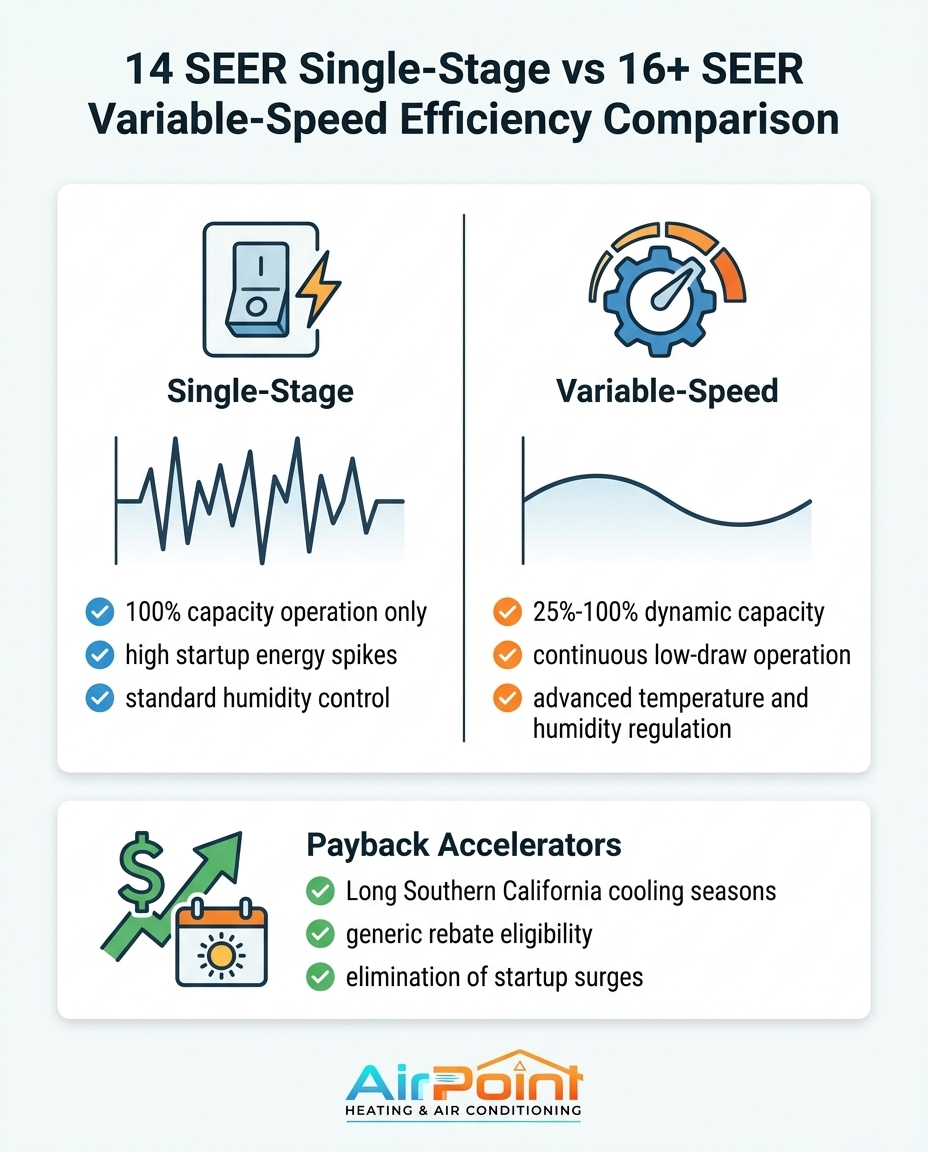
Comparing Efficiency: 14 SEER Single-Stage vs. 16+ SEER Variable-Speed
To calculate your specific time-to-break-even, you have to compare the baseline standard against the advanced technology. Currently, a 14 SEER (Seasonal Energy Efficiency Ratio) single-stage unit represents the older baseline for many homes, while 16+ SEER variable-speed systems represent the modern high-efficiency upgrade.
Understanding the SEER Jump
SEER is a measurement of cooling output over a typical cooling season divided by the total electrical energy input. A higher number means greater efficiency. However, the jump from a 14 SEER unit to a 16+ SEER system is magnified significantly when you add variable-speed compressor technology to the equation. The rating alone tells part of the story; the operational mechanics tell the rest.
If you are evaluating upgrading to 16 SEER in Southern California, a SEER savings calculator evaluates the percentage difference in energy consumption over a 10-to-15-year lifespan. The data consistently shows that the variable-speed functionality captures far more sustained savings than a single-stage unit with a similar numerical rating.
• Capacity Stages — 14 SEER Single-Stage: 100% On or 100% Off — 16+ SEER Variable-Speed: Dynamic (As low as 25% up to 100%)
• Energy Spikes — 14 SEER Single-Stage: High surges at every start-up cycle — 16+ SEER Variable-Speed: Minimal surges; continuous low-draw operation
• Humidity Control — 14 SEER Single-Stage: Standard (only dehumidifies while actively cooling) — 16+ SEER Variable-Speed: Advanced (continuous air movement extracts more moisture)
• Temperature Swings — 14 SEER Single-Stage: Noticeable 3-4 degree fluctuations — 16+ SEER Variable-Speed: Precise control within 0.5 degrees of target
• Payback Acceleration — 14 SEER Single-Stage: Slow (limited by high operational draw) — 16+ SEER Variable-Speed: Fast (driven by long hours at low capacity)
The Impact of August Late-Summer Heatwaves on Your Break-Even Point
Timing plays a crucial role in how quickly you begin to see a return on your investment. August late-summer heatwaves place immense stress on aging, inefficient systems. This is the time of year when older compressors draw the most power, struggle the hardest to keep up, and are most likely to fail entirely.
A recent case during a summer heatwave involved a homeowner whose older AC began making loud, high-pitched noises before the fan stopped turning entirely. The system was essentially burning up under the intense late-summer load. After a quick diagnosis, a new, highly efficient condensing unit and additional intake vents were installed. The immediate outcome was a house that cooled down significantly faster, with a unit that operated quietly and provided vastly improved airflow.
Replacing a failing unit during this late-summer transition means you immediately start capturing peak-season energy savings. Variable-speed units handle sudden peak cooling demands efficiently without the massive energy spikes that older units require to fight through a heatwave.
Why late-summer replacements accelerate ROI:
• Immediate peak-load reduction: You stop paying the high energy penalty of a struggling, inefficient system during the hottest weeks of the year.
• End-of-season efficiency gains: As the intense heat transitions into a moderate autumn, the new variable-speed unit immediately drops into its ultra-efficient low-capacity mode.
• Avoiding emergency breakdowns: Upgrading before a total catastrophic failure allows you to make a calculated, data-driven decision rather than a panicked purchase.
Measuring Non-Monetary ROI: Comfort and Temperature Regulation
While the mathematical time-to-break-even is critical, true payback is not just about utility percentages. The quality-of-life improvements provided by variable-speed compressor technology represent an immediate, day-one return on your investment that a spreadsheet cannot fully capture.
A typical pattern we see is uneven cooling, like a recent situation where a family's upper level remained stubbornly warmer than the rest of the house due to an aging AC and heater system. By completing a full system replacement that included updated ducting, zoning, and a second thermostat alongside the high-efficiency equipment, the home achieved wonderful, perfectly regulated temperatures throughout every room.
Eliminating Temperature Swings
Standard single-stage units create a very noticeable cycle: a loud blast of freezing air, followed by a period of stuffiness as the unit shuts off and waits for the house to warm up again. Variable-speed technology prevents this completely. Because the system runs almost continuously at a very low speed, it constantly circulates the air.
The non-monetary returns of continuous circulation:
• Passive dehumidification: Longer run cycles pull significantly more moisture out of the indoor air, making the home feel cooler even at higher thermostat settings.
• Improved air quality: Because the air is constantly moving through your filtration system, dust, allergens, and pet dander are captured much more effectively.
• Drastic noise reduction: Variable-speed compressors operate at a fraction of the decibel level of traditional clunky compressors. You often have to stand right next to the outdoor unit to even hear if it is running.
Accelerating Your Payback Period with High-Efficiency Incentives
The initial barrier to entry for high-efficiency equipment is naturally higher than standard builder-grade units. However, there are several financial levers available that reduce that initial investment, which mathematically shortens your time-to-break-even.
Qualifying high-efficiency variable-speed installations may be eligible for generic federal tax credits or local utility rebates. These programs are designed specifically to incentivize homeowners to reduce their overall energy footprint. By lowering the initial out-of-pocket investment through these programs, the percentage-based savings generated by the equipment cover the remaining cost much faster. We always advise readers to verify current, up-to-date programs with their utility provider or a qualified tax professional, as program eligibility and requirements shift periodically.
AirPoint Heating & Air Conditioning utilizes a transparent, data-driven approach to helping customers calculate realistic ROI without aggressive upselling. We believe in empowering homeowners to make informed financial choices based on how the equipment will actually perform in Los Alamitos and coastal-adjacent Southern California.
Additionally, utilizing HVAC financing options can perfectly align your monthly efficiency savings with manageable payments. When the monthly reduction in your energy consumption offsets a significant portion of the financing payment, the upgrade becomes a logical, cash-flow-friendly decision rather than a burdensome expense.
Frequently Asked Questions About Variable-Speed Upgrades
How long does it take for a high efficiency AC to pay for itself?
The payback period typically ranges between five to eight years, depending heavily on your local climate and usage habits. In Southern California, the long cooling season accelerates this timeline because the unit runs efficiently for more months out of the year. By utilizing continuous low-capacity operation, the percentage of energy saved each month aggregates quickly. Proper maintenance and taking advantage of available efficiency rebates can shorten this break-even point even further.
How much energy does a variable speed compressor save?
A variable-speed compressor can reduce your cooling energy consumption by up to 30% to 50% compared to an older, single-stage standard unit. Because it operates at lower capacities (often around 25% to 30% of its maximum output) for the majority of the day, it avoids the massive electrical spikes required to constantly start and stop a traditional system. This sustained, low-draw operation is the primary reason the efficiency percentages are so favorable.
Is a variable speed AC worth the extra investment in Southern California?
Yes, the regional climate makes variable-speed technology particularly advantageous. Because Southern California experiences long, moderate cooling seasons rather than short, extreme summers, the system spends thousands of hours operating in its most efficient, low-speed zone. This maximizes the energy reduction percentages over the life of the unit, making the return on investment much faster here than in colder, northern climates.
Does a variable speed AC run all the time?
It runs nearly continuously, but that is exactly how it is designed to operate efficiently. Instead of blasting at 100% capacity and then shutting off entirely, it runs at a very low, quiet speed to maintain an exact temperature. This continuous operation uses significantly less electricity than a system that constantly surges to turn on and off, much like how a car gets better gas mileage cruising on the highway compared to stop-and-go city traffic.
How does variable-speed technology improve indoor humidity control?
The extended, low-speed run cycles pull significantly more moisture out of the indoor air than a standard unit. Because a single-stage unit cools the house quickly and shuts off, it doesn't run long enough to effectively dehumidify the space. A variable-speed unit constantly moves air over the cold indoor coil, providing excellent passive dehumidification that makes your home feel vastly more comfortable.
Can upgrading from 14 SEER to 16 SEER make a noticeable difference in comfort?
The difference in comfort is immediate and highly noticeable, especially when that 16 SEER rating is paired with variable-speed technology. You will experience the elimination of hot and cold spots, a massive reduction in operational noise, and a steady, regulated temperature throughout the house. The upgrade transforms the system from a simple cooling box into a comprehensive indoor climate control solution.
Make a Data-Driven Upgrade Decision for Your Home
The true payback of a variable-speed unit in Southern California is measured in sustained efficiency, reduced monthly energy consumption, and unmatched indoor comfort. Relying on generic national calculators will only give you a fraction of the picture. When you factor in our long, moderate cooling seasons and the specific mechanical advantages of low-capacity operation, the time-to-break-even becomes a highly attractive metric.
Replacing a failing, inefficient system before or during August late-summer heatwaves is a strategic move that immediately captures peak-season energy savings while protecting your home from emergency breakdowns. You do not have to navigate these technical comparisons alone. It is time to schedule an HVAC consultation to get a transparent, customized efficiency evaluation for your specific home. By securing a clear, non-monetary framework for evaluating long-term energy savings, you can confidently make an upgrade decision that delivers total comfort and long-term peace of mind.
Other Blogs
Latest Blog Posts
The Essential Fall Home Maintenance Checklist: Decoding HVAC Startup Smells

Finding Your Efficiency Sweet Spot: Using a SEER Savings Calculator for HVAC Upgrades

Common Homeowner Questions Answered: Why Does My Heater Smell Like Burning Dust?

Customer Testimonials



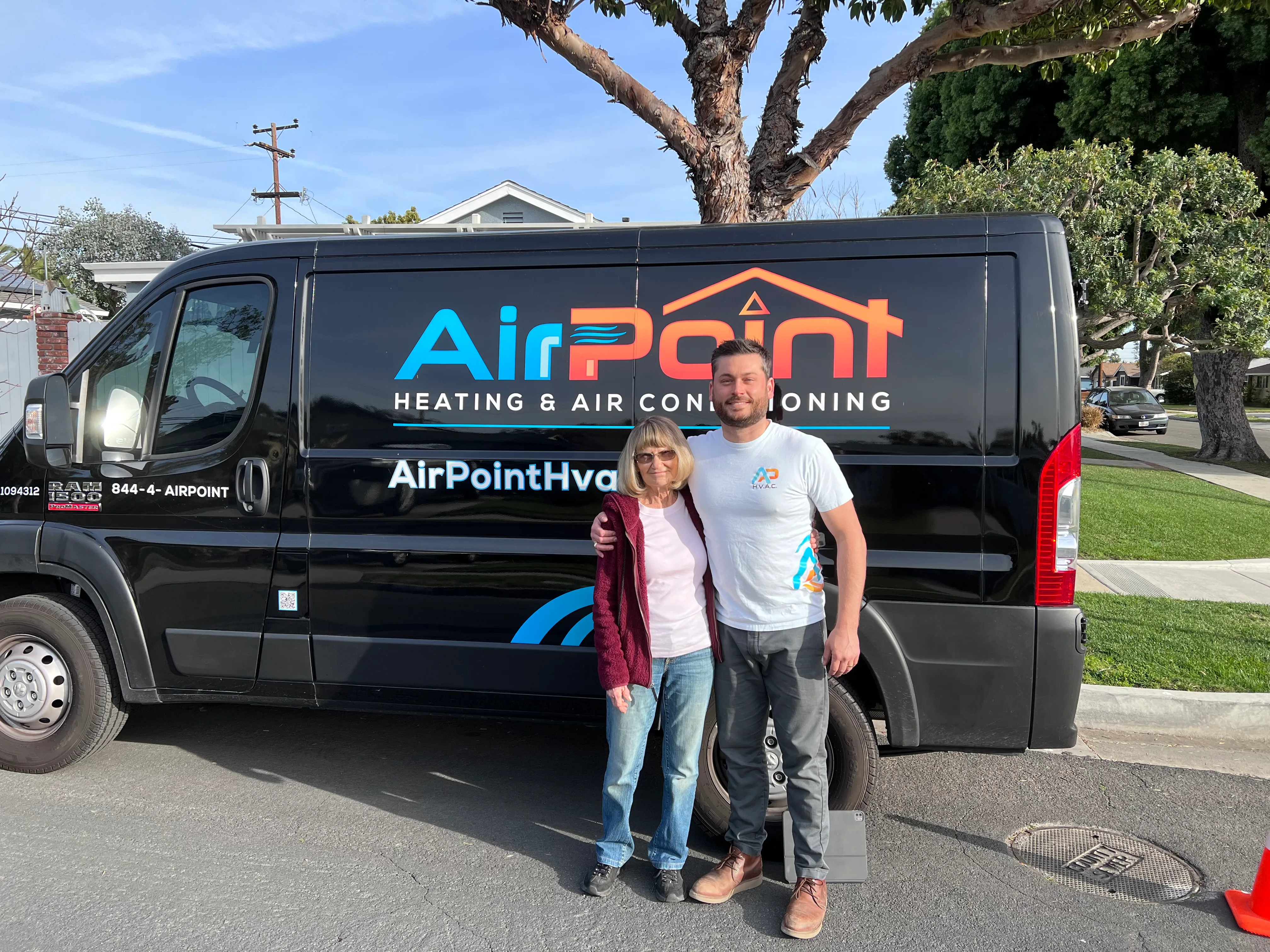
I recommend Air Point for your HVAC needs."