





How Much Does a High Efficiency System Save — Quick Answer for Orange County Homeowners
How much does a high efficiency system save is one of the most important questions you can ask before replacing your HVAC equipment — and the short answer is: quite a bit, depending on what you're starting with.
Here's a quick breakdown of realistic annual savings by upgrade type:
| Upgrade | Estimated Annual Savings |
|---|---|
| 80% to 96% AFUE furnace | $200–$260/year on heating |
| 10 SEER to 15 SEER2 AC | ~33% reduction in cooling costs |
| 14 SEER2 to 18 SEER2 AC | ~28% less electricity for cooling |
| Full system upgrade (heating + cooling) | 30–50% total HVAC bill reduction |
| Smart thermostat added to any upgrade | Additional 10–15% savings |
Nearly half of your home's energy bill goes toward heating and cooling. For most households, that's over $1,000 a year spent just keeping things comfortable. When your system is aging — especially if it's more than 10–15 years old — a large chunk of that money is being wasted on inefficiency rather than actual comfort.
In Los Alamitos and across Orange County, where summer cooling loads run high and families depend on reliable year-round comfort, upgrading to a high-efficiency system isn't just about saving money. It's about getting consistent temperatures, better air quality, and peace of mind knowing your equipment isn't working harder than it needs to.
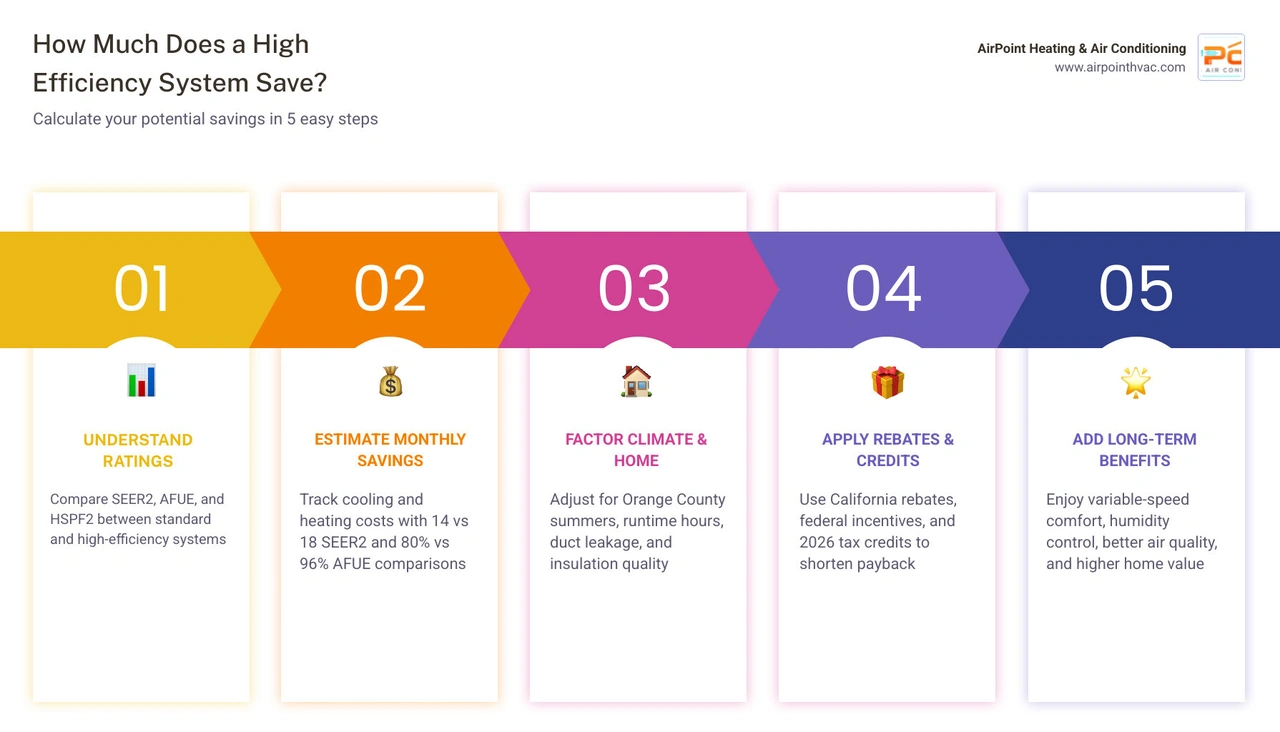
This guide walks you through exactly how to calculate your potential savings in five straightforward steps — no guesswork required.
Step 1: Understand the Difference Between Standard and High-Efficiency Systems
To calculate how much you will save, we first have to look at the ratings stamped on your equipment. In June 2026, the industry relies on standardized metrics to measure performance.
- SEER2 (Seasonal Energy Efficiency Ratio 2): This measures the cooling efficiency of your air conditioner or heat pump over a typical cooling season. The "2" indicates the updated, more rigorous testing protocols that reflect real-world ductwork resistance. Standard systems start at 13.4 or 14 SEER2, whereas high-efficiency units reach 18 to 22+ SEER2.
- AFUE (Annual Fuel Utilization Efficiency): This measures how efficiently a gas furnace converts fuel into heat. A standard-efficiency furnace has an 80% AFUE, meaning 80% of the gas becomes heat while 20% escapes through the chimney. High-efficiency furnaces run from 95% to nearly 98.5% AFUE.
- HSPF2 (Heating Seasonal Performance Factor 2): This measures the heating efficiency of a heat pump over the colder months. Standard systems hover around 7.5 HSPF2, while high-efficiency models climb past 10 HSPF2.
The technological leap between standard and high efficiency is significant. Standard 80% AFUE furnaces use a single heat exchanger to warm your air. High-efficiency systems, often called condensing furnaces, utilize a secondary heat exchanger. This secondary chamber captures latent heat from the exhaust gases, cooling them until they condense into water.
When it comes to air conditioning, standard systems use basic single-stage compressors that turn fully on or fully off. High-efficiency systems utilize variable-speed or modulating technology to run continuously at lower, energy-saving speeds. If you are debating whether the initial investment is worth it, reading about whether Is a High Efficiency System Worth the Extra Cost can help clarify how these mechanical differences translate into long-term financial benefits.

Step 2: Determine How Much Does a High Efficiency System Save on Your Monthly Bills
Now let's dive into the math. To determine how much does a high efficiency system save on your utility bills, we compare the efficiency ratings of your current system against your potential upgrade.
For heating, a 97% AFUE furnace returns 97 cents of every dollar spent on gas as heat, compared to just 80 cents for an 80% AFUE model. That means you instantly save 17 cents on every single dollar spent on heating. Upgrading from an 80% to a 96% AFUE furnace cuts heating bills by 16% to 20%, keeping roughly $200 to $260 in your pocket annually.
For cooling, the savings are even more dramatic in Southern California. Upgrading from an older 10 SEER AC to a 15 SEER2 unit creates roughly a 33% annual savings on cooling costs. If you leap from a standard 14 SEER2 to a high-efficiency 18 SEER2 system, you cut your cooling electricity consumption by approximately 28%.
To keep these savings intact over the years, maintenance plays a key role. Neglected systems degrade quickly, which is why understanding the AC Maintenance Impact on Energy Bills is essential to protecting your calculated ROI.
| System Type | Standard Efficiency | High Efficiency | Estimated Consumption Reduction |
|---|---|---|---|
| Gas Furnace | 80% AFUE | 96% AFUE | 16% – 20% less gas used |
| Air Conditioner | 14 SEER2 | 18 SEER2 | ~28% less electricity used |
| Heat Pump (Heating) | 7.5 HSPF2 | 10+ HSPF2 | 20% – 30% less electricity used |
Step 3: Factor in Your Local Climate and Home Dynamics
The math on paper is a great starting point, but real-world performance depends heavily on where you live and the condition of your home.
In our Southern California service areas — from the coastal breezes of Newport Beach, Seal Beach, and Huntington Beach to the warmer inland climates of Irvine, Yorba Linda, and Fullerton — we experience long, warm summers. High-efficiency air conditioners or heat pumps provide substantial savings here because of the sheer volume of cooling runtime hours.
However, even the most efficient 20 SEER2 air conditioner will struggle to save you money if your home has structural issues. The primary culprits of efficiency loss include:
- Duct Leakage: Leaky ductwork can waste 20% to 30% of your conditioned air by venting it into your attic or crawlspace. It also pulls dusty attic air into your living spaces.
- Poor Insulation: Thin attic insulation allows heat to seep into your home during hot summer afternoons, forcing your system to run longer.
- Improper System Sizing: If a system is too large, it will cycle on and off rapidly (short-cycling), which wastes energy and places mechanical stress on the compressor. If it is too small, it will run constantly without cooling your home.
Before we install any upgrade, we perform a professional Manual J load calculation to ensure your new system is sized perfectly for your home's unique footprint. If you are considering transitioning away from gas entirely, understanding how clean electric heating performs in our climate is a great next step; you can read more about Heat Pump Efficiency to see if it fits your household goals.
Step 4: Apply Utility Rebates and Tax Credits to Your Payback Period
The payback period is the time it takes for your monthly utility savings to offset the higher upfront cost of a high-efficiency system. Under normal circumstances, this payback period ranges from 5 to 12 years. However, you can dramatically shorten this timeline by taking advantage of financial incentives.
Because high-efficiency and ENERGY STAR qualified systems reduce demand on the electrical grid, local utilities and government programs offer excellent financial offsets. These include:
- Local Utility Rebates: Southern California utility companies frequently offer rebates for upgrading to high-efficiency central air conditioners, gas furnaces, and heat pumps.
- Federal Tax Credits: Under current standards, qualifying high-efficiency heat pumps and air conditioners may qualify for federal tax credits, reducing your tax liability.
- State Programs: California continues to run specialized programs designed to reward homeowners who transition to low-emission, highly efficient equipment.
By combining these incentives, you can lower the effective cost of your upgrade, bringing your payback period down significantly. To see what programs are currently active for your neighborhood, look through our guide on California Energy Rebates for HVAC Upgrades.
Step 5: Account for Long-Term Comfort and Maintenance Benefits
While lower utility bills are the most obvious benefit, high-efficiency systems offer several non-financial advantages that make a major difference in your day-to-day comfort.
Variable-Speed and Modulating Technology
Standard HVAC systems operate like a light switch — they are either 100% on or completely off. This leads to annoying temperature swings of 3 to 5 degrees. High-efficiency systems use variable-speed blower motors and modulating gas valves that operate more like cruise control. They run almost continuously at lower speeds (sometimes as low as 40% capacity), maintaining your indoor temperature within a half-degree of your thermostat setting.
Superior Humidity Control
Because variable-speed systems run longer, slower cycles, they excel at removing moisture from the air. In humid coastal cities like Laguna Beach or Long Beach, superior moisture control allows you to feel perfectly comfortable even when the thermostat is set a few degrees higher, saving you additional energy.
Quiet Operation and Indoor Air Quality
Because they don't constantly blast air at full speed, high-efficiency units are incredibly quiet. Additionally, the continuous, low-speed air movement means your air is constantly passing through your filtration system, removing dust, pollen, and pet dander far more effectively.
Increased Home Value
A modern, high-efficiency heating and cooling system is a major selling point. It reassures home inspectors and buyers that the home has been well-maintained and will cost less to run. To see how this affects your property's equity, read about How a New HVAC System Increases Home Value. That protecting this investment requires consistent care; you can explore Why Regular AC Maintenance is Crucial to ensure your system runs smoothly for its entire 15-to-20-year lifespan.
Frequently Asked Questions About Energy-Efficient HVAC Upgrades
How much does a high efficiency system save compared to an older unit?
If you are replacing a system that is 10 to 15 years old, the savings are substantial. Older systems typically operate at around 10 SEER or lower due to age-related wear and tear. Upgrading from a 10 SEER unit to an 18 SEER2 high-efficiency system can reduce your cooling bills by 30% to 50%. For more information on how modern electric alternatives compare to older gas systems, read our breakdown of Energy Savings Heat Pump.
How much does a high efficiency system save in mild climates like Southern California?
Even in mild climates like Orange County, a high-efficiency system is highly beneficial. While our winters are gentle, our summers bring prolonged heatwaves, making cooling efficiency critical. Additionally, high-efficiency heat pumps are exceptionally well-suited for our climate because they handle both mild heating and heavy cooling needs with incredible efficiency. You can learn how to get the most out of these versatile systems by reading our guide on how to Optimize Heat Pump Efficiency.
Does a high-efficiency system require specialized maintenance?
Yes. High-efficiency condensing furnaces produce acidic wastewater during the combustion process, which must be safely drained away. Technicians must inspect these condensate drain lines and pumps during annual tune-ups to prevent water damage or system shutdowns. Regular filter changes and professional check-ups are vital to protect the advanced electronics and secondary heat exchangers in these units. To learn more about keeping your heating system in top shape, check out how Regular Heat Pump Maintenance Saves Money.
Conclusion
Calculating how much does a high efficiency system save is the first step toward a more comfortable, energy-efficient home. While the mechanical details can seem complex, the bottom line is simple: upgrading to high-efficiency equipment reduces waste, lowers your monthly bills, and provides unmatched indoor comfort.
At AirPoint Heating & Air Conditioning, we believe that comfort is happiness. As a family-owned, award-winning business serving Los Alamitos and surrounding Orange County communities, we provide honest communication, expert installations, and a 100% satisfaction guarantee.
Ready to stop wasting energy and start saving? Book your high-efficiency HVAC consultation with AirPoint Heating & Air Conditioning today for fast, reliable service!
Other Blogs
Latest Blog Posts

The Truth About Smart Thermostat Auto-Switch Features During Unpredictable Fall Weather
Why Coastal Long Beach Homes Often Need Different Heat Pump Defrost Cycles
Factoring in Heating Efficiency (HSPF) When Comparing Heat Pump Options in Fall

Customer Testimonials



I recommend Air Point for your HVAC needs."