







Why Coastal Homes and HVAC Mold Go Hand in Hand
How your HVAC system prevents mold near the coast comes down to three core functions: removing moisture from the air, maintaining steady airflow, and filtering out mold spores before they can settle and spread.
Quick answer — how your HVAC fights coastal mold:
- Dehumidification: Your AC pulls moisture out of warm air as it passes over cold evaporator coils, draining it safely away
- Airflow: Consistent circulation stops the stagnant, humid "dead zones" where mold takes hold
- Filtration: Quality air filters trap mold spores before they circulate through your living spaces
- Humidity control: A properly sized and maintained system keeps indoor humidity between 30% and 50% — the range where mold cannot grow
Most homeowners along the Orange County coast know that salty ocean air and marine layer humidity are part of the deal. What catches people off guard is that the very system designed to keep their home comfortable can quietly become a mold incubator when it is not properly maintained or configured for coastal conditions. Mold spores only need humidity above 70% and as little as 24 to 48 hours to establish a colony — and coastal mornings in Southern California regularly push outdoor humidity past 80%. When that air finds its way inside, your HVAC system is your first and most important line of defense.
The Science of How Your HVAC System Prevents Mold Near the Coast
To understand how your air conditioner protects your home in places like Huntington Beach or Newport Beach, we have to look at the difference between "feeling cool" and "being dry." In the HVAC world, we call this the difference between sensible cooling (lowering the temperature you see on the thermostat) and latent cooling (removing the moisture you feel on your skin).
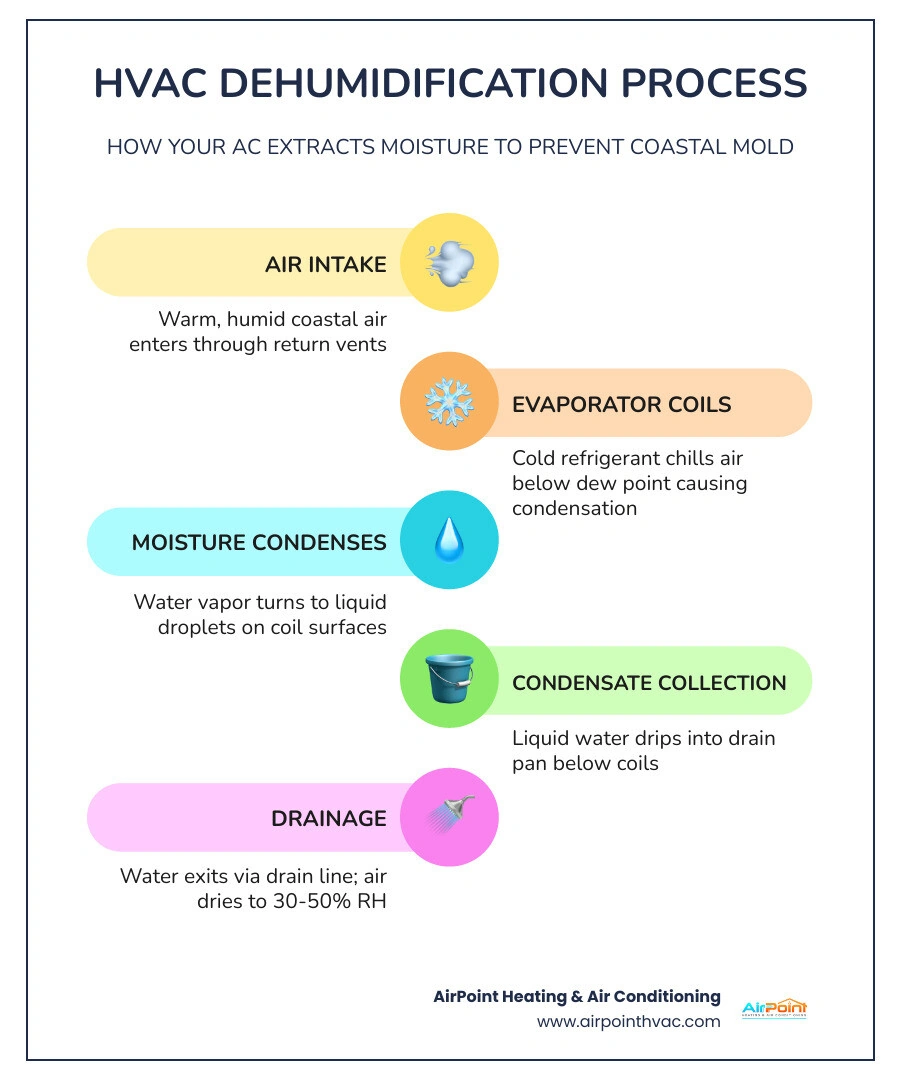
When your AC runs, warm, humid air from your home is sucked into the return vents and blown across the evaporator coils. These coils are filled with cold refrigerant. As the warm air hits the cold metal, the moisture in the air condenses into liquid water—much like the "sweat" on the outside of a cold glass of iced tea. This water drips into a condensate pan and flows out of your home through a drain line.
This process is the backbone of Indoor Air Quality. By removing those "pints" of water from the air, the system lowers the relative humidity. Our goal is always a target range of 30% to 50%. Once humidity climbs above 60%, mold begins to eye your drywall as a snack; above 70%, it’s a full-blown breeding ground.
| Feature | Sensible Cooling | Latent Cooling |
|---|---|---|
| Primary Goal | Lowering air temperature | Removing moisture (humidity) |
| Mechanism | Heat exchange via refrigerant | Condensation on evaporator coils |
| Comfort Result | Stops you from sweating | Stops the air from feeling "sticky" |
| Mold Impact | Minimal | Critical Prevention Tool |
How Your HVAC System Prevents Mold Near the Coast with Proper Airflow
Mold is a bit like a shy party guest; it loves quiet, dark corners where nobody is moving. Stagnant air zones—like the back of a closet, behind heavy furniture, or in a poorly ventilated attic—allow moisture to settle on surfaces.
Your HVAC system prevents this by keeping the air in a constant state of motion. When we design Indoor Air Quality Attic Ductwork for homes in Los Alamitos or Rossmoor, we focus on pressure balance. If your ductwork has leaks, it can create a vacuum effect, pulling moist, salt-laden air from the "marine layer" directly into your walls or attic. Proper airflow ensures that every cubic foot of air in your home eventually passes through the dehumidification and filtration cycle.
How Your HVAC System Prevents Mold Near the Coast via Filtration
Think of your air filter as a bouncer at the door. Mold spores are microscopic and are always present in the outdoor air. In humid coastal environments, these spores are looking for a damp surface to land on and start a colony.
Using the Best Air Filter for Homes Near the Coast is essential. We often recommend filters with a MERV 13 rating for coastal residents. These are dense enough to trap microscopic mold spores and even smog particles from the marine layer without over-stressing your system's motor.
However, a filter only works if it's clean. Understanding How Air Filters Impact Your HVAC System is key: a clogged filter restricts airflow, which can cause your evaporator coils to freeze. When that ice melts, it creates the exact kind of standing water mold loves. Near the ocean, we recommend a 30-60 day replacement cycle because the salt and moisture can cause filters to "cake" faster than they would inland.
Why Coastal California Homes Face Unique Mold Risks
Living in Seal Beach or Laguna Beach is a dream, but your HVAC unit might disagree. The primary culprit is salt air corrosion. Salt is hygroscopic, meaning it attracts water. When salt spray settles on your outdoor condenser fins, it triggers an electrolytic reaction—basically a slow-motion battery effect that eats away at the aluminum and copper.
This corrosion doesn't just shorten the lifespan of your unit; it creates tiny pits and leaks. These leaks can lead to low refrigerant levels, which prevents the system from performing that crucial "latent cooling" we mentioned earlier. If your system can't dehumidify, your indoor air stays above that dangerous 70% humidity threshold.

We also deal with unique "diurnal temperature swings" along the coast. It might be 65°F and foggy in the morning (100% humidity!) and 80°F by the afternoon. This rapid change can cause "flash rust" on furnace components and condensation inside ductwork if the system isn't calibrated correctly. You can learn more about these specific challenges in our guide on How Coastal California Climate Affects Your HVAC System.
Critical Maintenance for Humid Environments
If you want to keep the "dirty sock syndrome" (that musty, moldy smell) out of your home, maintenance isn't optional—it's a requirement.
One of the most important tasks we perform during our Ultimate HVAC Maintenance Tips Coastal California visits is flushing the condensate drain line. In high-humidity areas, algae and "slime" can grow inside these pipes, leading to a backup. A single clogged drain line can cause thousands of dollars in water damage and mold growth in your floors or ceilings.
We recommend biannual inspections for all our coastal neighbors. During these visits, we:
- Clean the Evaporator Coils: Removing the dust that acts as "food" for mold.
- Check Refrigerant Levels: Ensuring the system can actually pull moisture from the air.
- Inspect Duct Integrity: Making sure you aren't sucking in humid air from the crawlspace.
- Evaluate Filtration: Reviewing Air Filter Types and MERV Ratings Explained to ensure you have the right protection for the season.
Advanced Upgrades: UV Lights and Dehumidifiers
Sometimes, a standard AC unit needs a little help to win the war against coastal humidity. This is where advanced indoor air quality (IAQ) technology comes in.
- UV-C Lamps: These are installed inside your air handler, right next to the evaporator coil. They emit a specific wavelength of light that "scrambles" the DNA of mold spores and bacteria. If a spore tries to settle on your damp coil, the UV light neutralizes it before it can reproduce.
- Whole-Home Dehumidifiers: In the "shoulder seasons"—those weeks in May or October when it's not hot enough to run the AC but the air feels like a wet blanket—a dedicated dehumidifier is a lifesaver. It pulls moisture from the air without over-cooling your home.
- Variable-Speed Air Handlers: Unlike older systems that are either "on" or "off," variable-speed systems can run at a lower, steadier pace. This allows them to circulate air longer, which means more time for the coils to pull moisture out of the air.
- Antimicrobial Coatings: For homes right on the sand, we can apply specialized coatings to the coils to prevent both salt corrosion and organic growth.
To see which of these might be right for your home, check out our guide on how to Enhance Indoor Air Quality Air Purifiers.
Smart Settings for Seal Beach and Newport Beach Residents
How you use your thermostat can actually determine whether mold grows in your system. One of the biggest mistakes we see is homeowners setting the thermostat fan to "ON" instead of "AUTO."
When the fan is "ON," it blows air constantly, even when the cooling cycle is over. This sounds like a good idea for airflow, but there’s a catch: the evaporator coils are still soaking wet from the previous cycle. By blowing air over those wet coils without the cooling on, you are actually "re-evaporating" all that water back into your home! Always keep your fan on AUTO to allow the water to drain away properly.
For those looking for the most efficient way to manage coastal air, Heat Pump Benefits for Coastal California Homeowners include superior dehumidification logic. And when the Santa Ana Winds HVAC Guide comes into play, bringing hot, dry air, your system needs to be ready to switch gears from moisture removal to heavy-duty filtration.
The "74-Degree Oasis" Strategy: Many coastal residents find that if they keep their humidity at 45%, they feel more comfortable at 74°F than they would at 70°F with high humidity. This saves money and keeps the home too dry for mold to survive.
Frequently Asked Questions about Coastal HVAC Mold
Can my air conditioner kill existing mold colonies?
No. An air conditioner is a preventative tool, not a cure. While it can "starve" mold by removing the moisture it needs to grow, it cannot kill established colonies. If you see mold on your vents or smell a persistent musty odor, you need professional remediation and a deep system cleaning.
How often should I change my filters if I live within a mile of the ocean?
If you are within a mile of the Pacific, we recommend checking your filter every 30 days. The combination of salt spray, moisture, and fine coastal sand can clog a "90-day" filter in a fraction of the time, leading to restricted airflow and potential mold issues inside the air handler.
What are the early warning signs of mold in my ductwork?
Keep an eye (and nose) out for:
- A "wet dog" or "dirty sock" smell when the AC first turns on.
- Visible black or grey speckles around the edges of your supply vents.
- Increased allergy or asthma symptoms when you are inside the house.
- Clumping dust at the vent grates, which indicates high moisture levels in the air.
Conclusion
At AirPoint Heating & Air Conditioning, we know that your home is your sanctuary, and in Southern California, that sanctuary includes the fresh ocean breeze. But we also know that how your HVAC system prevents mold near the coast is the difference between a healthy home and a costly remediation project.
Whether you are in Los Alamitos, Huntington Beach, or Irvine, our family-owned team is here to ensure your air stays crisp, clean, and dry. From precision tune-ups to advanced Indoor Air Quality upgrades, we back everything we do with a 100% satisfaction guarantee.
Don't let the marine layer move into your living room. Book Now for fast, reliable service today!
Other Blogs
Latest Blog Posts
Fall Home Maintenance Tips: Troubleshooting Heating Odors and Using a SEER Savings Calculator
Home Maintenance Tips: Troubleshooting a Burning Smell During Your Fall Heating Startup
Home Maintenance Tips and Troubleshooting: Navigating Your First Fall Heater Startup

Customer Testimonials



I recommend Air Point for your HVAC needs."