






Why Knowing How Often to Replace Your HVAC Air Filter Can Save You Money and Headaches
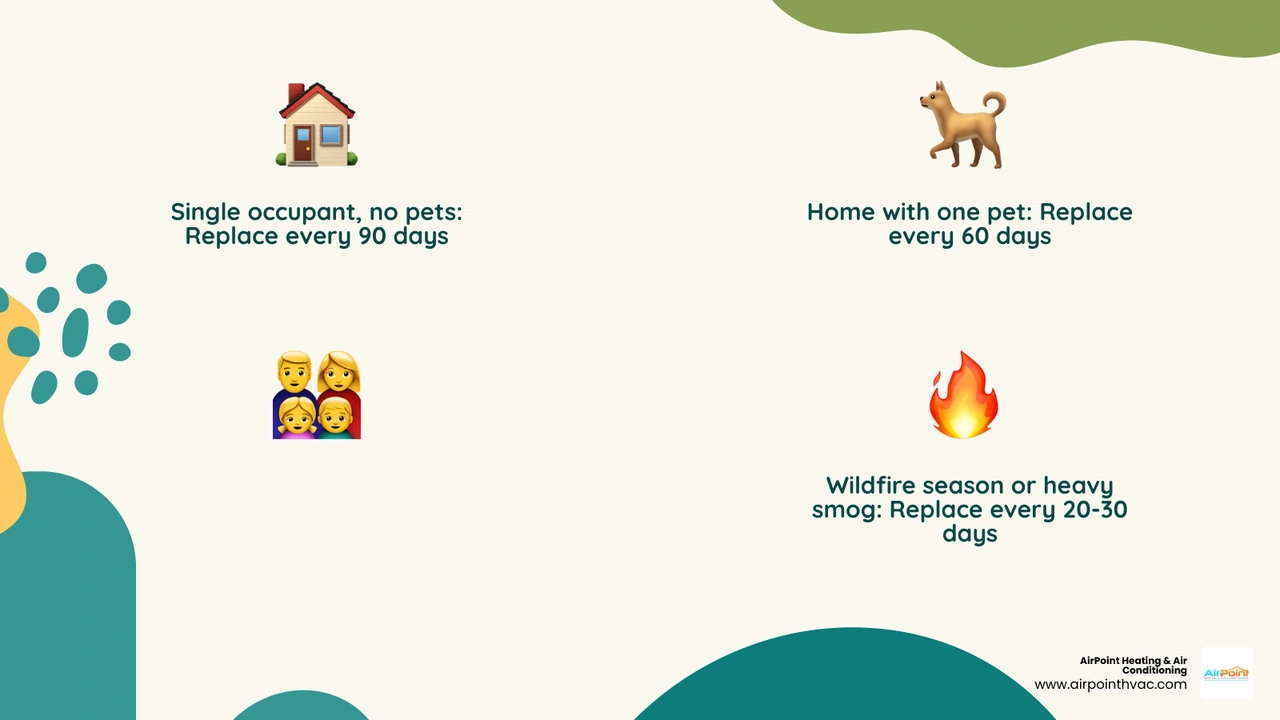
How often to replace your HVAC air filter depends on your home, but here is a quick reference to get you started:
| Household Type | Recommended Replacement Interval |
|---|---|
| Single occupant, no pets | Every 90 days |
| Average family home | Every 60-90 days |
| Home with one pet | Every 60 days |
| Home with multiple pets or allergies | Every 20-45 days |
| Wildfire season or heavy smog | Every 20-30 days |
| Vacation or rarely occupied home | Every 9-12 months |
| Fiberglass filter (any home) | Every 30 days or less |
| Thick 4-5 inch deep-pleat filter | Every 6-12 months |
Some home maintenance tasks are easy to forget — until something goes wrong. Your HVAC air filter is one of them. It quietly sits inside your system, trapping dust, pollen, pet dander, and mold spores every single day. When it gets clogged, your system works harder, your energy bills climb, and the air your family breathes gets worse. In fact, a dirty filter can push energy consumption up by 5 to 15%, and neglecting it long enough can lead to costly system damage.
The good news? Staying on top of filter replacements is one of the simplest and most affordable ways to protect your home comfort system and your family's health — especially here in the Los Alamitos area, where warm seasons, coastal air, and occasional wildfire smoke all put extra demands on your HVAC system.
This guide walks you through exactly how often to swap your filter, what factors change that timeline, and how to do it right.
How Often to Replace Your HVAC Air Filter: The General Rule
For the average Orange County home, the 90-day mark is the gold standard. If you live in a relatively dust-free environment without pets, changing your filter every three months keeps the air flowing smoothly. However, "average" is a loose term. During peak usage months—like our sweltering Southern California summers or those chilly January nights—your HVAC system runs almost constantly. More runtime means more air passing through the filter, which leads to faster debris accumulation.
We often recommend that homeowners in Los Alamitos, CA check their filters monthly during these peak seasons. If the filter looks gray or you can see a thick layer of "fuzz," it’s time for a swap, even if it hasn't been 90 days yet. A clogged filter creates airflow restriction, which is like trying to breathe through a straw while running a marathon. It strains your blower motor and can eventually lead to a total system breakdown. Always check your manufacturer recommendations, as some high-efficiency systems are designed for specific filter types that may have different lifespans.
How often to replace your HVAC air filter with pets
We love our furry friends, but they are the primary reason many households need to double their filter replacement frequency. Dogs and cats shed hair and release dander (microscopic skin flakes) that are light enough to stay airborne until they are sucked into your return vents. In a home with one pet, a 60-day interval is usually the sweet spot for maintaining healthy air.
If you are in South County, CA and share your home with multiple pets, that timeline drops significantly. Airborne fur can mat across the surface of a filter surprisingly fast, blocking air and forcing your system to work overtime. For multi-pet households, we suggest inspecting the filter every 20 to 30 days. Replacing it every 45 days ensures that pet odors don't linger and that your cooling system doesn't freeze up due to lack of air.
How often to replace your HVAC air filter during wildfire season
In recent years, outdoor air quality has become a major factor for residents in Yorba Linda, CA and surrounding areas. During wildfire season, the air is thick with smoke particles, ash, and heavy smog. Even if you keep your windows closed, these microscopic pollutants find their way inside.
During active wildfire events or periods of poor air quality, your HVAC filter becomes your primary line of defense. It can trap up to 80% or more of these contaminants, but it will clog much faster than usual. We recommend 20-day checks during these times. If the filter appears black or smells like smoke, replace it immediately to protect your indoor air quality and prevent ash from settling deep within your ductwork.
Key Factors Influencing Your Replacement Schedule
Beyond pets and smoke, several lifestyle factors dictate how often to replace your HVAC air filter.
- Home Occupancy: A house with five or six people naturally generates more dust, skin cells, and hair than a home with a single occupant. More people mean more movement, which keeps dust stirred up and moving toward the filter.
- Square Footage: Smaller homes often require more frequent filter changes because the total volume of air in the house is cycled through the system more often than in a sprawling estate.
- Allergy and Respiratory Health: If someone in your family suffers from asthma or seasonal allergies, you shouldn't wait for the filter to look dirty. For residents in Whittier, CA who struggle with pollen or dust mites, changing the filter every 20 to 45 days can provide significant relief from sneezing and congestion.
- Cleaning Habits: If you vacuum and dust frequently in Brea, CA, you are removing debris before the HVAC system can suck it up. Conversely, if you are doing home renovations, construction dust will clog a filter in a matter of days.
Understanding Filter Types and MERV Ratings
Not all filters are created equal. The "best" filter for your neighbor might be the wrong one for you. This is largely determined by the MERV (Minimum Efficiency Reporting Value) rating, which scales from 1 to 20 based on the size of particles the filter can trap.
- Fiberglass Filters (MERV 1-4): These are the thin, blue, or white "see-through" filters. They are designed primarily to protect the HVAC equipment from large dust bunnies, not to clean the air you breathe. They generally need to be changed every 30 days or less.
- Pleated Media Filters (MERV 8-11): These are the residential standard. They have a much larger surface area to trap particles like mold spores and pet dander. These typically last 90 days.
- High-Efficiency Filters (MERV 13-16): These are excellent for allergy sufferers but are thicker and can restrict airflow if your system isn't designed for them.
- HEPA Filtration: True HEPA filters trap 99.97% of particles but are usually only found in specialized whole-home air purifiers rather than standard furnace slots.
| Filter Type | Particle Capture | Typical Lifespan |
|---|---|---|
| 1-inch Fiberglass | Large dust, lint | 30 Days |
| 1-inch Pleated | Dust, pollen, dander | 60-90 Days |
| 4-5 inch Deep Pleat | Bacteria, smoke, fine dust | 6-12 Months |
| Carbon-Coated | Odors, VOCs, smoke | 3-6 Months |
In Cerritos, CA, many modern systems use 5-inch deep-pleat filters. These have significantly more "holding capacity" and can often last up to a full year. To learn more about how these choices affect your equipment, you can read about How Air Filters Impact Your HVAC System.
Signs It’s Time for an Immediate Swap
Sometimes, the calendar isn't the best guide. Your home will tell you when it’s time for a fresh filter. Keep an eye out for these red flags:
- Visible Graying: If you pull the filter and it looks like the lint trap of a dryer, it’s long overdue.
- Musty Odors: A dirty filter can trap moisture and organic matter, leading to a "stale" or "dirty sock" smell when the AC kicks on.
- Reduced Airflow: If the air coming out of your vents feels weaker than usual in Seal Beach, CA, the filter is likely choked with debris.
- Health Symptoms: Sudden sneezing fits or itchy eyes indoors are a sign that your filter is no longer capturing allergens.
- Longer Cooling Cycles: If your AC filter replacement in West Garden Grove, CA is neglected, the system will struggle to reach the set temperature, leading to non-stop running and higher bills.
The "Light Test" Method: This is the easiest way to check. Take your filter out and hold it up to a bright light or the sun. If you can clearly see light passing through the material, it still has some life left. If the light is blocked or looks very dim, the filter is full and needs to be replaced.
Step-by-Step Guide to Replacing Your Air Filter
Replacing your filter is a quick task that takes less than five minutes. Here is how we recommend doing it:
- Shut Down the System: Turn your HVAC system off at the thermostat. You don't want the fan to kick on while the filter is out, as this can suck raw dust directly into the sensitive internal components.
- Locate the Filter: Most filters are located in a slot on the side of the furnace/air handler or behind a large return air grille in a wall or ceiling.
- Check the Size: Look at the side of your old filter. You’ll see dimensions like "20x25x1." You must use the exact same size. If you are in Buena Park, CA and aren't sure which size you need, check your owner's manual.
- Note the Airflow Direction: This is the most common mistake! Look for an arrow on the filter frame. This arrow must point toward the HVAC unit (the direction the air is being sucked). Installing it backward reduces efficiency and can cause the filter to collapse.
- Secure the Housing: Ensure the cover or grille is snapped back into place firmly.
- Set a Reminder: Whether it's a recurring alert on your phone or a note on your Fullerton, CA wall calendar, schedule your next check now so you don't forget.
Frequently Asked Questions about Air Filters
Can I wash a disposable pleated filter?
No. Disposable filters are made of paper or specialized synthetic fibers designed for single use. Getting them wet will ruin their structural integrity and can lead to mold growth inside your HVAC system. If you want a reusable option, you must purchase a filter specifically labeled as "washable," though these generally trap fewer small particles than pleated disposables.
Does a higher MERV rating always mean a better filter?
Not necessarily. While a MERV 16 filter traps more than a MERV 8, it also creates more airflow resistance. If your blower motor isn't powerful enough to push air through a very dense filter, it will overheat and fail. For most residential homes, a MERV 8 to 11 provides the best balance of air filtration and system safety.
What happens if I never change my air filter?
Neglect leads to a "cascade of failure." First, your energy consumption spikes. Next, the lack of airflow can cause your evaporator coils to freeze into a block of ice. Finally, dust will bypass the clogged filter and settle on the fan motor and valves, leading to repairs that can cost thousands of dollars. In extreme cases, it can shorten the life of your entire system by years.
Conclusion
At AirPoint Heating & Air Conditioning, we believe that "comfort is happiness." Maintaining a regular schedule for your air filter swaps is the easiest way to ensure your home remains a sanctuary of clean, fresh air. Whether you are enjoying the coastal breeze in Newport Beach or the sunny days in Huntington Beach, your HVAC system deserves the protection that a clean filter provides.
Regular maintenance doesn't just prevent breakdowns; it ensures your system runs at peak efficiency, keeping your utility bills low and your family healthy. If you’ve noticed dust buildup, strange smells, or just can't remember the last time you saw your air filter, we are here to help. Our expert technicians can provide a precision tune-up and help you select the perfect filtration level for your specific needs.
Don't let a simple filter stand between you and a comfortable home. Schedule your professional indoor air quality assessment today for fast, reliable service across Orange County. Our family-owned team is ready to provide the honest, award-winning care you deserve.
Other Blogs
Latest Blog Posts
Why Is My Heater Smelling or Clicking? A Fall Startup Troubleshooting Guide
Why Does My Heater Smell Like Burning Dust? A Mid-Fall HVAC Repair Guide
HVAC Repair: Decoding Fall Furnace Smells and Startup Issues

Customer Testimonials



I recommend Air Point for your HVAC needs."