






How to Tell if Your Heat Pump's Reversing Valve is Stuck After a Long Summer
The Frustration of Cold Air on the First Cool Fall Evening
If you have your thermostat set to heat but vents blowing cold air, you are likely searching for how to tell if your heat pump's reversing valve is stuck after a long summer. It is incredibly frustrating to wait out the long, hot months, finally experience a crisp evening, and turn on the heat only to be met with a chilled breeze. When this happens, homeowners often wonder if their entire heating and cooling system has failed, or if they simply flipped the wrong switch on the wall. In our years of helping Los Alamitos residents, we find that it usually comes down to one specific component.
Here is the thing: heat pumps are remarkable machines that handle both cooling and heating, but they rely on a single, critical part to switch between the two modes. This component is called the reversing valve. When it works, your home transitions seamlessly from summer cooling to winter heating. When it fails, you are left shivering indoors. Fortunately, narrowing down the cause between a simple user error and a mechanical failure is straightforward when you know what to look for.
While dealing with a sudden lack of heat is stressful, our team at AirPoint Heating & Air Conditioning can quickly resolve these transition-season HVAC issues with a professional assessment. Understanding the basic mechanics of heat pump systems will help you communicate effectively with your technician and get your home comfortable again.
Why Prolonged Summer Cooling Causes Reversing Valves to Stick
To understand why your system is struggling during the early fall / September transition, it helps to look inside the equipment. The reversing valve is a clever mechanical device that physically reverses the flow of refrigerant through your system. In the summer, it directs hot refrigerant outside to dump heat. In the winter, it reverses that flow to bring heat inside.
The Mechanics of the Slider
Inside the brass body of the reversing valve is a small sliding mechanism, often made of specialized plastics like Teflon or nylon. This slider is shifted back and forth by changes in refrigerant pressure, which are controlled by a smaller component called a low-voltage solenoid coil. When the thermostat calls for a mode change, the solenoid energizes, shifting a pilot valve. This creates a pressure difference that forces the main slider to move from one side of the tube to the other.
The Toll of a Southern California Summer
Here in Los Alamitos and across Southern California, our technicians see firsthand how long, warm summers demand months of continuous cooling. This means the reversing valve sits in the exact same position, locked in cooling mode, for over half the year before being asked to move. Most modern heat pumps default to heating but are energized to stay in cooling mode throughout the summer.
When the valve sits stagnant for six to eight months, the internal lubrication can settle, and the physical slide mechanism can seize up. The internal seals may slightly bond to the brass casing. When you finally switch your thermostat to heat, the solenoid might try to shift the valve, but the physical slider remains jammed. This is a specific transition-season vulnerability, and it is a major reason why homeowners require professional heating services right as the weather begins to cool down. It does not necessarily mean your entire heat pump is broken; it just means a critical traffic cop inside the system is stuck.
Recognizing the Primary Symptoms of a Stuck Valve
If you have your thermostat set to heat but vents blowing cold air, the reversing valve is a prime suspect, but it is not the only possible culprit. Differentiating between a stuck valve, a refrigerant leak, or a simple control issue can save you time and stress.
The Most Obvious Signs
The most glaring symptom of a stuck reversing valve is a system that runs continuously but delivers air that is noticeably cooler than the ambient room temperature. The blower motor is working, the outdoor compressor is humming, but the physical heat transfer is happening in the wrong direction. Instead of warming your home, the system is actively cooling it.
Defrost Cycle Confusion
Another symptom involves the outdoor unit's defrost cycle. During normal winter operation, frost can build up on the outdoor coils. To melt this frost, the heat pump temporarily switches back into cooling mode (sending hot refrigerant outside). If the reversing valve is stuck, the system cannot initiate this defrost cycle properly, leading to a thick casing of ice on the outdoor unit as temperatures drop further into the season.
Differentiating from Other Failures
It is important to rule out other issues before assuming mechanical failure. A refrigerant leak, for example, will cause poor performance in both heating and cooling modes. If your system struggled to keep the house cool at the very end of summer, a leak is highly likely. However, if the system cooled perfectly yesterday but blows cold air on the heat setting today, the reversing valve is the most logical suspect. Before calling our team for help with common heat pump issues, you should also rule out simple thermostat misconfigurations.
• Air Temperature at Vents — Stuck Reversing Valve: Actively cold (cooling mode) — Refrigerant Leak: Lukewarm or room temperature — Thermostat Error: Varies (may just blow unconditioned air)
• Previous Mode Performance — Stuck Reversing Valve: Cooled perfectly all summer — Refrigerant Leak: Struggled in cooling mode as well — Thermostat Error: Worked fine until settings were changed
• Outdoor Unit Behavior — Stuck Reversing Valve: Compressor runs normally — Refrigerant Leak: Compressor runs constantly, may ice up — Thermostat Error: May not turn on at all
Safe Troubleshooting: 5 Checks You Can Perform
Before you panic about a major repair, there are several safe, non-invasive checks you can perform as a homeowner. These steps will help you confirm whether you have your thermostat set to heat but vents blowing cold air due to a simple oversight or a genuine mechanical failure.
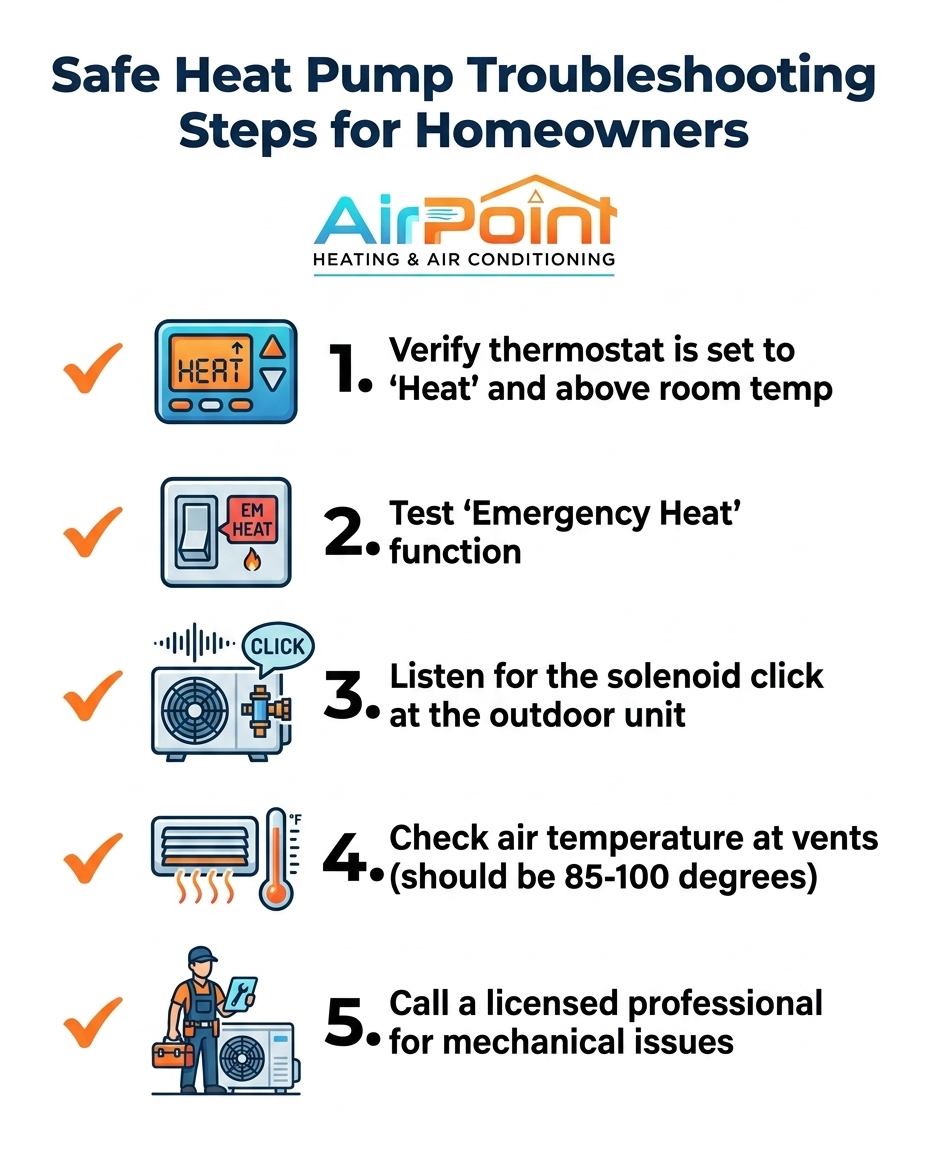
1. Verify the thermostat settings: Ensure the thermostat is explicitly set to "Heat" and not "Auto" or "Cool." Set the temperature setpoint at least 3 degrees above the current room temperature to force the system to call for heat.
2. Test the "Emergency Heat" function: If your thermostat has an "Emergency Heat" or "Aux Heat" setting, turn it on. This engages the backup electrical heat strips (if equipped) rather than the heat pump compressor. If warm air starts flowing, you know the blower and ductwork are fine, pointing the blame back to the outdoor heat pump unit.
3. Listen for the solenoid click: Have someone stand near the outdoor unit while you switch the thermostat from cool to heat (or vice versa). You should hear a distinct click as the solenoid energizes.
4. Feel the air temperature at the indoor vents: When functioning correctly in heat mode, a heat pump should produce air that is typically 85 to 100 degrees. If the air feels like a crisp breeze, the heat transfer process is failing.
5. Call a licensed HVAC professional: If you have verified the thermostat settings, heard the click (or heard nothing at all), and are still getting cold air, stop troubleshooting. Mechanical and high-voltage electrical failures require immediate professional intervention by our trained technicians.
Electrical vs. Mechanical: What the Solenoid Sound Means
When dealing with the early fall / September transition, understanding the acoustic clues your heat pump provides can be incredibly helpful. The reversing valve relies on two distinct systems working together: the electrical solenoid coil and the mechanical slide valve. Listening to the unit can tell you which half of the equation is failing.
Hearing the Click: Electrical Success, Mechanical Failure
The solenoid coil uses a magnetic field to move the internal pilot valve. When this happens, a healthy reversing valve makes a distinct "click" followed by a subtle "whoosh" sound as the pressurized refrigerant changes direction.
If you stand by the outdoor unit and hear a sharp click when the thermostat calls for heat, but the system still blows cold air, you have valuable diagnostic information. The click means the thermostat is successfully sending the low-voltage electrical signal to the unit, and the solenoid coil is energizing. The problem is almost certainly mechanical: the internal slide mechanism is physically jammed and cannot shift, despite the electrical command.
Silence at the Unit: Electrical Failure
Conversely, if you change the thermostat settings and hear absolutely nothing at the outdoor unit—no click, no hum, no whoosh—the issue might be electrical. The solenoid coil itself could be dead, a wire could be damaged, or the control board might be failing to send the signal.
During a routine pre-heating season tune-up last fall, one of our technicians thoroughly inspected a local customer's system and explained potential issues with aging components like the solenoid before the weather turned fully cold. This proactive approach gives homeowners confidence in their system's future performance, as they know what to listen for as the seasons change. If your system is silent when it should be clicking, an electrical diagnostic is the next necessary step.
Why Reversing Valve Replacement Requires a Professional
If diagnostics point to a mechanically stuck reversing valve during the early fall / September transition, you might wonder if this is a repair you can tackle yourself. The short answer is absolutely not. Replacing a reversing valve is one of the most complex and heavily regulated repairs in the HVAC industry, and it is a job we handle regularly at AirPoint Heating & Air Conditioning.
The Dangers of Refrigerant and High Heat
First and foremost, replacing a reversing valve requires recovering the system's refrigerant. Refrigerant is federally regulated, and it is illegal to vent it into the atmosphere. Our professional technicians use specialized recovery machines and tanks to safely extract the chemical before any physical repairs can begin.
Once the system is empty, the physical replacement begins. The repair involves un-brazing the old copper lines and re-brazing the new valve into place. This happens in incredibly tight spaces near sensitive components. A professional uses an oxy-acetylene torch that reaches thousands of degrees. Furthermore, they must wrap the new valve in wet rags or specialized heat-blocking putty while brazing; if the new valve gets too hot during installation, the internal Teflon seals will melt, ruining the brand-new component before it ever turns on.
The Value of Accurate Diagnostics
Diagnosing high-voltage electrical components safely requires proper licensing to avoid severe injury or further system damage. A professional technician will accurately determine if the valve is physically stuck, if the solenoid is dead, or if there is an underlying control board issue.
When a Los Alamitos homeowner's heater malfunctioned and stopped working entirely during a sudden temperature drop last fall, our professional technicians came out and repaired the system, restoring function efficiently on the very same day. This highlights AirPoint Heating & Air Conditioning's prompt, professional diagnostic capabilities for complex transition-season failures, ensuring accurate repairs without guesswork.
• Refrigerant Recovery: Safely and legally removing the existing charge.
• Nitrogen Purging: Flowing nitrogen through the pipes during brazing to prevent internal oxidation and soot buildup.
• Heat Control: Protecting the delicate internal sliding mechanism from torch heat.
• Vacuuming: Pulling a deep vacuum on the system to remove all moisture before recharging.
Frequently Asked Questions About Reversing Valves
Why is my heat pump blowing cold air when set to heat?
If you have your thermostat set to heat but vents blowing cold air, the system is likely stuck in cooling mode. This happens when the reversing valve, which directs the flow of hot and cold refrigerant, fails to shift positions. It can be caused by a dead electrical solenoid, a faulty thermostat, or a physical jam inside the valve itself after months of summer cooling.
How do you test a heat pump reversing valve?
A professional tests a heat pump reversing valve by first checking the electrical signals from the thermostat to the outdoor unit. They will measure the voltage at the solenoid coil to ensure it is receiving power. If the electrical side is functioning, they will monitor refrigerant pressures and listen for the physical click and whoosh of the valve shifting to determine if the internal slide is mechanically jammed.
What happens when a reversing valve gets stuck?
When a reversing valve gets stuck, the heat pump becomes locked in one operational mode, regardless of what the thermostat requests. If it sticks in the cooling position during the winter, the system will continue to blow cold air indoors and may eventually freeze up outside because it cannot initiate a proper defrost cycle.
What does a heat pump solenoid sound like?
A heat pump solenoid typically makes a distinct, sharp "click" sound when it receives an electrical signal to energize or de-energize. Immediately following this click, you will usually hear a swooshing or hissing sound as the pressurized refrigerant rapidly changes direction through the internal copper pipes.
Can a stuck reversing valve be unstuck without replacing it?
In some rare instances, tapping lightly on the body of the reversing valve with the handle of a screwdriver while the solenoid is energized can dislodge a stuck slider. However, this is almost always a temporary fix. Once the internal lubrication degrades or the physical casing warps enough to cause a jam, the valve will inevitably stick again and requires complete replacement.
Get Your Heat Pump Ready for the Heating Season
A heat pump blowing cold air during the early fall / September transition is a clear sign that your system needs professional attention. Ignoring the issue or hoping it will resolve itself will only lead to colder nights and unnecessary wear and tear on your outdoor compressor. Timely diagnostics by our team ensure that a minor electrical issue doesn't escalate, and that mechanical failures are addressed safely and legally.
As the weather continues to cool down, having a reliable heating system is vital for your home's comfort. Do not let a stuck reversing valve leave you shivering. It is time to schedule HVAC service for a comprehensive evaluation, giving you the peace of mind that your system is fully prepared for the heating season ahead.
Other Blogs
Latest Blog Posts

Finding Your Efficiency Sweet Spot: Using a SEER Savings Calculator for HVAC Upgrades

Common Homeowner Questions Answered: Why Does My Heater Smell Like Burning Dust?

The Essential Seasonal Home Maintenance Checklist: Decoding Fall HVAC Startup Smells and Sounds

Customer Testimonials



I recommend Air Point for your HVAC needs."