





Home Maintenance Tips and Troubleshooting: Navigating Your First Fall Heater Startup
October Temperature Drops: What to Expect When You Turn On the Heat
When preparing for the seasonal shift, applying the right home maintenance tips and troubleshooting strategies is the key to a smooth October / mid-fall heating startup. The arrival of autumn brings a welcome drop in temperatures, signaling that it is time to transition your home from cooling to heating mode. However, turning on the furnace for the very first time after a long period of dormancy often yields unexpected results. You might notice strange odors wafting through the vents or find that the system shuts off before the house actually feels warm. While these initial symptoms can be alarming, they are a common part of the seasonal transition.
In Southern California, our long, warm summers mean that your heater has likely been sitting completely dormant for six to eight months. During this extended off-season, dust naturally settles inside the ductwork, on the burners, and across the heat exchanger. Because the system has not cycled any warm air since early spring, our technicians at AirPoint Heating & Air Conditioning typically see that this first startup is much more eventful than a mid-winter heating cycle. Acknowledging this weather shift helps set proper expectations for what is normal and what requires further investigation.
If you are exploring the best ways to maintain your entire system, reviewing your air conditioning services alongside your heating needs provides a complete picture of your home's climate control health.
This initial heating run is the perfect opportunity to evaluate the overall health of your HVAC system. By paying close attention to how the unit sounds, smells, and operates during its first few cycles, you can catch minor issues before they develop into major mechanical failures. Assessing system performance now also gives you a baseline for efficiency, helping you plan for future upgrades or utilize efficiency calculators to project long-term energy savings.
The Initial Burning Smell: Normal Dust Burn-Off Explained
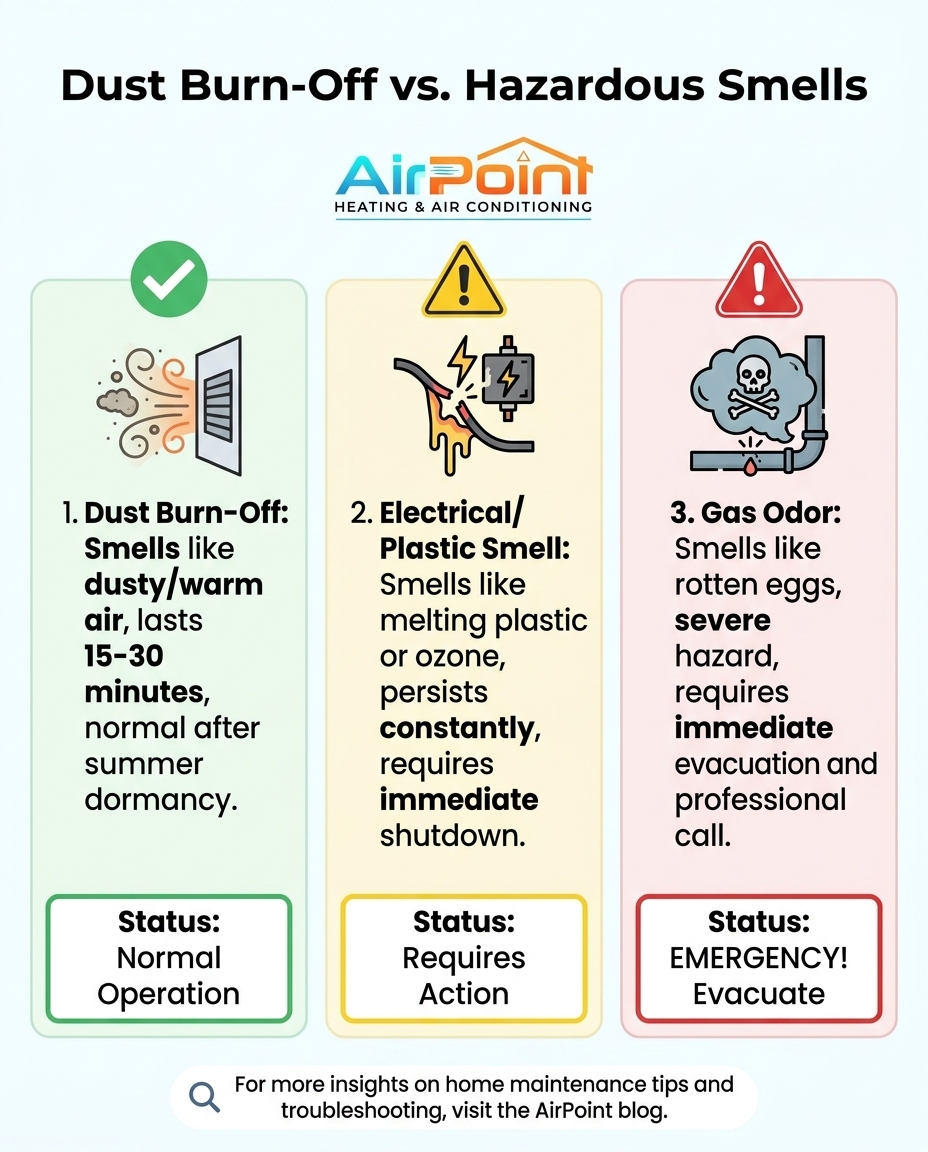
One of the most common concerns our team hears during an October / mid-fall heating startup is a distinct burning odor coming from the supply registers. If you experience this during the first cold evening of the year, we often reassure homeowners that the underlying problem is rarely a mechanical failure. Instead, the cause is almost always the natural accumulation of household dust.
Throughout the spring and summer, microscopic particles of dust, pet dander, and airborne debris settle onto the internal components of your furnace. The heat exchanger—the metal component responsible for transferring heat into the air—collects a thin layer of this material. When the burners ignite for the first time in months, the heat exchanger rapidly rises in temperature, literally incinerating the settled dust. This process creates a noticeable, sometimes pungent odor that mimics the smell of singed hair or warm dirt.
The Solution: The most effective way to handle normal dust burn-off is simple patience and temporary ventilation. You do not need to turn off the system if the smell matches the description of burning dust. Instead, open a few windows to allow fresh air to circulate through the home while the system completes its initial cycle.
To help you monitor the situation, here is a breakdown of what to expect during a normal burn-off phase:
• Dusty, warm odor — Normal Duration: 15 to 30 minutes — What It Means: Standard incineration of settled debris on the heat exchanger.
• Light haze near vents — Normal Duration: 1 to 2 heating cycles — What It Means: Microscopic particles being cleared from the immediate ductwork.
• Odor fades completely — Normal Duration: Within 1 hour of runtime — What It Means: The heat exchanger is clean and operating normally.
If the smell dissipates within this standard timeframe, your system is functioning exactly as designed for the start of the season.
Identifying Dangerous Odors: When to Shut Down the System
While dust burn-off is harmless, other odors indicate a severe malfunction that requires immediate attention. Distinguishing between a normal seasonal symptom and a genuine mechanical hazard is critical for protecting homes in Los Alamitos and the surrounding areas. At AirPoint Heating & Air Conditioning, our team prioritizes honest, transparent diagnostic advice over alarmist sales tactics, ensuring you know exactly when a situation is truly unsafe.
If you detect any of the following hazardous smells, the problem is not dust. These odors point to failing components, electrical shorts, or fuel leaks:
• Electrical ozone or burning wire: This acrid smell often resembles an overheated appliance or a blown fuse. It indicates that the blower motor is overheating, a wire casing is melting, or a circuit board is failing.
• Melting plastic or rubber: A sharp, chemical odor usually means a foreign object has fallen into the ductwork near the heat exchanger, or an internal rubber belt/component is actively deteriorating under stress.
• Persistent rotten eggs or sulfur: This is the universal warning sign of a natural gas leak. Natural gas is naturally odorless, but utility companies add a chemical called mercaptan to give it this distinct, foul smell for safety purposes.
If you encounter electrical, plastic, or gas odors, immediately shut off the heating system at the thermostat. In the case of a gas smell, evacuate the home and contact your local utility provider right away. For electrical or plastic odors, leave the system off and wait for a licensed technician.
Never attempt DIY electrical or mechanical diagnostics on a modern furnace. High-voltage components and combustible fuels require specialized training to handle safely. Maintaining a safety-first approach ensures your home remains secure while the underlying issue is properly identified and resolved.
Troubleshooting Short-Cycling During Your First Heating Run
Another frequent issue encountered during an October / mid-fall heating startup is a phenomenon known as short-cycling. This occurs when the furnace turns on, blows warm air for just a few minutes, and then abruptly shuts down before the home reaches the temperature set on the thermostat. The system will then wait a short period before repeating the process, continuously turning on and off in rapid succession.
The problem with short-cycling is twofold: it prevents your home from getting comfortable, and it places immense mechanical strain on the system's ignition components and blower motor. The leading cause of this behavior is severely restricted airflow, which is often the result of neglected maintenance during the heavy summer cooling months.
Inside your furnace is a safety device called the high limit switch. Its job is to monitor the temperature of the heat exchanger. If airflow is blocked, the heat generated by the burners cannot be pushed out into the ductwork. The heat exchanger rapidly overheats, and the high limit switch triggers an emergency shutdown to prevent a fire hazard or a cracked heat exchanger. Once the metal cools down, the system tries to run again, creating the continuous short-cycling loop.
The Solution: Addressing this early is a vital part of seasonal troubleshooting. Because the system is actively protecting itself from overheating, you must identify and remove the airflow restriction. Often, the restriction is external to the furnace itself—stemming from clogged filters, blocked registers, or closed dampers that were adjusted during the summer and forgotten.
Safe Airflow and Thermostat Checks for Homeowners
Before assuming your heater requires a major mechanical repair, there are several safe, actionable maintenance steps you can perform. These checks do not cross the line into professional-only work, but they resolve a surprising number of startup issues. In our years of servicing homes in Los Alamitos, where coastal breezes can bring in extra dust and particulate matter year-round, our team finds these steps are especially relevant.
Follow this checklist to verify your system has the basic requirements to operate correctly:
• Verify thermostat settings: Ensure the thermostat is explicitly switched to the "Heat" position. Simply turning up the temperature while the system is still set to "Cool" or "Auto" will not engage the furnace. Set the target temperature at least three to five degrees higher than the current room temperature to force a cycle.
• Inspect and replace the air filter: A heavily soiled filter acts like a solid wall, choking the blower motor and causing the high limit switch to trip. If the filter is gray, opaque, or visibly caked with dust, replace it immediately. Understanding air filter types and MERV ratings helps ensure you select a replacement that balances filtration with proper airflow.
• Clear all supply and return vents: Walk through every room in the house and verify that the supply registers (where air blows out) and return grilles (where air is pulled in) are fully open. Move any rugs, heavy drapes, or furniture that might be blocking these vents.
• Check the outdoor exhaust: If you have a high-efficiency condensing furnace, locate the PVC exhaust pipes on the exterior of your home. Ensure they are not blocked by fallen autumn leaves, overgrown shrubs, or debris, as a blocked exhaust will trigger a safety shutdown.
By completing these basic home maintenance tips and troubleshooting steps, you eliminate the most common external causes of heating failures, ensuring your system has the unobstructed airflow it needs to function.
Why a Failing Heater Warrants a Full HVAC Efficiency Evaluation
If basic airflow checks do not resolve your heating issues, you may be dealing with a more significant mechanical decline. Because your heating and cooling systems operate in tandem—often sharing the exact same blower motor, internal cabinet, and ductwork network—a failing older heater is a strong indicator that the entire HVAC system requires a comprehensive evaluation.
Older, run-down units with deteriorating components do not just struggle in the winter; they waste a tremendous amount of energy year-round. For example, during a preventative winter maintenance check on a very old, rundown HVAC unit with a leaky compressor, addressing deteriorating coolant pipe wrap and topping off refrigerant can improve the system's efficiency significantly. However, when multiple components begin to fail simultaneously, repairing an out-of-date system may no longer be the most logical financial choice.
When facing major repairs on an aging unit, it is wise to calculate the long-term operational costs. Homeowners can use a SEER savings calculator to determine the true payback period of a full system upgrade. Comparing the high energy consumption of a failing unit against the streamlined performance of modern, high-efficiency equipment often reveals that replacement is more cost-effective than continuous patching.
Furthermore, exploring HVAC financing options can make proactive, full-system efficiency upgrades much more manageable for Los Alamitos homeowners. Rather than waiting for a complete breakdown in the middle of January, evaluating the entire system now allows for a planned, stress-free transition to reliable climate control.
The Connection Between Winter Repairs and Summer Cooling
Upgrading an older system resolves winter heating issues while simultaneously preparing the home for severe summer heatwaves. When a technician addresses leaky compressors or balances refrigerant levels during a cool-weather tune-up, the conversation naturally leads to long-term efficiency solutions. The blower motor that pushes warm air through your home today is the exact same motor that will distribute chilled air next August. If that motor is drawing excessive amperage or struggling to overcome static pressure now, it will likely fail when stressed by triple-digit summer temperatures. Upgrading the shared infrastructure ensures year-round reliability and opens the door to broadly applicable energy rebates and tax credits designed to reward high-efficiency installations.
When to Call a Professional for Your System Diagnostics
There is a distinct line between basic homeowner maintenance and the need for professional intervention. If you have replaced a dirty filter, cleared all vents, and verified your thermostat settings, yet the system continues to short-cycle or emit hazardous odors, professional service is absolutely required.
A licensed professional performs a comprehensive evaluation that goes far beyond surface-level checks. They utilize specialized diagnostic tools to measure the electrical draw of the blower motor, test the microfarad readings on capacitors, inspect the heat exchanger for microscopic cracks, and verify that gas pressures align with manufacturer specifications. They also evaluate complex ducting setups that are common in larger properties.
For instance, a pattern we see often in multi-level homes where the upper level remains significantly warmer than the rest of the house is that standard ducting is insufficient. In these scenarios, our technicians frequently recommend implementing ducting with zoning and a second thermostat to eliminate hot spots and regulate temperatures properly across all floors. Complex airflow dynamics cannot be resolved with a simple filter change.
To ensure your equipment operates safely and efficiently, it is highly recommended to schedule an AC evaluation alongside your heating inspection. Proper, professional maintenance protects homes in Los Alamitos from unexpected breakdowns and extends the viable lifespan of the equipment.
Making the Right Call for Your Home's Comfort and Safety
Navigating an October / mid-fall heating startup does not have to be a stressful experience. By understanding the clear difference between normal dust burn-off and hazardous electrical odors, you can approach the change of seasons with confidence and peace of mind. Applying foundational home maintenance tips and troubleshooting strategies—like checking filters and clearing vents—empowers you to resolve minor airflow issues safely on your own.
However, when symptoms persist, evaluating your system's health proactively prevents minor malfunctions from turning into mid-winter emergencies. A clear, non-alarmist understanding of your equipment's condition is the best defense against unexpected failures. If your system is struggling to keep up, reach out to our team for a transparent, honest evaluation of your heating and cooling needs to ensure your home remains comfortable and safe all year long.
Other Blogs
Latest Blog Posts
Common Homeowner Questions Answered: Is That Fall Heater Burning Smell Normal?
Common Homeowner Questions Answered: Why Does My Heater Smell Like Burning?
Why Is My Heater Smelling or Clicking? A Fall Startup Troubleshooting Guide

Customer Testimonials



I recommend Air Point for your HVAC needs."