





That Alarming Burning Smell During Your First Fall Startup
The first chilly October evening arrives, and as you switch the thermostat from cool to heat, an acrid burning odor suddenly fills the room—a scenario that our team at AirPoint Heating & Air Conditioning knows frequently tops the list of concerns for anyone researching home maintenance tips and troubleshooting. That initial blast of heated air can carry a sharp, unsettling scent that instantly puts homeowners on high alert. When a furnace has sat completely idle for half the year, firing it up for a mid-fall heating startup often produces this exact phenomenon. While your first instinct might be to panic and assume the unit is catching fire, not all odors indicate a critical mechanical failure.
Understanding the difference between normal seasonal behavior and a hazardous malfunction is a critical part of owning a home. A brief burning dust smell is incredibly common, but it is equally important to recognize when basic checks reach their limit and professional intervention becomes necessary. For comprehensive support, connecting with trusted HVAC services ensures that any underlying issues are caught before they turn into mid-winter emergencies.
The Science Behind Seasonal Dust Accumulation
The problem: Every heating system relies on a heat exchanger—a series of metal tubes or coils that get incredibly hot to warm the air passing over them. During the long cooling season, these heating elements sit dormant in the dark, damp environment of your HVAC cabinet.
The cause: In our years of keeping Los Alamitos homes comfortable, we've seen exactly how Southern California's long, dry summers eventually give way to the autumn Santa Ana winds. These weather patterns drastically increase the amount of indoor particulate matter circulating through your home. Dust mites, pet dander, microscopic skin cells, and textile fibers are constantly pulled into your return vents. While your filter catches the majority of this debris, micro-particles inevitably slip through and settle directly onto the cold, idle heat exchanger.
The solution: When the burners finally ignite for that mid-fall heating startup, the metal heat exchanger rapidly heats up to hundreds of degrees. The accumulated layer of organic particulate matter instantly incinerates. This physical process of burning off the settled debris is exactly what produces that distinct, dusty burning smell. It is a normal operational phase for standard residential units, and the best way to bypass it entirely is to schedule HVAC service for a thorough pre-season cleaning.
How Idle Systems Collect Debris
Even when the heat is off, your system's blower motor often continues to run to circulate air conditioning or simply filter the indoor air. This constant airflow means the return vents are perpetually pulling airborne dust into the ductwork. Standard residential air filters are highly effective, but they cannot catch 100% of microscopic particles over a continuous six-month idle period. As the air passes over the dormant heating elements, static electricity and minor condensation cause these tiny particles to cling to the metal surfaces, creating a fine, combustible layer just waiting for the first heating cycle.
The 30-Minute Rule: Normal Burn-Off vs. Cause for Concern
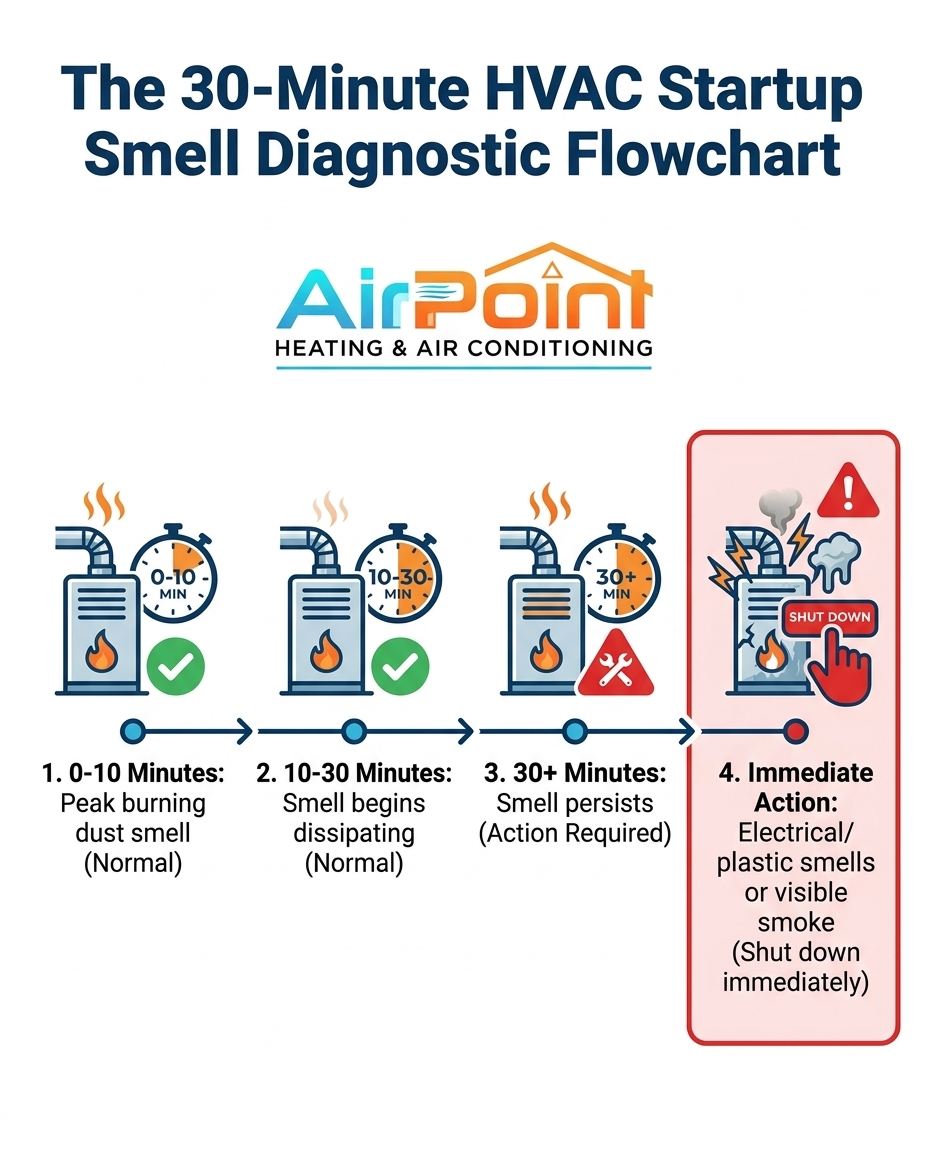
To safely evaluate the health of your heating system during its initial run, our technicians rely on a specific timeframe known as the 30-minute rule. This guideline helps homeowners monitor smell duration (under 30 minutes vs. continuous) to determine if the system is safe.
1. Note the ignition time: The moment you hear the burners ignite and the blower fan engage, check the clock. The burning dust smell should become noticeable within the first three to five minutes of operation.
2. Monitor the peak intensity: The odor will peak quickly as the heaviest layer of dust incinerates. You may want to crack a window during this brief window to help ventilate the rooms closest to the vents.
3. Watch for dissipation: Between the 10-minute and 20-minute mark, the smell should begin to noticeably fade. The system is pushing the last of the incinerated particulate matter out through the registers.
4. Enforce the 30-minute boundary: By the time the system has been running for half an hour, the air should smell completely normal. If the smell persists beyond 30 minutes, it transitions from a seasonal nuisance to a diagnostic warning. Continuous odors require immediate action to prevent severe component damage or safety hazards.
Identifying Hazardous Odors That Require Immediate Shutdown
While a temporary dust smell is harmless, other odors serve as critical warning signs of mechanical or combustion failures. If your smell duration (under 30 minutes vs. continuous) extends indefinitely, or if the scent is sharp and chemical rather than dusty, you must take immediate action. A failing blower motor, melting wire insulation, or a compromised heat exchanger can pose severe risks to the household.
Electrical vs. Combustion Warning Signs
Understanding the specific scent profiles of failing components can help you react appropriately. If you detect any of the following hazardous odors, immediately turn off the thermostat and shut down the main power breaker to the HVAC unit.
• Burning Plastic / Ozone — Probable Cause: Failing blower motor, melting electrical insulation, or an overheating capacitor. — Required Action: Shut down power at the breaker immediately.
• Sulfur / Rotten Eggs — Probable Cause: Natural gas leak. Gas companies add this scent (mercaptan) as a deliberate warning. — Required Action: Evacuate the home and call the gas company.
• Exhaust Fumes / Smoke — Probable Cause: Cracked heat exchanger leaking carbon monoxide, or a blocked exhaust flue. — Required Action: Shut down the thermostat and open windows.
A cracked heat exchanger is particularly dangerous because it allows carbon monoxide and combustion gases to mix with the breathable air circulated through your vents. Because carbon monoxide itself is odorless, the accompanying smell of raw exhaust fumes is often the only sensory warning before carbon monoxide detectors trigger. Upgrading to modern, reliable heating solutions is often the safest route when an older heat exchanger becomes compromised.
Safe Homeowner Troubleshooting Boundaries
When dealing with a persistent startup smell, there are a few safe, non-invasive checks you can perform before calling a technician. However, it is vital to respect the boundaries of homeowner maintenance to avoid voiding warranties or risking personal injury.
• Inspect and replace the air filter: A severely clogged filter restricts airflow, forcing the blower motor to work harder. This restricted airflow can cause the internal components to overheat, producing a burning smell. For better indoor air quality, spend some time understanding air filter types and MERV ratings to choose the right balance of filtration and airflow.
• Verify all vents are open and unblocked: Walk through the house and ensure that no heavy furniture, rugs, or curtains are blocking the supply registers or return grilles. Closed vents create backpressure in the ductwork, which also leads to system overheating.
• Check the thermostat communication: Ensure the thermostat is firmly set to "Heat" and that the fan is set to "Auto" rather than "On." If the fan is running continuously without the burners firing, it may circulate residual dusty smells without actually heating the home.
• Never open the furnace cabinet: This is a hard boundary. Do not attempt to remove the access panels, touch internal wiring, or perform DIY internal diagnostics. High-voltage capacitors and delicate gas valves require specialized training to handle safely.
The Role of Preventative Maintenance in Aging Systems
The value of proactive care: The most effective way to eliminate the mid-fall burning dust smell entirely is through routine preventative maintenance. An annual tune-up involves a technician physically cleaning the heat exchanger, vacuuming the burner assembly, and removing the accumulated summer dust before the system is ever turned on.
Wear and tear mimics startup issues: As equipment ages, general wear and tear can produce symptoms that mimic a harmless startup smell but actually represent failing components. A slipping blower belt can smell like burning rubber, while an overheating motor can smell like hot metal. Proactive servicing improves the efficiency and extends the lifespan of both your heating and air conditioning systems.
Real-world reliability: Addressing these minor issues early prevents mid-season breakdowns. One local homeowner recently reached out to our team when their air conditioning stopped working entirely. An AirPoint technician arrived within 24 hours, honestly assessed the aging equipment, and clearly showed what was needed to restore function. That same proactive, transparent approach applies to heating maintenance—catching a worn component during a fall tune-up saves you from a total shutdown on the coldest night of the year.
When to Skip Troubleshooting and Call a Professional
The problem: You have monitored the system, and the burning smell has lasted well past the 30-minute mark, or you detect distinct notes of melting plastic, ozone, or exhaust fumes.
The cause: Persistent odors indicate that a mechanical component is actively failing, electrical insulation is melting, or the combustion process is heavily compromised. Continuing to run the system in this state guarantees further damage and introduces significant safety hazards to the home.
The solution: Shut the system down immediately at the thermostat and call a licensed professional. Technicians utilize specialized diagnostic tools to pinpoint the exact failure. They will measure the electrical amp draw on the blower motor to check for overheating, use digital combustion analyzers to detect gas leaks, and employ specialized inspection cameras to examine the heat exchanger for microscopic cracks.
Knowing that emergency help is available provides immense peace of mind. With our 24/7 availability and a 100% satisfaction guarantee, you never have to second-guess whether it is the right time to call for help. Another Los Alamitos homeowner faced a sudden heater failure during a freezing winter stretch. Our technician came out the same day, addressed the hazardous issue, explained the available options without any high-pressure tactics, and ultimately replaced the failing system and ductwork with a highly efficient unit. Timely, professional intervention ensures your home remains safe and comfortable.
Frequently Asked Questions About HVAC Repair and Startup Smells
Why does my heater smell like burning dust?
A heater smells like burning dust because airborne particles settle on the heat exchanger during the months the system is turned off. When you turn the heat on for the first time in the fall, the metal components heat up rapidly, incinerating that accumulated layer of dust and pet dander. This brief burn-off process is completely normal for standard residential furnaces.
How long does furnace smell last when first turned on?
The normal burning dust smell should peak within the first 5 to 10 minutes and completely dissipate within 30 minutes. If the odor continues past the half-hour mark, it is no longer considered normal dust burn-off. Persistent smells require you to shut the system down and contact a professional technician.
Is it normal for a heater to smell like it's burning?
Yes, it is normal for a heater to have a faint burning dust smell during the very first heating cycle of the season. However, it is never normal for a heater to smell like burning plastic, ozone, electrical wires, or rotten eggs. If you detect sharp, chemical, or exhaust-like odors, turn the unit off immediately.
When should I worry about furnace smell?
You should worry about a furnace smell if it lasts longer than 30 minutes, if it smells like melting plastic, or if it is accompanied by visible smoke or loud grinding noises. Additionally, the smell of sulfur or rotten eggs indicates a natural gas leak, which requires immediate evacuation and a call to your gas provider.
Can a dirty air filter cause a burning smell in my house?
Yes, a severely clogged air filter can restrict airflow so much that the blower motor has to overwork, causing it to overheat and emit a burning electrical smell. Restricted airflow also traps heat inside the furnace cabinet, which can trigger the system's high-limit safety switch to shut the burners down repeatedly.
Should I open my furnace to clean the dust myself?
No, you should never open the furnace cabinet to clean internal components yourself. The interior houses delicate gas valves, high-voltage electrical connections, and the fragile heat exchanger. Cleaning these parts requires specialized training and tools; attempting a DIY cleaning can risk personal injury or void your manufacturer warranty.
Ensure a Safe and Odor-Free Heating Season
The takeaway: While a brief, 30-minute dust smell is a normal part of your mid-fall heating startup, prolonged or chemical odors are a direct cry for help from your HVAC system. Learning to differentiate between harmless dust burn-off and hazardous electrical or combustion issues empowers you to protect your home and your equipment.
The next step: As the temperatures continue to drop, prioritize safety and efficiency. If you have any doubts about your system's performance, or if a strange odor persists past the 30-minute mark, do not hesitate to reach out for a professional inspection. Ensuring your furnace is thoroughly cleaned, tested, and operating safely will give you complete peace of mind all winter long.
Other Blogs
Latest Blog Posts
Home Maintenance Tips and Troubleshooting: Decoding Fall Heating Startup Symptoms

The Truth About Smart Thermostat Auto-Switch Features During Unpredictable Fall Weather

Why Coastal Long Beach Homes Often Need Different Heat Pump Defrost Cycles

Customer Testimonials




I recommend Air Point for your HVAC needs."