




The Chilly Reality of Unbalanced Airflow
Your furnace is running nonstop, but your living room still feels like an icebox. At AirPoint Heating & Air Conditioning, finding reliable hvac solutions for drafty rooms is a common frustration we help homeowners solve, especially when the rest of your house is perfectly warm. As the temperatures drop, this uneven heating becomes impossible to ignore. You want to relax in your favorite chair, but those chilly November evenings quickly turn uncomfortable when a constant, invisible breeze cuts through the room.
When faced with this problem, the most common homeowner reaction is to try and force more heat into the cold space. You might walk around the house closing vents in unused guest bedrooms or hallways, hoping to push all that warm air directly into the living room. It seems perfectly logical on the surface.
However, this DIY hack actually creates a phenomenon known as positive pressure, which paradoxically makes the drafty room feel even colder. Instead of solving the issue, you end up fighting against the natural physics of your home. To truly fix the problem, you need comprehensive home heating solutions that address the root cause of the airflow imbalance, rather than just forcing air where it doesn't want to go.
The Physics of Home Heating: Supply vs. Return Air
To understand why a room feels drafty, you first have to understand how your residential HVAC system actually moves air. Our technicians always explain to customers that your heating system does not just magically create heat out of nowhere; it operates on a strict closed-loop principle. For every single cubic foot of warm air that your furnace pushes into a room, it must pull one cubic foot of stale air back out.
The Problem: When this delicate balance is disrupted, your home experiences uneven heating. A draft is rarely just "cold air leaking in"—it is usually a symptom of a pressure imbalance within the house.
The Cause: The imbalance often stems from a misunderstanding of the two main types of airflow in your home:
• Supply Air: This is the freshly conditioned, warm air that your furnace pushes out through the supply vents (registers) into your living spaces.
• Return Air: This is the cooler, stale air that gets pulled back into the large return grilles, traveling through the filter and back to the furnace to be reheated.
When the temperature drops during those chilly November evenings, a phenomenon called the "stack effect" takes over. Warm air naturally rises toward your ceiling and upper floors. As it escapes through tiny leaks in your attic or upper walls, it creates a vacuum at the lower levels of your house. This vacuum actively sucks cold outside air in through gaps around your doors, windows, and foundation.
The Solution: Balancing the supply and return air stops this vacuum effect. When your HVAC system breathes in and out evenly, the indoor pressure stabilizes. This prevents the stack effect from drawing freezing air into your living room, completely neutralizing the drafts at their source.
The Positive Pressure Myth: Why Closing Vents Makes Drafts Worse
It is time to debunk one of the most persistent myths in home heating: the idea that closing vents in unused rooms will push more heat into your drafty living room. While it sounds like common sense, closing vents is actually one of the worst things you can do for your indoor comfort and your equipment.
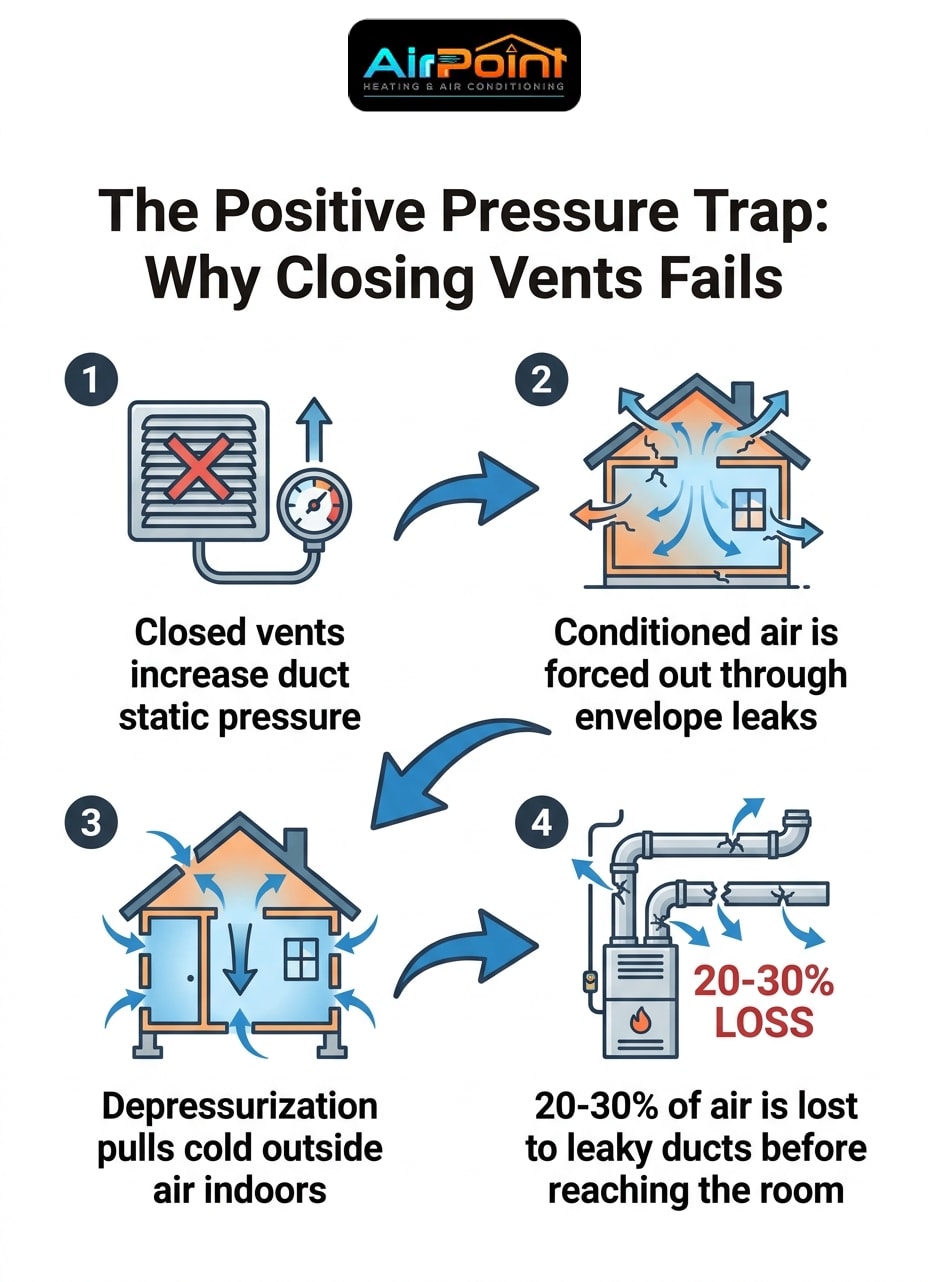
When you close a vent, your furnace does not produce less air. It still pushes the exact same volume of air into the ductwork. Because that air now has fewer places to escape, it builds up pressure inside the ducts and the rooms where the vents remain open. This creates a state of positive pressure in your living room.
Our team sees this exact scenario play out constantly. Here is why positive pressure fails so spectacularly in the Los Alamitos coastal-adjacent homes we service:
• It forces your expensive heat outside: When a room is positively pressurized, that excess air desperately looks for a way out. It will force your freshly heated, conditioned air out through tiny gaps in your window frames, wall outlets, and baseboards.
• It depressurizes the rest of the house: Because you are trapping air in one room, the rest of the house becomes starved for air (negative pressure). This negative pressure acts like a giant vacuum, actively pulling freezing outside air indoors.
• It creates a cycle of drafts: The cold air pulled in by the negative pressure eventually makes its way toward the return vents, creating a constant, chilling breeze across your floors.
Furthermore, closing vents drastically increases the static pressure inside your ductwork. Think of it like blowing air through a straw and then pinching the end. The blower motor in your furnace has to work twice as hard to push air against that resistance, which can lead to premature motor failure and skyrocketing energy bills. If you are looking for actual fixes for a freezing bedroom or living space, our experts will tell you that closing vents is never the answer.
The Hidden Culprit: How Leaky Ducts Sabotage Your Comfort
If closing vents isn't the answer, where is all your warm air going? In many cases, our crew finds that the true culprit is hiding right above your ceiling or beneath your floors. According to data from the U.S. Department of Energy, residential duct systems typically lose 20 to 30 percent of the air moving through them due to leaks, holes, and poorly connected joints—a statistic we frequently verify in the field.
When you turn on the heat on chilly November evenings, you expect 100 percent of that warm air to reach your living room. But if your supply ducts are leaky, a massive portion of that heat is escaping into unconditioned spaces like your attic, crawlspace, or inside your walls. You are essentially paying to heat the spaces where the spiders live, while your family shivers on the couch.
Leaky return ducts are equally problematic, if not worse. If the large duct pulling air back to your furnace has a hole in it while running through a cold attic, it will suck freezing, dusty attic air directly into your HVAC system. Your furnace then has to work incredibly hard to heat that freezing air before blowing it into your home. This not only causes drafts but also introduces allergens and dust into your breathing air.
Signs your ducts might be leaking:
• Weak airflow: You hold your hand over the living room vent, and the air barely trickles out.
• Excessive dust: Your home gets dusty unusually fast, indicating attic or crawlspace air is being pulled in.
• Unexplained energy spikes: Your heating bills rise, but your comfort level drops.
Because ductwork is mostly hidden behind drywall, visual inspections only go so far. Proper diagnostics require specialized equipment to measure airflow and pressure. Investing in professional ductwork evaluation and repair is often the most effective step in eliminating drafts and restoring your home's thermal boundary.
The Crucial Role of Dedicated Return Air Pathways
Homeowners often obsess over the supply vents—the ones blowing the warm air—but completely ignore the return vents. However, missing or inadequate return air pathways are one of the leading causes of pressurized, drafty rooms in Los Alamitos coastal-adjacent homes.
Imagine a master bedroom or a large living room that has two supply vents blowing warm air in, but no dedicated return vent to pull the air out. When you close the door to that room, you trap the air inside. The room quickly pressurizes, acting like a balloon filled to the brim. Because the room is full of high-pressure air, the new warm air from the furnace physically cannot enter the room. It just bounces off the high-pressure zone and travels to other parts of the house.
This trapped air eventually cools down, leaving the room freezing. The only way to fix this is to give the air a clear path back to the furnace. Adding dedicated return vents or simple transfer grilles (vents that allow air to pass through a wall or door) allows the air to circulate properly, instantly eliminating the pressure imbalance.
Older ductwork often lacks adequate return pathways by modern standards. During a recent autumn renovation, our team helped a homeowner who discovered that their deteriorating old ductwork and hallway furnace severely restricted their home's functionality. The rooms were constantly cold and stuffy. The solution we implemented required removing the old ductwork, installing new ducts, and crucially, adding proper return vents while relocating the furnace to the attic. This modernized the entire HVAC setup, finally allowing the air to breathe and improving the overall comfort of the home.
How Coastal Moisture Amplifies the Chill
Understanding the physics of airflow is only half the battle; you also have to factor in your local climate. Human comfort is not just about the number on the thermometer—it is deeply tied to relative humidity. The amount of moisture in the air dramatically changes how a draft feels against your skin.
In Southern California, particularly in the Los Alamitos coastal-adjacent homes we regularly upgrade, the climate presents a unique challenge. During the day, the weather might be mild, but as the sun sets, the damp coastal night air rolls in. This outside air carries a high level of moisture. When your home is depressurized (perhaps because you closed vents in other rooms), this damp, cold air is actively sucked into your living room through tiny cracks around your windows and doors.
Moist air transfers heat much faster than dry air. When a draft of damp coastal air hits your skin, it pulls your body heat away rapidly, making a 65-degree draft feel piercingly cold, much like a wet winter wind. This is why the drafts in this region feel so urgent and uncomfortable compared to dry, inland climates.
Controlling your airflow is not just about managing temperature; it is also about keeping that heavy moisture outside where it belongs. By sealing leaks and balancing the pressure, you prevent the damp air from invading your space. For homes that struggle heavily with moisture control, integrating dedicated indoor air quality systems alongside your heating equipment can help manage humidity levels, ensuring the air inside feels warm, dry, and consistently comfortable.
Actionable HVAC Solutions for Drafty Rooms
Now that we have debunked the myths and explained the physics, how do you actually fix a freezing living room? True comfort requires moving away from DIY band-aids and focusing on professional, root-cause solutions. When the chilly November evenings set in, these are the proven methods our team at AirPoint Heating & Air Conditioning uses to restore your home's warmth and pre-winter readiness.
Ductwork Diagnostics and Sealing
Before replacing any major equipment, the integrity of your ductwork must be verified. If 30 percent of your heat is leaking into the attic, a new furnace won't solve the problem.
1. Identifying hidden leaks: Professionals use specialized tools, such as blower doors and duct blasters, to measure exactly how much air is escaping and pinpoint the location of the leaks.
2. Restoring system efficiency: Once located, leaks are sealed using mastic sealant or metal tape (never standard duct tape, which degrades quickly). This ensures that all the heat your furnace produces actually makes it to your living room.
Air Balancing and Return Optimization
Once the ducts are sealed, the air needs to be distributed evenly.
1. Professional Air Balancing: A technician will adjust the dampers (valves inside the ductwork, not the vent covers in the room) to ensure the correct volume of air is delivered to every single room based on its size and heat loss.
2. Optimizing Return Air: If a room is pressurizing because it lacks a return path, professionals can install new return drops or transfer grilles. This relieves the pressure and allows warm air to flow in freely.
Zoned and Ductless Enhancements
Sometimes, a room is just inherently difficult to heat due to its design—like a room with vaulted ceilings, massive windows, or an addition built over a cold garage. In these cases, forcing the central furnace to do all the work is inefficient.
1. Bypassing ductwork entirely: For stubborn rooms, installing ductless mini split systems provides targeted, localized heating without relying on the home's main ductwork.
2. Customized temperature control: These systems allow you to set a specific temperature just for the living room, ensuring ultimate comfort without overheating the rest of the house.
• Closing vents in unused rooms — The Professional Solution: Adjusting duct dampers for proper air balancing
• Using draft stoppers on doors — The Professional Solution: Adding transfer grilles to improve return airflow
• Buying a larger furnace — The Professional Solution: Sealing leaky ductwork to prevent heat loss
• Running a loud space heater — The Professional Solution: Installing a whisper-quiet ductless mini-split
Frequently Asked Questions About Drafty Rooms and Airflow
Does closing vents help heat a drafty room?
No, closing vents actually makes the problem worse. It increases the static pressure inside your ductwork, forcing your heated air out through tiny leaks in your home's envelope. Furthermore, it depressurizes other areas of the house, which actively sucks freezing outside air indoors, creating more drafts.
Why is my living room so drafty compared to the rest of the house?
A living room often feels drafty due to a lack of proper return airflow or hidden duct leaks. If the room has supply vents but no return vent, the air pressurizes and prevents new heat from entering. Additionally, living rooms in Los Alamitos coastal-adjacent homes often feature large windows or exterior walls that increase heat loss if the room isn't properly balanced.
How does return air affect room temperature?
Return air is the crucial second half of the heating cycle; without it, warm air cannot circulate. If stale, cold air cannot leave the room through a return vent, the room becomes pressurized. This high pressure acts like an invisible wall, blocking the fresh, warm air from your furnace from entering the space.
Will a bigger furnace fix drafty windows?
No, installing a bigger furnace will not fix drafts and will likely cause short-cycling, where the system turns on and off too rapidly. Drafts are an airflow and pressure issue, not a capacity issue. Balancing the ductwork and sealing air leaks are the correct ways to stop drafts at their source.
How do professionals balance HVAC airflow in a house?
Professionals balance airflow by measuring the air volume at each register and adjusting specialized dampers located deep inside the ductwork. They do not just close the vent covers in the room. This process ensures that every room receives the precise amount of conditioned air required to maintain a consistent temperature.
Can leaky ductwork cause cold drafts?
Yes, leaky ductwork is a primary cause of indoor drafts. If your supply ducts leak into the attic, you lose the heat intended for your living room. If your return ducts leak, they can pull freezing air from unconditioned spaces and blow it directly into your home, causing a noticeable chill.
Stop the Drafts and Restore Your Home's Comfort
Dealing with a freezing living room on chilly November evenings is incredibly frustrating, but forcing positive pressure by closing vents is a myth that will only worsen the chill. True, lasting comfort comes from understanding the physics of your home: balancing the supply and return air, sealing hidden duct leaks, and ensuring your system can breathe freely without restriction.
Instead of applying temporary band-aids that damage your equipment and spike your energy bills, it is time to look at the root cause. With AirPoint's 100% Satisfaction Guarantee and our local family-owned expertise, you can trust that our thorough diagnostics will uncover exactly why your room is cold. Stop fighting the drafts and let our professionals restore the warm, even comfort your home deserves.
Other Blogs
Latest Blog Posts

Heat Pump Auxiliary Heat Triggers: Why Your System Switched During the First November Cold Snap

Understanding Heat Pump Base Pan Heater Function Before November Freezes

What We Found Inside a Dormant Furnace: Why November Pre-Checks Prevent Midnight Breakdowns

Customer Testimonials



I recommend Air Point for your HVAC needs."