






Factoring in Heating Efficiency (HSPF) When Comparing Heat Pump Options in Fall
Busting the Southern California Efficiency Myth
In our years serving the Los Alamitos community at AirPoint Heating & Air Conditioning, we have noticed a persistent myth among coastal homeowners: the belief that factoring in heating efficiency (HSPF) when comparing heat pump options in fall is largely unnecessary because Southern California weather is supposedly all about air conditioning. Most homeowners focus entirely on the cooling rating of a new system, assuming the heating side of the equation is just an afterthought. However, our team frequently sees how ignoring heating efficiency metrics during the September pre-heating season is one of the most common ways homeowners accidentally lock themselves into higher winter utility bills.
Looking for professional guidance? Explore our heating services or review your heat pump options to get started.
The Cooling-Only Blind Spot
Because summer heat waves drive the most urgent HVAC replacements, homeowners are conditioned to scrutinize every detail of a system's cooling capabilities. You might spend hours researching how well a unit performs in triple-digit heat, completely bypassing the specifications for winter operation. This creates a significant blind spot. A heat pump is a dual-function system, meaning it provides both your summer cooling and your winter heating. If you only optimize for one season, you are only getting half the value out of your investment.
When you sit down to compare equipment proposals this fall, the decision point comes down to determining exactly how much weight to give the heating rating versus the cooling rating. A balanced approach is absolutely necessary for year-round comfort and energy management. If you install a system with a phenomenal cooling rating but a subpar heating rating, your system will draw excessive electricity every time the winter temperatures drop, erasing the efficiency gains you made during the summer.
Why Fall is the Critical Evaluation Window
The September pre-heating season is the ideal window to evaluate these ratings because you are not in an emergency cooling situation, nor are you freezing in the middle of winter. You have the time to carefully review the technical specifications, ask your contractor detailed questions, and make a calculated decision. Taking the time to understand both sides of the efficiency equation now ensures that your home is prepared for the inevitable temperature shifts that arrive later in the year.
SEER2 vs. HSPF2: Understanding the New Efficiency Standards
To make an informed decision, you need to understand the metrics used to measure heat pump performance. Recently, the Department of Energy updated its testing procedures, transitioning the industry from the older SEER and HSPF standards to the more rigorous SEER2 and HSPF2 standards. This change provides a much more accurate reflection of how a heat pump will actually perform once installed in your home.
Defining the Cooling Metric: SEER2
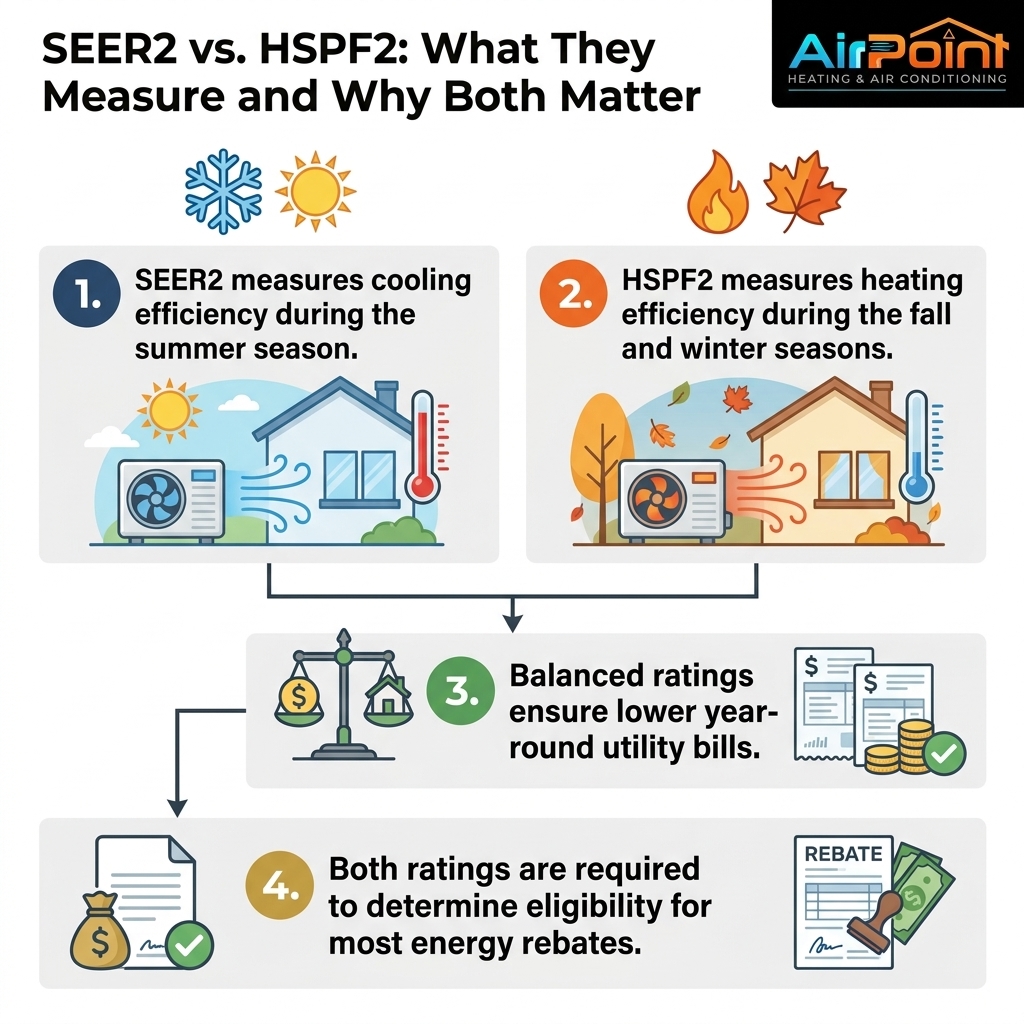
SEER2 stands for Seasonal Energy Efficiency Ratio 2. This is the updated standard for measuring the cooling efficiency of air conditioners and heat pumps. It calculates the total cooling output provided during a typical cooling season divided by the total electrical energy input during that same period. A higher SEER2 rating indicates a more energy-efficient system during the hot summer months. The "2" designates that the unit was tested under new, stricter conditions that better simulate the static pressure of real-world ductwork.
Defining the Heating Metric: HSPF2
HSPF2 stands for Heating Seasonal Performance Factor 2. This is the updated Department of Energy standard for measuring a heat pump's heating efficiency. Similar to the cooling metric, it represents the total space heating required during the heating season divided by the total electrical energy consumed by the heat pump system. A higher HSPF2 rating means the system requires less electricity to keep your home warm during the fall and winter. When you look at HSPF2 vs SEER2 efficiency labels, you are looking at the two halves of your home's year-round energy profile.
Side-by-Side Performance Comparison
Understanding how these two ratings interact is vital for comparing your options. Here is a breakdown of what each rating measures and how it impacts your home:
• SEER2 — Primary Function: Cooling Performance — Season of Impact: Late Spring, Summer, Early Fall — What It Measures: Cooling output divided by electrical input over a typical summer season.
• HSPF2 — Primary Function: Heating Performance — Season of Impact: Late Fall, Winter, Early Spring — What It Measures: Heating output divided by electrical input over a typical winter season.
• Combined Impact — Primary Function: Year-Round Operation — Season of Impact: All Seasons — What It Measures: The total operational efficiency and overall annual energy consumption of the heat pump.
By evaluating both metrics together, you ensure that your new system is optimized for every month of the year, not just the hottest weeks of August.
Why Heating Efficiency Matters in a Transitional Climate
It is easy to dismiss heating efficiency if you live in an area that rarely sees snow, but that mindset ignores the reality of local weather patterns. Our technicians at AirPoint Heating & Air Conditioning know firsthand that the Los Alamitos coastal/inland transitional climate presents a very specific set of challenges for residential HVAC systems. In this region, daytime warmth can rapidly shift to surprisingly cold nights, making a highly efficient heating system just as vital as a robust cooling system.
The Challenge of Sudden Temperature Drops
In a transitional climate, your heat pump might sit idle all afternoon while the sun warms your home, only to be called upon aggressively as soon as the sun sets and the marine layer rolls in. During these sudden temperature drops, a heat pump must extract ambient heat from the cooler outdoor air and transfer it inside. If your system has a poor HSPF2 rating, it will struggle to capture that ambient heat efficiently. To compensate, the system will run longer cycles and draw significantly more electricity to maintain your indoor set point.
Real-World Winter Reliability
Relying on a unit with poor heating efficiency often leads to unexpected utility spikes during the winter months. Homeowners are frequently caught off guard when their January electricity bill rivals their August bill, simply because their heat pump was not optimized for nighttime heating demands. A strong heating rating prevents this excessive energy draw, ensuring that your system operates smoothly even when the outdoor temperature dips lower than expected.
Our team recently helped a local Los Alamitos homeowner who experienced this exact dynamic during a sudden winter chill. Their older heater began having persistent issues keeping up with the rapid temperature drop, leaving the house uncomfortably cold. An AirPoint technician was dispatched the same day, thoroughly addressed the immediate heater issue, and discussed long-term replacement options. Ultimately, the homeowner opted to have us install a more efficient system along with updated ductwork. The outcome was immediate: the new, highly rated system ensured consistent, reliable warmth without the excessive energy draw of their outdated unit.
Connecting Ratings to Indoor Comfort
Beyond just energy consumption, your system's efficiency rating directly impacts your tangible indoor comfort. A unit with a high HSPF2 rating operates more consistently, providing a steady flow of warm air rather than blasting lukewarm air continuously. This means fewer cold spots in your living room and a much more comfortable environment during chilly coastal evenings.
How to Read and Compare Efficiency Labels on Your Quotes
Once you understand the importance of balancing these two metrics, the next step is applying this knowledge to the actual estimates you receive from contractors. Reading equipment proposals can be overwhelming, but breaking the process down makes it much easier to identify the best overall value for your home.
Step-by-Step Guide to Evaluating Quotes
1. Locate the specific ratings: Look for the HSPF2 vs SEER2 efficiency labels on the equipment proposals. These numbers should be clearly listed next to the model numbers of the heat pump and the air handler. If a quote only lists the SEER2 rating, ask the contractor to provide the corresponding HSPF2 rating.
2. Check the EnergyGuide label: Every new unit comes with a yellow EnergyGuide label. This label provides a standardized snapshot of the system's efficiency and estimated annual energy usage. Use this label to verify the numbers provided in your quote.
3. Understand the DOE minimums: Familiarize yourself with the current Department of Energy minimum standards for your region. A "good" rating is one that comfortably exceeds these minimums, providing a buffer of efficiency that will pay off over the lifespan of the system.
4. Spot over-indexed quotes: Be wary of quotes that push the absolute highest SEER2 rating available while ignoring the HSPF2 rating entirely. These extreme-weather specifications are often designed for climates with brutal, year-round heat and may not provide a balanced return on investment in a transitional climate.
5. Ask the right questions: Engage your contractor in a discussion about winter performance. Ask them directly how the proposed unit handles sudden temperature drops and whether the heating efficiency rating is sufficient for your specific neighborhood's microclimate.
The Importance of the AHRI Certificate
To confirm that the ratings on your quote are accurate, you can request the AHRI (Air-Conditioning, Heating, and Refrigeration Institute) certificate for the proposed system. Because a heat pump works in tandem with an indoor air handler or furnace, the true efficiency rating is based on how those specific components perform together. The AHRI certificate provides the verified, matched-system ratings for both cooling and heating, ensuring you get exactly what you are promised.
Balancing Upfront Costs with Long-Term Utility Savings
Higher efficiency ratings generally correlate with a higher initial cost for the equipment. The challenge for any homeowner is determining where the "sweet spot" lies—the point where the extra upfront investment is justified by the expected reduction in monthly energy consumption. Making this calculation requires a clear-eyed look at your home's actual seasonal usage.
Calculating the Break-Even Point
The break-even point is the moment when the accumulated energy savings surpass the initial premium paid for higher-efficiency equipment. To estimate this, you need to consider how frequently your system runs during the summer and the winter. If you invest in a unit with stellar ratings for both seasons, your monthly energy consumption will be lower year-round, accelerating the time it takes to reach that break-even point. Utilizing tools like a SEER calculator can help you visualize the difference in electrical draw between a baseline model and a high-efficiency model.
Avoiding High-Pressure Sales Tactics
Unfortunately, some sales tactics rely on pushing the highest possible ratings across the board, regardless of whether those extreme specifications make sense for your specific home. A top-tier unit designed for sub-zero winters might have an incredible heating rating, but if your local climate only requires moderate heating, you will never recoup the massive upfront cost of that specific feature.
The Value of Transparent Expert Guidance
This is where working with the right contractor makes all the difference. As your transparent local experts, our team at AirPoint Heating & Air Conditioning focuses on helping Los Alamitos homeowners avoid overpaying for unnecessary extreme-weather specs. By analyzing your home's unique thermal profile and your family's usage habits, a trusted professional can recommend a system that perfectly balances upfront costs with long-term utility savings. The goal is not to sell the most expensive box, but to install the system that delivers the most efficient, reliable comfort for your specific environment.
Navigating Energy Rebates and Tax Credits This Fall
Another major reason to pay close attention to both efficiency metrics during the September pre-heating season is their impact on financial incentives. Many homeowners are unaware that upgrading to a high-efficiency heat pump often qualifies them for various generic energy incentives, which can significantly offset the initial installation costs.
Federal Tax Credits and Local Utility Rebates
Federal tax credits may apply to qualifying heat pump installations, providing a direct financial benefit when you file your annual taxes. However, these programs usually require the new system to meet specific minimums for both SEER2 and HSPF2. If your chosen unit has an excellent cooling rating but falls short on the heating rating, you could entirely miss out on the credit.
Similarly, local utility rebates might also be available for systems that meet balanced efficiency criteria. Utility companies want to reduce the overall strain on the electrical grid during both summer heat waves and winter cold snaps. Therefore, they structure their rebate programs to reward homeowners who install well-rounded, highly efficient equipment.
Verifying Program Requirements
Because incentive programs change frequently and vary by region, it is critical to verify current programs with your utility provider or a qualified tax professional before making a final decision. When you are weighing operating costs of heat pumps vs. gas furnaces, factoring in these generic rebates can completely change the math in favor of a high-efficiency heat pump. Ensuring your system meets the required metrics for both seasons is the safest way to guarantee eligibility.
Securing Your Winter Comfort: Next Steps for Your Heat Pump Installation
Navigating the technical specifications of a new HVAC system does not have to be an overwhelming process. The key takeaway is that a clear, region-specific understanding of both HSPF2 and SEER2 is the foundation of a smart, long-lasting investment. By evaluating both metrics, you protect yourself against unexpected utility spikes and ensure your home remains comfortable regardless of what the coastal weather brings.
The September pre-heating season is rapidly closing, making now the optimal time to finalize your decisions before the winter temperatures drop and installation schedules fill up. Do not wait until your current system fails on a chilly evening to start comparing quotes.
If you are reviewing estimates and want to ensure you are making the right choice for your home's unique climate, reach out for a professional, transparent evaluation. Contact our team to schedule HVAC service and let us help you find the perfect balance of efficiency, comfort, and value.
Frequently Asked Questions
Does HSPF matter in California?
Yes, HSPF absolutely matters in California, especially in coastal and transitional areas. While the state is known for warm summers, nighttime temperatures during the fall and winter can drop significantly. A strong heating efficiency rating ensures your system can handle these chilly nights without drawing excessive electricity, keeping your winter utility bills manageable.
What is the difference between SEER2 and HSPF2?
The primary difference lies in the season they measure. SEER2 measures a heat pump's cooling efficiency during the summer, calculating how effectively it removes heat from your home. HSPF2 measures the system's heating efficiency during the fall and winter, calculating how effectively it extracts ambient heat from the outdoor air to warm your home.
How do I choose the right heat pump efficiency for a mild climate?
Choosing the right efficiency requires balancing both ratings rather than maximizing just one. In a mild climate, you want a system that comfortably exceeds the Department of Energy minimums for both SEER2 and HSPF2. Consulting with a local HVAC professional can help you avoid overpaying for extreme-weather specifications that your specific neighborhood does not require.
What is a good HSPF rating for a heat pump?
A good HSPF rating is one that meets or exceeds the current regional standards set by the Department of Energy. With the transition to the stricter HSPF2 testing protocols, the numerical values have shifted slightly, but a "good" rating generally indicates the unit operates efficiently enough to qualify for standard energy incentives and provide reliable winter warmth without excessive power consumption.
Do higher HSPF2 ratings qualify for energy rebates?
Yes, higher HSPF2 ratings often help a system qualify for various energy incentives. Many generic federal tax credits and local utility rebates require a heat pump to meet strict minimums for both heating and cooling efficiency. Always verify the current requirements with your utility provider or tax professional to ensure the specific model you choose is eligible.
Other Blogs
Latest Blog Posts

Do UV Light Purifiers Actually Neutralize Fall Mold Spores in Your HVAC System?
Diagnosing Short-Cycling in Oversized Furnaces Installed During the 90s Housing Boom
Retrofitting La Mirada Mid-Century Homes with Zoning Systems for Better Temperature Control

Customer Testimonials




I recommend Air Point for your HVAC needs."