





Home Maintenance Tips and Troubleshooting: Decoding Fall Heating Startup Symptoms
The First Chilly Night: What to Expect When You Turn On the Heat
You switch the thermostat from cool to heat on the first chilly evening, and within minutes, a strange burning smell fills the hallway. Navigating home maintenance tips and troubleshooting during an October fall heating startup can often feel overwhelming, especially when your furnace has been sitting idle for months. At AirPoint Heating & Air Conditioning, our team frequently fields calls from concerned homeowners during this exact seasonal transition. After a long summer of relying on your cooling equipment, shifting your mindset to heating safety requires a change in focus. The initial startup of a dormant heating system frequently produces odd smells and unfamiliar noises, leaving many homeowners wondering if their system is safe to run or on the verge of a breakdown.
If you recently reviewed your summer energy bills and are thinking about upgrading your air conditioning systems next year, utilizing a SEER savings calculator can help you plan your future investments. However, as the temperatures drop, your immediate attention must turn to heating safety and performance.
The Anxiety of the First Heat Cycle
During an October fall heating startup, it is entirely normal to feel a bit of anxiety. Gas furnaces and heat pumps are complex pieces of machinery. When a system sits completely unused for approximately eight months, natural environmental factors take their toll. Dust settles deep inside the cabinet, moving parts lose their residual lubrication, and electrical connections can develop microscopic layers of oxidation.
When you finally send that call for heat from your thermostat, the system goes through a sequential order of operations. The inducer motor spins up, the igniter glows, the gas valve opens, and the main blower pushes air through the ductwork. If any of these components struggle after their long slumber, you will notice it immediately. Understanding which of these startup symptoms are harmless and which require professional intervention is the key to maintaining a safe, comfortable home throughout the winter season.
Why Your Heater Smells Like Burning Dust (And When It's Normal)
The most common cause for concern during the first cold snap is a distinct, pungent odor coming from the air vents. To understand why this happens, we have to look at what occurs inside your HVAC system during the long off-season.
The Problem: Unpleasant Odors from Vents
Within minutes of the warm air beginning to circulate, a smell resembling burnt hair or singed dust spreads through the house. This odor is often strong enough to prompt homeowners to open windows or shut the system down completely out of fear of an electrical fire.
The Cause: Idle Accumulation
Throughout the spring and summer, airborne particles constantly circulate through your home. Even with high-quality air filters in place, microscopic dust, pet dander, and lint eventually find their way into the ductwork and the furnace cabinet. This debris settles directly onto the heat exchanger—the metal component that gets extremely hot to warm the air passing over it. The Los Alamitos coastal climate plays a significant role here. In our experience servicing local neighborhoods, the slightly humid, salty marine air causes dust to become slightly sticky, allowing it to cake onto the heat exchanger rather than just resting lightly on the surface.
The Solution: The Burn-Off Period
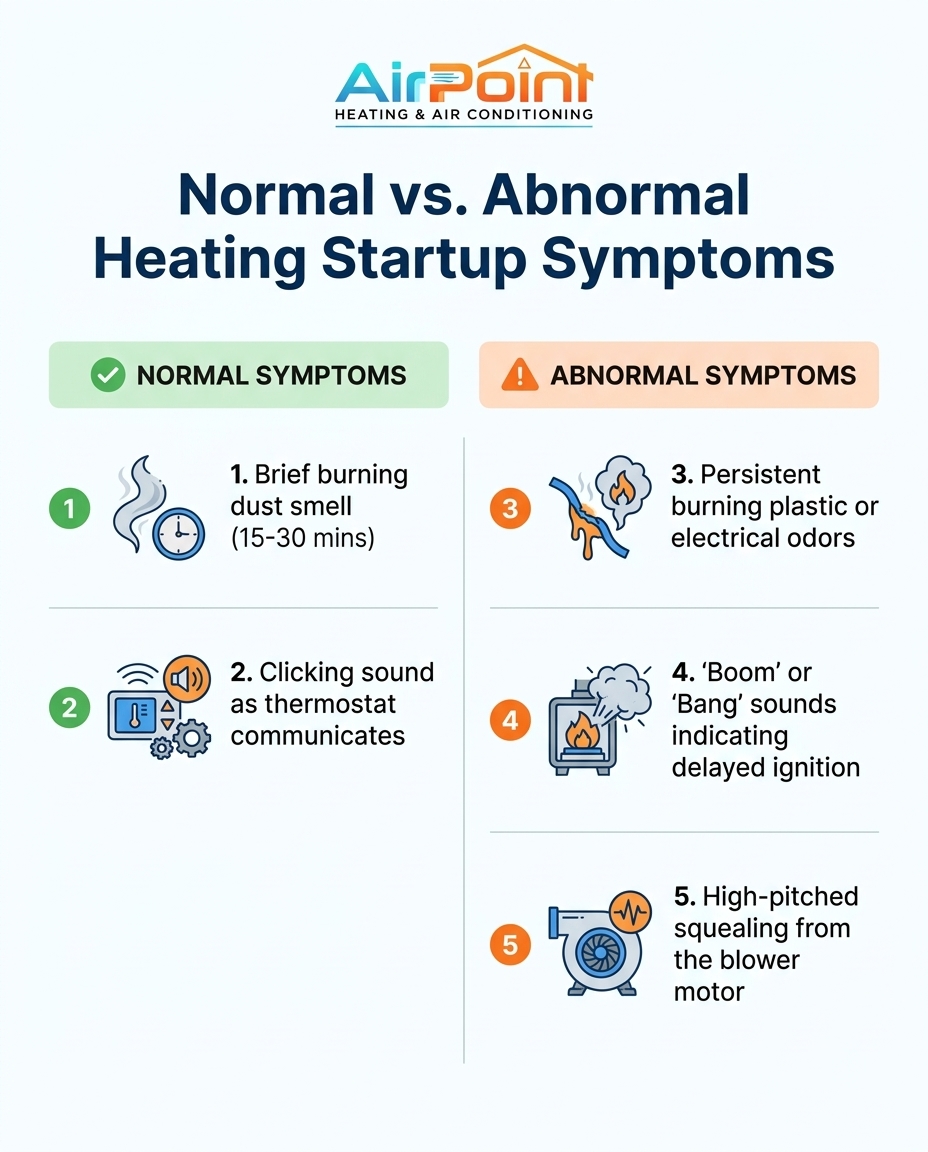
When the heat exchanger reaches its operating temperature for the first time in eight months, that caked-on layer of dust literally burns off. At AirPoint Heating & Air Conditioning, we believe in providing transparent guidance: a normal dust burn-off smell should only last between 15 and 30 minutes. Our technicians typically see that you do not need to pay for a professional service call if the smell dissipates within this half-hour window. Simply ensure proper ventilation by cracking a few windows while the initial cycle runs.
When the Smell is Abnormal:
• Duration: If the burning dust smell persists for longer than an hour, the system may be overheating, or there may be excessive debris inside the cabinet.
• Plastic Odors: A smell resembling melting plastic indicates a failing wire casing or a foreign object lodged in the ductwork.
• Electrical Odors: An acrid, ozone-like smell often points to an overheating blower motor or a failing circuit board.
If you experience plastic or electrical odors, turn the system off at the thermostat immediately and leave it off until a technician can inspect it.
Delayed Ignition and Strange Sounds: When to Call a Professional
While a brief burning smell is usually harmless, certain noises during an October fall heating startup indicate a serious mechanical or safety failure. Your furnace should operate with a steady, predictable hum. Sudden, jarring noises are a clear signal that the system is struggling.
Understanding Delayed Ignition
One of the most dangerous sounds a gas furnace can make is a loud "boom" or "bang" immediately after the system tries to start. This is known as delayed ignition. In a properly functioning furnace, the gas valve opens and the burners ignite instantly. However, if the burners are dirty, or if the igniter is failing, the gas valve will open, but the gas will not catch fire right away. The gas pools inside the combustion chamber. When the spark or igniter finally catches, it ignites a larger-than-normal volume of gas all at once, creating a small, localized explosion.
Delayed ignition is never a DIY fix. The force of these small explosions can crack the heat exchanger over time, potentially allowing carbon monoxide to leak into your home's air supply. If you hear this booming sound, you must turn off the system and schedule an HVAC estimate for a comprehensive safety diagnostic.
Other Warning Sounds to Monitor:
• High-pitched squealing: Typically indicates a failing blower motor belt or bearings that have lost their lubrication during the long off-season.
• Metal-on-metal grinding: Often points to a blower wheel that has come loose from its housing and is scraping against the metal cabinet.
• Rapid clicking: While a single click from the thermostat is normal, rapid clicking at the furnace usually means the spark igniter is struggling to light the pilot or burners.
Our team recently helped a local homeowner who was dealing with a very old and run-down HVAC unit that was making strange noises and suffering from a leaky compressor. After an AirPoint technician arrived, a complete tune-up was performed, the compressor issue was resolved, refrigerant was topped off, and the entire system was cleaned. This thorough service transformed an outdated, noisy unit into a much more efficient and reliable system just in time for the changing weather.
The Impact of Coastal Moisture on Idle Heating Components
Many generic national home maintenance guides fail to account for regional environmental factors. If you read a winterizing guide written for a dry, inland desert climate, it will miss the most crucial factor affecting your system: the Los Alamitos coastal climate. As a local HVAC provider, we see firsthand how living near the coast means your HVAC system interacts with a unique set of atmospheric conditions, even when it is turned off.
The Marine Layer Effect
During the eight months your heating system sits dormant, the coastal marine layer regularly introduces higher levels of ambient humidity and trace amounts of salt into the air. This moisture is drawn into your ductwork and furnace cabinet naturally through passive airflow.
When dry dust settles in an inland climate, a quick burst of air can easily blow it away. However, when dust settles in a coastal environment, the marine moisture acts as a binding agent. The dust turns into a fine, cake-like layer on the heat exchanger, the blower motor fins, and the delicate electronic sensors. This is why the initial burning dust smell can sometimes be slightly more pronounced in coastal homes.
Oxidation on Critical Sensors
The most significant impact of this coastal moisture is oxidation. Your furnace relies on a flame sensor—a small metal rod that detects whether the gas burners are actually lit. If the burners don't light, the sensor shuts off the gas valve to prevent a dangerous buildup.
• Coastal Humidity — Impact on Idle HVAC Systems: Causes dust to cake onto the heat exchanger rather than rest loosely. — Resulting Startup Symptom: Stronger, slightly longer burning dust odor during initial startup.
• Salt Air Exposure — Impact on Idle HVAC Systems: Accelerates micro-corrosion on bare metal components and electrical contacts. — Resulting Startup Symptom: Intermittent electrical faults or thermostat communication errors.
• Marine Moisture — Impact on Idle HVAC Systems: Creates an oxidation layer on the brass or steel flame sensor. — Resulting Startup Symptom: Furnace ignites, runs for three seconds, and then shuts down immediately (short cycling).
Over the summer, the mild but salty humidity can cause a microscopic layer of oxidation to form on this sensor. When you try to start the heat in the fall, the oxidized sensor cannot read the flame properly. The furnace will ignite, run for a few seconds, and then shut down as a safety precaution. This coastal-specific challenge is a primary reason why our team strongly recommends pre-season professional maintenance in our service area.
Essential Home Maintenance Tips for Fall HVAC Efficiency
While clearing oxidation from a flame sensor or inspecting a heat exchanger requires a licensed professional, there are several safe, effective steps you can take to prepare your system for an October fall heating startup. Taking care of these basic maintenance items ensures better airflow, improves indoor air quality, and reduces the strain on your equipment.
1. Inspect and Replace Air Filters: A clogged filter forces the blower motor to work significantly harder to push air through the home. This not only increases your energy bills but can also cause the heat exchanger to overheat and shut down prematurely. Start the season with a fresh filter to mitigate any indoor air quality issues caused by burnt dust. If you are unsure which filter is right for your system, understanding MERV ratings and air filter types is a great place to start.
2. Clear All Vents and Registers: Walk through every room in your house and inspect the supply and return vents. Over the summer, it is easy to accidentally push a rug over a floor register or move a sofa in front of a wall vent. Blocked vents disrupt the airflow balance of your entire system, leading to cold spots and increased static pressure inside the ductwork.
3. Test the Thermostat Settings: Before the coldest nights arrive, switch the thermostat to "Heat" and raise the temperature a few degrees above the current room temperature. Listen for the system to engage. Ensure that the thermostat is properly communicating with the heating equipment and that warm air begins to flow within a few minutes.
4. Clean Around the Outdoor Heat Pump: If you use a heat pump rather than a gas furnace, your outdoor unit will be operating throughout the winter. Clear away any fallen leaves, overgrown branches, or debris from around the base of the condenser. The unit needs at least two feet of clear space on all sides to pull in enough air to heat your home efficiently.
5. Check Carbon Monoxide Detectors: Before running any gas appliance for the season, verify that your carbon monoxide detectors have fresh batteries and are functioning correctly. This is a non-negotiable safety step for any home utilizing natural gas heating.
Upgrading vs. Repairing: Evaluating Your HVAC System
As you navigate your fall startup, you may notice that your system is struggling more than it did last year. An aging system often presents clear signs of decline, such as uneven temperatures from room to room, a steady increase in utility bills, and the need for frequent, minor repairs. Deciding whether to invest in a tune-up or a full system replacement can be a difficult choice.
The Value of a Professional Tune-Up
For systems that are less than ten years old, a professional tune-up can often restore lost efficiency. Technicians can clean the caked-on dust, recalibrate the thermostat, lubricate moving parts, and clear the oxidation from the flame sensor caused by the Los Alamitos coastal climate. These adjustments reduce the workload on the motor and ensure the system burns fuel efficiently.
When Replacement Makes Sense
However, if your system is over 12 to 15 years old and requires a major repair—such as a cracked heat exchanger or a failing blower motor—replacement is often the more financially sound decision. At AirPoint Heating & Air Conditioning, we believe in providing honest ROI (Return on Investment) calculations rather than automatically pushing for the highest SEER equipment. By evaluating your home's specific footprint and your long-term plans, you can choose a system that actually pays for itself over time through lower energy costs. Additionally, federal tax credits may apply to qualifying heat pump installations, making an upgrade even more sensible—just be sure to consult your tax professional for current program details.
Our technicians recently assisted a local homeowner who experienced a sudden heater malfunction right as the weather turned. After a thorough evaluation of the aging unit, our team explained all available options transparently. The customer decided to replace the outdated system with a highly efficient modern unit, which included updating the ductwork to solve long-standing airflow issues. The new heater was up and running the very same day, providing immediate comfort and long-term reliability.
If you are considering a replacement but are concerned about the upfront costs, exploring HVAC financing options can make necessary upgrades highly accessible. Flexible payment solutions allow you to install a safe, efficient system immediately while spreading the investment out over time.
Frequently Asked Questions About Fall HVAC Troubleshooting
Even with a thorough understanding of an October fall heating startup, homeowners often have specific questions about their system's behavior. Here are clear answers to the most common concerns.
Why does my heater smell like burning dust?
Dust naturally accumulates on the heat exchanger during the summer months while the heater is completely inactive. When the furnace is turned on for the first time in the fall, the heat exchanger gets extremely hot and literally burns off this layer of settled dust. This process creates a temporary, distinct odor that circulates through your ductwork, but it is a normal part of the seasonal transition.
How long should a heater smell when first turned on?
The burning dust smell should dissipate entirely within 15 to 30 minutes of the first heating cycle. If the smell lasts longer than an hour, or if it changes from a dusty odor to a sharp electrical or melting plastic smell, you should turn the system off at the thermostat immediately and seek professional diagnostic help.
What does delayed ignition sound like?
Delayed ignition sounds like a distinct "boom," "bang," or a small localized explosion coming from the furnace cabinet shortly after it tries to start. This noise indicates that gas is building up inside the combustion chamber before the igniter finally catches it. It is a dangerous condition that can damage the system and requires immediate professional repair.
When should I call a professional for heating repair?
You should call a professional whenever startup smells persist beyond the initial burn-off period, if you hear loud banging or squealing noises, or if the system runs but fails to produce warm air. Additionally, any odors resembling burning plastic, ozone, or electrical wires are immediate red flags that require a licensed technician to ensure the home's safety.
Can I clean the furnace heat exchanger myself?
No, accessing and cleaning the heat exchanger requires dismantling critical parts of the furnace cabinet and working directly with the combustion chamber. This is a significant safety hazard involving gas lines and exhaust venting. Cleaning and inspecting the heat exchanger must always be performed by a trained and licensed HVAC professional.
Ensure a Safe and Warm Winter with a Pre-Season Inspection
While a brief dusty smell and a few initial clicks are perfectly normal during your fall startup, true peace of mind comes from professional verification. The Los Alamitos coastal climate places unique stresses on idle equipment, making an expert eye invaluable before the coldest weather sets in. The team at AirPoint Heating & Air Conditioning is ready to help you prepare. Both the EPA and the Department of Energy strongly recommend annual pre-season HVAC inspections to ensure safe operation, prevent carbon monoxide hazards, and maintain peak energy efficiency. Taking proactive steps now ensures that when the winter chill arrives, your home will remain a safe, warm, and comfortable haven for your family.
Other Blogs
Latest Blog Posts
HVAC Repair: Decoding Fall Furnace Smells and Startup Issues

The Truth About Smart Thermostat Auto-Switch Features During Unpredictable Fall Weather
Why Coastal Long Beach Homes Often Need Different Heat Pump Defrost Cycles

Customer Testimonials



I recommend Air Point for your HVAC needs."