





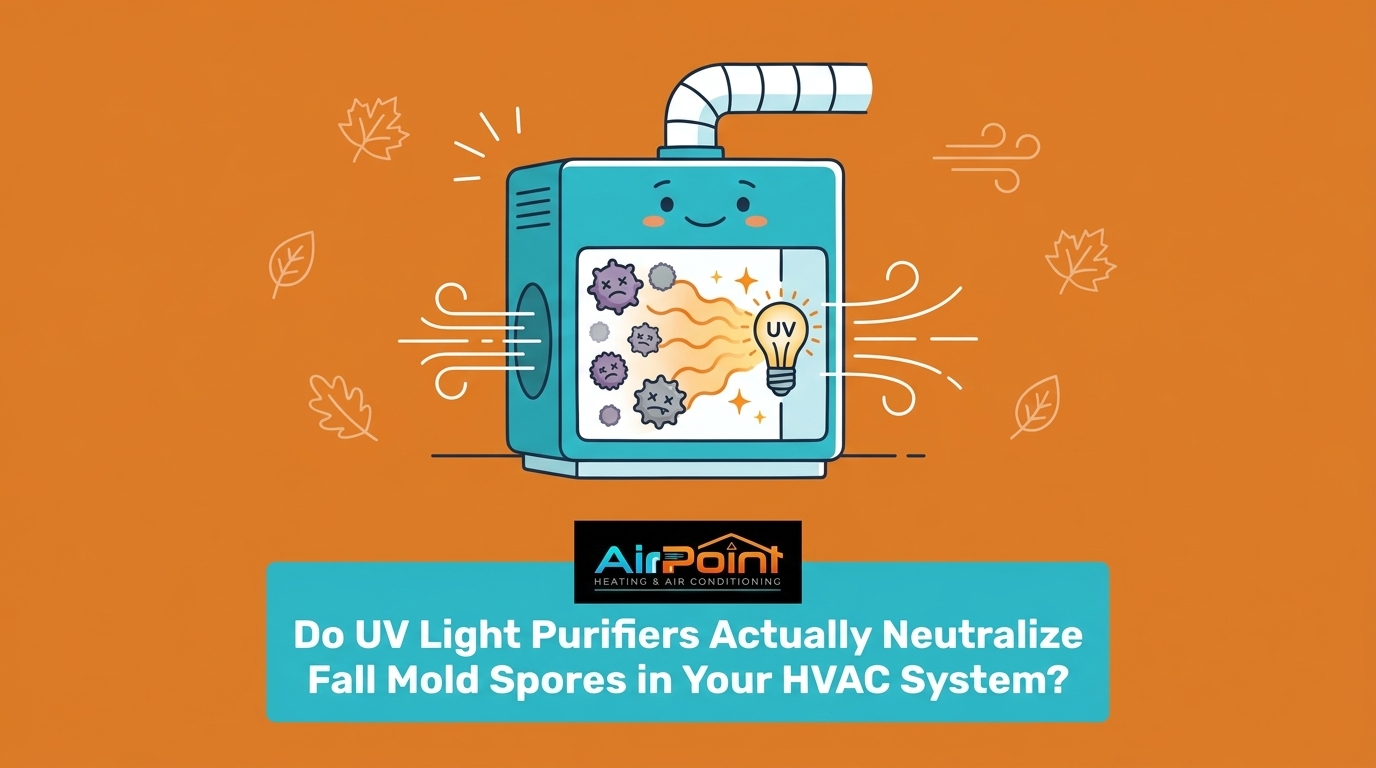
Do UV Light Purifiers Actually Neutralize Fall Mold Spores in Your HVAC System?
Preparing Your Home for the Fall Marine Layer
Late summer heat is finally breaking, but that cooling trend brings the return of early fall marine layer dampness right to your doorstep. As morning fog rolls in and humidity spikes this September 2026, you might notice a distinct, musty odor drifting out of your air vents. This raises a critical question for homeowners focused on indoor air quality: do UV light purifiers actually neutralize fall mold spores in your HVAC system? The short answer is yes, but understanding exactly how this technology works is the key to ensuring it actually protects your home.
When the seasons change, your home's climate control needs shift dramatically. During this transitional period, your HVAC system often sits idle for longer stretches of the day. This downtime, combined with elevated coastal humidity, creates the perfect environment for airborne biological contaminants to thrive. As our technicians at AirPoint Heating & Air Conditioning often see during pre-heating-season tune-ups, if you are tired of simply masking odors and want to address the root cause of seasonal mold, it is time to look at comprehensive indoor air quality solutions that rely on proven science rather than basic marketing claims.
Ultraviolet germicidal irradiation (UVGI) is not a new concept, but its application in residential heating and cooling systems is frequently misunderstood. To determine if investing in a UV light purifier is the right move for your home, you need to look past the glowing blue bulbs and understand the biological battle happening inside your ductwork.
The Coastal Transition: Why Fall Triggers HVAC Mold Growth
The microclimate in Los Alamitos and coastal Orange County is uniquely challenging for heating and cooling equipment during the autumn months. In neighborhoods like Rossmoor, we consistently observe a distinct daily weather pattern: heavy morning dampness from the ocean pushing relative humidity above 75%, followed by dry, sometimes dusty afternoon winds. This constant fluctuation between high humidity and dry air takes a toll on the dark, unconditioned spaces where your equipment operates.
Mold spores are a natural part of our environment, but they require three specific elements to multiply and become a problem inside your home:
• Consistent moisture: Provided by the early fall marine layer dampness and condensation from your late-season cooling cycles.
• Total darkness: The inside of your air handler or furnace cabinet is completely devoid of natural sunlight.
• A food source: Dust, pet dander, and organic debris that bypass your air filter serve as an all-you-can-eat buffet for biological growth.
When the dry Santa Ana winds eventually blow through, they stir up these microscopic spores, and your blower fan distributes them into every room of your house. This is why you often experience an uptick in indoor allergies, sneezing, and respiratory irritation right as the weather starts to cool down.
The Role of the Evaporator Coil in Moisture Accumulation
To understand why mold loves your system, you have to look at the evaporator coil. This component is responsible for absorbing heat from your indoor air. As warm air blows over the icy-cold metal fins of the coil, condensation forms—much like water droplets on the outside of a cold glass of water on a hot day.
This moisture drips down into a condensate drain pan. While the system is designed to drain this water away, the fins of the coil and the pan itself remain perpetually wet during the cooling season. When you transition into fall and the system runs less frequently, that lingering moisture sits stagnant in the dark. In our experience servicing 3-ton to 5-ton residential systems across the area, this creates a highly active micro-environment where spores settle, feed on trapped dust, and begin to colonize. Before long, your equipment goes from conditioning your air to actively breeding biological pollutants.
Standard Filtration vs. UVGI Neutralization
One of the most common misconceptions our technicians encounter is that a high-quality air filter will solve all mold problems. While standard air filters are absolutely essential, they serve a fundamentally different purpose than ultraviolet light. Filters are designed for trapping, whereas UVGI technology is designed for neutralizing.
Standard air filters, even those with high MERV (Minimum Efficiency Reporting Value) ratings like MERV 11 or 13, act as microscopic nets. They catch physical particles like dust, pollen, and pet hair. However, when it comes to biological contaminants, trapping them on a filter can sometimes backfire. If a mold spore gets caught in your filter, and the air passing through that filter is heavy with early fall marine layer dampness, the spore can actually survive and continue to grow directly on the filter media.
This is why upgrading your air filtration system to handle fall allergens is best done in tandem with active neutralization. UV lights do not catch anything; they actively destroy the biological material that passes through their light field. They do not replace your standard filters. Instead, they work synergistically. The filter catches the heavy physical debris, keeping the air clear so the UV light can effectively target and destroy the microscopic biological threats.
Why Trapping Isn't Always Enough for Biologicals
Mold spores are incredibly small, typically ranging from 1 to 100 microns in size. To put that in perspective, a human hair is about 70 microns thick. Many standard filters cannot reliably capture particles at the smaller end of this spectrum. When high humidity causes the filter material to become saturated or compromised, you risk "biological blow-through," where active spores push past the filter and enter your living space. Active neutralization ensures that even if a spore bypasses the filter, it is rendered harmless before it reaches your bedroom.
The Science of UV-C: How 254-Nanometer Wavelengths Destroy Mold DNA
Not all ultraviolet light is created equal. The blacklights you see at a bowling alley or the UV-A and UV-B rays from the sun do not have the specific energy required to purify the air inside your home. Air purifiers rely on UV-C light, a highly energetic portion of the electromagnetic spectrum that is naturally filtered out by the Earth's ozone layer.
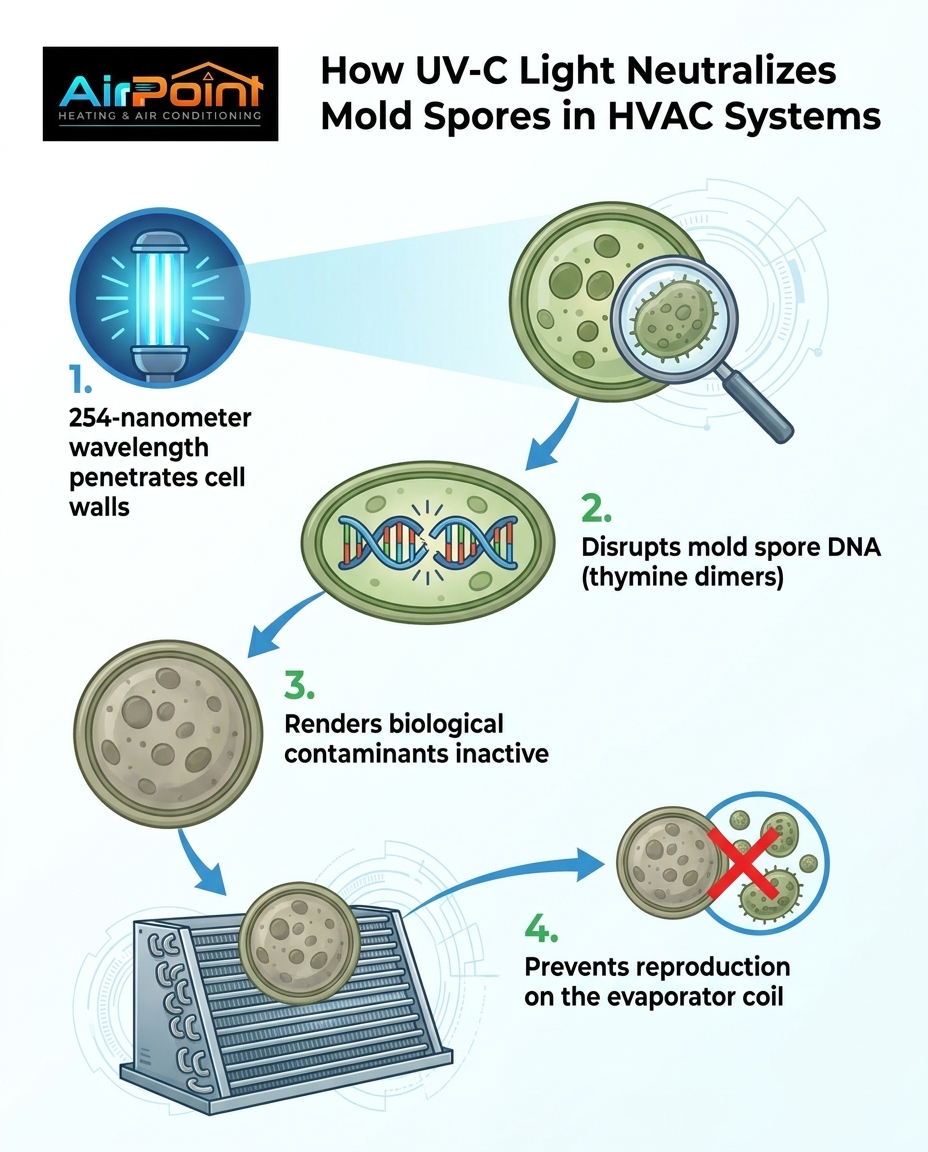
Here is the step-by-step scientific process our IAQ specialists explain when detailing how UV-C light neutralizes mold spores:
1. Targeted Wavelength Delivery: The purifier emits UV-C light at exactly 254 nanometers. This specific wavelength is scientifically proven to be the most lethal to microorganisms.
2. Cellular Penetration: As the airborne mold spore passes through the light field, the 254-nanometer light penetrates the spore's outer cell wall.
3. DNA Disruption: The UV-C energy strikes the mold's DNA, specifically targeting the thymine bases. It causes these bases to fuse together, creating what scientists call "thymine dimers."
4. Reproductive Neutralization: This genetic damage acts like a cellular roadblock. The mold spore is not necessarily "vaporized," but its DNA is so scrambled that it can no longer reproduce, grow, or cause allergic reactions. It is rendered completely inactive.
ASHRAE Standards and Proven Effectiveness
You don't have to take a manufacturer's word for it. The American Society of Heating, Refrigerating and Air-Conditioning Engineers (ASHRAE) officially recognizes UVGI as an effective method for inactivating airborne and surface-dwelling microorganisms. This is the exact same technology used to sterilize hospital operating rooms and municipal water supplies, scaled down and adapted to protect residential indoor environments.
Coil Scrubbers vs. Air Sterilization: Targeting the Source
If you decide to implement UVGI technology, the next critical decision is placement. There are two primary types of residential UV light installations, and they serve different functions based on where the biological threat originates.
• Placement — Coil Scrubbers (Surface Irradiation): Mounted directly over the indoor evaporator coil. — Air Sterilization (In-Duct Irradiation): Installed in the main supply or return air plenums.
• Operation — Coil Scrubbers (Surface Irradiation): Shines 24/7 directly onto the metal fins and drain pan. — Air Sterilization (In-Duct Irradiation): Usually wired to activate only when the blower fan is running.
• Primary Goal — Coil Scrubbers (Surface Irradiation): Prevents mold and biofilm from growing at the moisture source. — Air Sterilization (In-Duct Irradiation): Treats moving air as it circulates through the house.
• Best For — Coil Scrubbers (Surface Irradiation): Homes dealing with seasonal dampness and dirty coils. — Air Sterilization (In-Duct Irradiation): Homes focused strictly on neutralizing airborne pathogens.
For homes in Los Alamitos and coastal Orange County, coil scrubbers are generally the most critical first line of defense. Because the heavy fall moisture creates a breeding ground right on the coil, shining a UV light directly on that surface 24 hours a day eliminates the problem at its source. If the mold cannot grow on the coil, it cannot release spores into your airstream.
Protecting Your System's Infrastructure
Beyond health benefits, keeping your evaporator coil sterile has a massive impact on your system's efficiency. When our crews open up older units in Los Alamitos, we frequently find coils choked by a thin layer of biological growth (often called biofilm). Even just 1/16th of an inch of this biofilm acts as an insulator, preventing the system from absorbing heat effectively and driving up energy consumption. By keeping the coil pristine, a UV light helps your system run shorter cycles, saving energy. Furthermore, stopping mold at the coil protects your entire ductwork system from becoming contaminated downstream.
Dwell Time and Airflow: Why Professional Sizing Matters
One of the biggest reasons homeowners are sometimes disappointed with store-bought UV lights is a failure to account for "dwell time." Dwell time is the fraction of a second that a mold spore is actually exposed to the UV-C light as it flies past in the airstream.
If your typical 3-ton system pushes air at 1,200 cubic feet per minute (CFM), that air is moving incredibly fast. If you install a weak UV bulb, the spore will zip past the light so quickly that its DNA won't absorb enough energy to form those neutralizing thymine dimers. The cellular disruption will be incomplete, and the spore will survive. Calculating the exact microwatts of UV intensity needed to overcome the velocity of your specific blower motor is a complex mathematical equation.
This is why DIY installations almost always fail to deliver real air quality improvements. Furthermore, UV-C light is so powerful that it will rapidly degrade internal plastics, wire casings, and flexible ducting if it is pointed in the wrong direction. Proper shielding and strategic placement require a licensed professional.
At AirPoint Heating & Air Conditioning, our deep understanding of local microclimates means we know exactly how much early fall marine layer dampness your system is fighting. We calculate the precise dwell time required for your specific equipment, whether it is a modern variable-speed air handler or a standard single-stage furnace, and we back our professional installations with a 100% satisfaction guarantee. You get the peace of mind knowing the science is actually working for you.
Frequently Asked Questions About UV Purifiers and Mold
Do UV lights kill mold spores in the air?
Yes, UV lights successfully neutralize airborne mold spores, provided the system is properly sized for the airflow. The light must emit a 254-nanometer wavelength and the airborne spore must have sufficient dwell time in the light field. When these conditions are met, the UV-C energy destroys the spore's DNA, rendering it harmless.
Are HVAC UV lights worth the money?
For homes struggling with seasonal dampness, lingering musty odors, or recurring biological growth on their indoor coils, UV lights provide a tremendous return on value. They not only improve indoor air quality and reduce allergy triggers, but they also keep the evaporator coil clean, which helps the entire system maintain optimal SEER efficiency ratings and last longer.
Where should a UV light be installed in an HVAC system?
The optimal placement depends on your primary goal, but they are most commonly installed directly over the evaporator coil (known as a coil scrubber) or in the main supply or return duct (air sterilization). For homeowners in Los Alamitos and coastal Orange County fighting seasonal moisture, placing the light over the indoor coil is usually the best strategy to stop mold at the source.
Can UV light get rid of black mold?
UV-C light is highly effective at preventing mold growth and neutralizing free-floating spores, but it is not a magic eraser for heavy, existing infestations. If your system already has a thick layer of physical mold growth on the coils or blower wheel, that material must be professionally cleaned and removed first. The UV light is then installed to ensure it never returns.
Do HVAC UV lights cause ozone?
High-quality, professionally installed 254-nanometer UV-C lights do not produce ozone. Ozone is typically created by lower-quality, unverified aftermarket products that use different wavelengths (like 185 nanometers). When you work with a licensed professional to install a trusted, ASHRAE-recognized system, you do not have to worry about harmful ozone byproducts.
Next Steps for Proven, Science-Backed Air Quality
Dealing with early fall marine layer dampness this September 2026 doesn't mean you have to accept musty odors and seasonal allergy spikes as a normal part of life. UVGI technology is a scientifically proven, ASHRAE-recognized method for neutralizing the specific mold spores that thrive during this coastal transition. By destroying the DNA of these biological contaminants, you stop them from reproducing on your coils and circulating through your living spaces.
Remember that the best defense is a comprehensive approach. A high-quality air filter traps the physical dust and debris, while a properly sized UV-C light neutralizes the microscopic biological threats. Because calculating dwell time and protecting your system's internal components requires precision, this is not a project to tackle on your own.
If you are ready to stop masking odors and want to address the root cause of seasonal poor air quality, it is time to consult with an expert who understands your local climate. Reach out today to schedule HVAC service and let us help you evaluate your system, size the right UV purifier, and ensure your home stays healthy and comfortable all season long.
Other Blogs
Latest Blog Posts
Diagnosing Short-Cycling in Oversized Furnaces Installed During the 90s Housing Boom
Retrofitting La Mirada Mid-Century Homes with Zoning Systems for Better Temperature Control

Why Clearing Dry Leaves from Your Heat Pump is Crucial Before the Santa Ana Winds Arrive

Customer Testimonials



I recommend Air Point for your HVAC needs."