






Managing Garden Grove's Sudden September Heatwaves When You've Already Switched to Heating
Navigating Extreme Diurnal Shifts: When Mornings Freeze and Afternoons Bake
Managing Garden Grove's sudden September heatwaves when you've already switched to heating is a frustrating balancing act that tests the limits of your home's climate control system. You wake up to a chilly house, bump the thermostat to heat to take the edge off the morning air, but by early afternoon, the indoor temperature is sweltering. This rapid transition is a highly localized weather phenomenon that puts unique mechanical stress on traditional split systems. For homeowners dealing with this jarring daily cycle, the challenge isn't just staying comfortable—it is about understanding how to operate dual-function equipment without causing premature breakdowns or triggering system lockouts during the volatile September transition. To safely navigate these daily temperature swings, you need a strategy that protects your equipment while maintaining indoor comfort. At AirPoint Heating & Air Conditioning, we've helped countless local homeowners master this transition, which is why partnering with our experts for comprehensive HVAC services is the smartest first step.
The reality of thermostat whiplash: When you demand rapid, opposing functions from your heating and cooling equipment within a matter of hours, you are forcing the system to perform a high-stress pivot. Most standard residential HVAC units are engineered for seasonal shifts, not daily ones. Forcing an air conditioner to battle the afternoon sun just hours after the furnace was running requires a delicate touch at the thermostat. By understanding the mechanical realities of your system—something our technicians emphasize during every early-fall tune-up—you can avoid the costly wear and tear that typically accompanies these erratic autumn days.
The Mechanics of Garden Grove's Unpredictable Fall Weather
To understand why your climate control system struggles during the early fall, you have to look at the specific meteorological factors driving the need for rapid mode switching. Southern California is famous for its microclimates, and Garden Grove sits right in the crosshairs of competing weather patterns. During the early fall months, the coastal-adjacent morning marine layer rolls in overnight. Our service teams driving through Los Alamitos and Garden Grove early in the morning often see this thick layer of low clouds blanketing the area, keeping the early hours unusually cool and damp and prompting many homeowners to kick on their furnaces before breakfast.
The rapid burn-off effect: As the sun rises and the marine layer rapidly burns off, the environment changes drastically. This natural clearing is often accelerated by early offshore wind patterns—the precursors to the famous Santa Ana winds—which push dry, hot air down from the inland canyons and out toward the coast. The result is a drastic temperature spike by mid-day, often creating a 30 to 40-degree diurnal swing within a single eight-hour window. These Garden Grove microclimates create a highly volatile environment for indoor climate management, rendering generic, nationwide HVAC advice completely ineffective.
• Morning Marine Layer (6 AM - 10 AM) — Typical Conditions: Cool, damp, overcast with temperatures in the low 60s. — Impact on Home Comfort: Indoor spaces feel drafty and retain overnight chill. — System Demand: Light to moderate heating required to reach baseline comfort.
• Mid-Day Burn-Off (10 AM - 1 PM) — Typical Conditions: Rapid clearing, rising sun angle, dropping humidity. — Impact on Home Comfort: Solar heat gain begins warming south and west-facing rooms. — System Demand: System idle or passive ventilation recommended.
• Afternoon Heat Spike (1 PM - 5 PM) — Typical Conditions: Clear skies, offshore breezes, temperatures climbing into the 90s. — Impact on Home Comfort: House traps heat, creating a sweltering indoor environment. — System Demand: Heavy, sustained cooling demand to counteract solar gain.
Why generic advice fails: Most standard thermostat guidelines assume a gradual transition from winter to spring or summer to fall. They do not account for these drastic, same-day microclimate shifts where the morning requires a furnace and the afternoon demands maximum air conditioning. Understanding this localized weather pattern is the first step in protecting your equipment from the mechanical shock of sudden operational pivots.
Why Same-Day Mode Switching Strains Traditional Split Systems
The mechanical risks associated with flipping a thermostat from heat to cool too quickly are rooted in the basic physics of refrigeration. Traditional split systems consist of an indoor furnace and an outdoor air conditioning condenser. These two components share a blower motor and ductwork, but they operate using entirely different mechanical processes. When you run the heater all morning, the indoor blower and heat exchanger get incredibly hot. If you suddenly switch the thermostat to cooling mode to combat the 2 PM heavy cooling load, you are forcing the system to push chilled air over components that are still radiating residual heat.
The physics of refrigerant pressures: Beyond the temperature clash, the real danger lies in the refrigerant lines. When an air conditioner shuts off, the high-pressure and low-pressure sides of the refrigerant loop need time to equalize. If you abruptly switch modes and demand immediate cooling, the compressor is forced to start against an unequalized, high-pressure load. This is the equivalent of trying to pedal a bicycle uphill in the highest gear from a dead stop. Over time, this extreme mechanical strain degrades the compressor's internal valves and electrical windings. Our repair crews frequently replace compressors that have succumbed to this exact type of stress, which is why properly maintaining your heating systems and cooling components is so critical when dealing with unpredictable weather.
The Danger of Compressor Lockouts
What is a compressor lockout? A compressor lockout is a built-in safety mechanism designed to protect your air conditioner from catastrophic failure. Modern control boards monitor the electrical draw and pressure states of the system. If the system detects that the compressor is struggling to start due to unequalized pressures—often caused by rapid mode switching—it will intentionally lock the compressor out, preventing it from turning on at all.
Why equalization time matters: The lack of equalization time directly triggers this protective mechanism. When a lockout occurs, the indoor fan may still blow, but the air coming from the vents will be room temperature because the outdoor condenser is shut down. Resetting a locked-out system usually requires shutting the power off at the breaker, waiting several minutes, and turning it back on. Our technicians find that older, single-stage equipment is particularly vulnerable to this structural stress, as these units lack the sophisticated soft-start technology found in modern, variable-speed systems. Standard heating equipment simply isn't designed to be immediately followed by intense, sudden AC usage without a proper resting period.
Safe Thermostat Strategies to Prevent System Damage
To prevent system damage during the volatile September transition, you need actionable, authoritative strategies for configuring your thermostat. At AirPoint Heating & Air Conditioning, we always advise our customers that managing extreme daily temperature swings requires more than just reacting to how the room feels; it requires proactive settings that protect the mechanical integrity of your HVAC equipment.
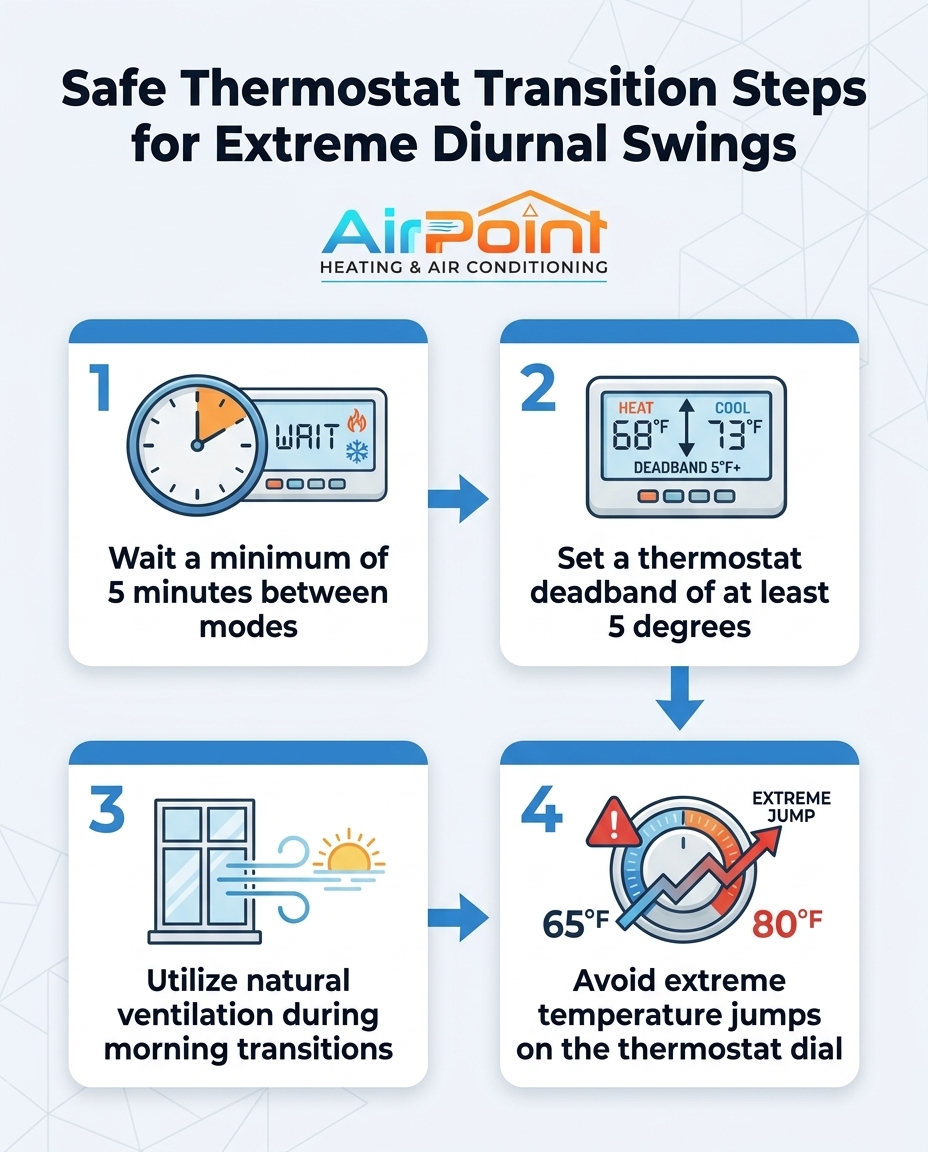
1. Enforce the 5-Minute Rule: The most critical rule of same-day mode switching is waiting at least 5 minutes before flipping the system from heating to cooling. When you turn off the heat, leave the thermostat in the "Off" position for a full 5 to 10 minutes. This mandatory resting period allows the indoor heat exchanger to cool down and, more importantly, gives the refrigerant pressures in the outdoor unit time to fully equalize. This simple pause is the best defense against compressor lockouts and ensures reliable air conditioning performance when you finally call for cooling.
2. Set a Wide Thermostat Deadband: A "thermostat deadband" is the temperature gap between your heating setpoint and your cooling setpoint when the system is set to "Auto." For example, if you set the heat to kick on at 68°F and the AC to kick on at 74°F, your deadband is 6 degrees. During extreme diurnal shifts, we recommend setting a deadband of at least 5 to 7 degrees. This prevents the system from rapidly bouncing back and forth between heating and cooling modes as the indoor temperature fluctuates slightly.
3. Limit the Use of 'Auto' Mode: While the 'Auto' setting on smart thermostats is convenient, it has severe limitations during extreme swings. If the deadband is too narrow, a smart thermostat might trigger the AC immediately after the furnace satisfies the heating demand, denying the system its necessary equalization time. During the shoulder season, manual control with deliberate resting periods is often safer for older equipment than relying on aggressive algorithmic switching.
4. Utilize Natural Morning Ventilation: Before the afternoon heat sets in, take advantage of the transition period. If the morning marine layer has burned off but the outside air is still in the low 70s, turn the HVAC system off entirely and open the windows. Flushing the house with fresh, temperate air delays the need for mechanical cooling and provides a natural buffer period for the equipment to rest.
Why Heat Pumps Excel in Southern California's Shoulder Seasons
While traditional split systems struggle with the whiplash of erratic fall weather, heat pumps are engineered specifically for these conditions. A heat pump is a dual-function system that handles both heating and cooling from a single outdoor unit. Instead of burning fuel to create heat, a heat pump uses a reversing valve to absorb ambient heat from the outside air and transfer it indoors. When the afternoon sun hits, that same reversing valve shifts position, and the system seamlessly transitions to air conditioning mode, pulling heat out of your home.
Unmatched efficiency for moderate mornings: Heat pumps are uniquely suited for Garden Grove microclimates because they offer incredible energy efficiency during moderate morning cold. While a gas furnace blasts intense, high-temperature heat that can quickly overshoot a comfortable temperature, a heat pump provides a steady, gentle warmth that perfectly counteracts a 60-degree morning without turning the house into a sauna.
Handling sudden heatwaves with inverter technology: Modern heat pumps utilize inverter-driven compressors, which operate much like the accelerator pedal on a car. Instead of turning on at 100% capacity and shutting off abruptly like older single-stage units, an inverter compressor ramps up and down smoothly to match the exact cooling load required. This means when the afternoon heat spike hits, the system adjusts its output dynamically, eliminating the harsh wear-and-tear of sudden, full-blast starts. Upgrading to these systems can permanently resolve the comfort inconsistencies common in older homes. In fact, our AirPoint installation team recently helped a local homeowner upgrade their aging setup right before the hottest days of the year, investing in a new AC and heating unit installation. Because the new dual-function system was matched perfectly to the home's square footage, the house maintained the perfect temperature even when the outdoor heat was at its absolute peak.
Deep local expertise matters: Maximizing the benefits of a heat pump requires deep local expertise in optimizing these dual-function systems specifically for Southern California's unpredictable microclimates. Properly sizing the equipment and configuring the airflow for both heating and cooling ensures that the system transitions smoothly without overworking. Investing in professional heat pump installation and maintenance with a trusted local team is the most effective way to future-proof your home against extreme daily temperature swings.
Identifying Transition Stress in Aging Equipment
Even with perfect thermostat management, older HVAC systems will eventually show signs of fatigue when forced to handle severe daily temperature swings. Homeowners need to be able to recognize when their current system is failing to handle the stress of the 2 PM heavy cooling load. Transition stress manifests in several distinct ways, and catching these symptoms early can mean the difference between a simple repair and a catastrophic system failure.
Auditory signs of system stress: We always tell our customers to pay close attention to the sounds the outdoor condenser makes when it kicks on in the afternoon. If you hear loud clanking, heavy grinding, or a buzzing sound that doesn't immediately result in the fan spinning, the compressor is struggling against high refrigerant pressures. Delayed starts—where the thermostat clicks but the system hesitates for several minutes before roaring to life—are a clear indicator that the electrical components (like the capacitor or contactor) are wearing out under the strain of rapid mode switching.
Performance drop-offs: A struggling system will inevitably fail to keep up with the intense afternoon heat after running the heater all morning. You might notice that the air coming from the vents feels lukewarm rather than crisp, or the system runs continuously without ever reaching the set temperature on the thermostat. This short-cycling and diminished capacity often point to a system that is fundamentally overwhelmed by the rapid environmental shift.
• Loud clanking or grinding on startup: Indicates compressor strain or unequalized refrigerant pressures.
• Short-cycling: The system turns on and off rapidly without fully heating or cooling the space.
• Delayed engagement: The thermostat calls for cooling, but the outdoor unit hesitates or hums before starting.
• Lukewarm airflow: The system is running, but failing to remove heat efficiently during the afternoon peak.
The value of pre-season intervention: Continuous transition stress accelerates the end-of-life for older, run-down units. Addressing these issues before the system is pushed to its absolute limits is vital. For example, during a recent early-fall service call, our technicians inspected a very old and run-down HVAC unit that was struggling with the daily temperature shifts. Our thorough tune-up revealed multiple stress points. By fixing a leaky compressor, topping off the refrigerant, rewrapping the coolant pipe, and replacing clogged filters, our technician was able to restore efficiency and get the aging system running smoothly again. Catching a leaky compressor or degraded coolant line early prevents the unit from destroying itself when the intense afternoon heat demands maximum performance.
Long-Term Preparation for Unpredictable Fall Weather
Managing the volatile September transition requires more than just reactive thermostat adjustments; it demands proactive, long-term preparation. As the weather continues to fluctuate wildly between chilly mornings and sweltering afternoons, ensuring your equipment is optimized for both modes is the only way to guarantee uninterrupted comfort. A system that is struggling to pivot now will likely face even bigger challenges when the deeper, more consistent winter cold finally arrives.
The importance of professional evaluation: Having a professional evaluate your system's transition capabilities provides peace of mind. When you schedule a pre-season tune-up with AirPoint Heating & Air Conditioning, our licensed technicians will test the reversing valve on a heat pump, check the electrical draw of the compressor during startup, and verify that the refrigerant pressures are equalizing correctly. This comprehensive evaluation ensures that your system isn't secretly destroying itself every time the weather shifts.
Looking ahead to the next season: Preparing your dual-function system for the months ahead is an ongoing process. By staying ahead of the maintenance curve, you can extend the lifespan of your equipment and lower your monthly energy usage. For a deeper dive into optimizing your system as the seasons change, you can learn more about preparing your heat pump for the shift from cooling to heating mode. Taking action now ensures that when the morning freeze hits, your home stays warm, and when the afternoon bakes, your cooling system is ready to respond flawlessly.
Frequently Asked Questions
Is it bad to switch from heat to AC in the same day?
Switching from heat to AC on the same day is not inherently bad, provided you allow the system adequate time to rest between modes. If you switch modes too quickly, you risk forcing the compressor to start under extreme pressure, which can cause significant mechanical wear. Always build in a buffer period to let the equipment equalize.
How long should I wait before switching from heat to AC?
We recommend waiting a minimum of 5 minutes after turning off the heat before activating the air conditioning. This crucial resting window allows the high and low-pressure sides of the refrigerant lines to balance out. Waiting protects the compressor from electrical overloads and prevents the system from triggering a safety lockout.
What is a thermostat deadband and why does it matter?
A thermostat deadband is the temperature gap between your heating and cooling setpoints when the system is operating in "Auto" mode. Setting a deadband of at least 5 degrees is essential because it prevents the HVAC system from rapidly cycling back and forth between heating and cooling as the room temperature fluctuates slightly.
Can switching from heat to cool damage my compressor?
Yes, abruptly switching from heat to cool without a waiting period can severely damage your compressor over time. Starting a compressor against unequalized refrigerant pressure forces it to work exponentially harder, which can degrade internal valves and overheat the electrical windings, eventually leading to a complete breakdown.
Why does my AC struggle to cool the house in the afternoon after running the heater?
Your AC may struggle because the indoor blower and ductwork are still retaining residual heat from the morning furnace cycle, forcing the AC to overcome that thermal load first. Additionally, if the system is older, the mechanical stress of the rapid transition may cause it to run inefficiently during peak afternoon temperatures.
Are heat pumps better for Garden Grove's fall weather than traditional split systems?
Heat pumps are generally superior for highly variable microclimates because they are engineered specifically as dual-function systems that transition seamlessly between heating and cooling. Their inverter-driven compressors adjust output dynamically, providing gentle morning warmth and robust afternoon cooling without the harsh mechanical shock experienced by traditional single-stage units.
Other Blogs
Latest Blog Posts

The Essential Fall Home Maintenance Checklist: Decoding HVAC Startup Smells

Finding Your Efficiency Sweet Spot: Using a SEER Savings Calculator for HVAC Upgrades

Common Homeowner Questions Answered: Why Does My Heater Smell Like Burning Dust?

Customer Testimonials



I recommend Air Point for your HVAC needs."