






Is a Mini Split Better Than Central Air? The Quick Answer for Los Alamitos Homeowners
The central ac vs ductless mini split comparison comes down to one key factor: whether your home already has ductwork — and how well it's working.
Here's a fast side-by-side look to help you decide:
| Factor | Central AC | Ductless Mini Split |
|---|---|---|
| Requires ductwork | Yes | No |
| Energy efficiency (SEER2) | Up to 21+ | Up to 38+ |
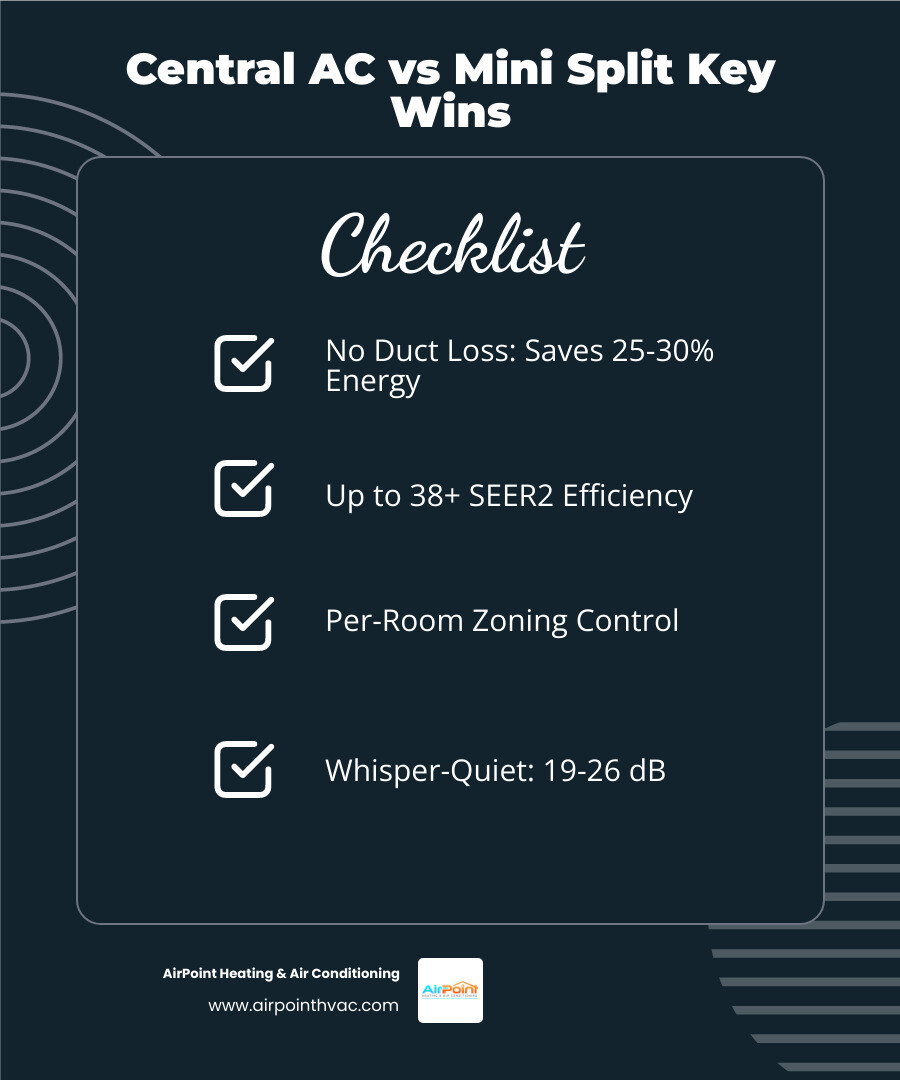
| Energy loss from ducts | 25-30% | None |
| Zoning / room control | Limited | Yes, per room |
| Best for | Large homes with existing ducts | Older homes, additions, zoned comfort |
| Heating capability | Needs separate furnace | Built-in heat pump option |
| Indoor noise level | Moderate (airflow sound) | Very quiet (19-26 dB) |
| Installation disruption | High (if no ducts exist) | Low (3-inch wall hole) |
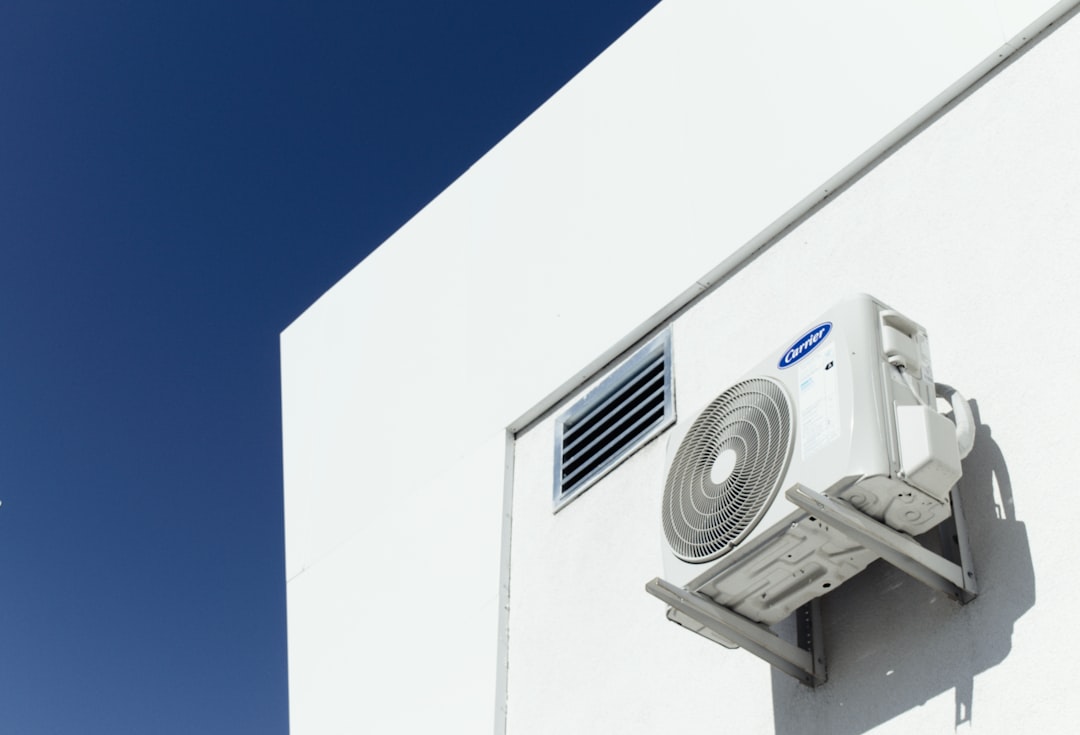
Both systems use refrigerant and an outdoor condenser to move heat out of your home. The big difference is how they deliver conditioned air indoors. Central AC pushes air through a network of ducts that runs throughout your home. Ductless mini splits send cooled air directly into each room through wall-mounted units — no ducts needed.
For many Orange County homeowners — especially those in older Los Alamitos homes, homes with room additions, or households dealing with uneven temperatures — ductless systems offer a significant efficiency advantage. According to the U.S. Department of Energy, typical duct systems lose 25 to 30 percent of cooling energy through leaks and poor insulation. That's real money gone every month on your energy bill.
That said, central AC remains a strong choice for larger homes with well-sealed, existing ductwork. There's no single winner — it depends on your home's layout, your comfort goals, and your current setup.
Understanding the central ac vs ductless mini split comparison
When we talk about cooling your home in 2026, we are really looking at two different philosophies of comfort. One is the "whole-home" approach, and the other is "surgical precision." To make the best choice for your family, it helps to understand the basic science behind how these systems differ.
Think of central AC like a whole-home audio system where speakers are built into every ceiling. You turn it on, and music plays everywhere. A ductless mini split is more like having high-quality Bluetooth speakers in each room; you only play music where you’re actually sitting, and everyone can choose their own volume.
Both systems rely on the same refrigeration cycle. They use an outdoor condenser unit to release heat and an indoor evaporator coil to absorb it. However, the way that cold air gets to your living room or bedroom is where the central ac vs ductless mini split comparison gets interesting.
How Central Systems Operate
Central Air Conditioning is often referred to as a "split system." It features a large outdoor condenser connected to an indoor air handler (usually located in a garage, attic, or closet).
The air handler uses a powerful blower fan to push cooled air through a vast network of ductwork. This air enters your rooms through supply registers and returns to the system through return vents. It is a "forced air" principle designed to maintain a uniform temperature throughout the entire house based on a single central thermostat.
The Mechanics of Ductless Technology
Ductless mini splits skip the "middleman" (the ducts). Instead, the outdoor unit is connected directly to one or more indoor wall-mounted heads via a slim conduit. This conduit houses the power cable, refrigerant lines, and a condensate drain.
These systems utilize advanced inverter technology. While older central AC units are often "all or nothing"—turning on at full blast and then shutting off—mini splits use variable-speed compressors. They can slow down or speed up to maintain a perfectly steady temperature. This prevents that annoying "blast of cold air followed by a warm lull" that many of us experience with older systems.
Efficiency and Performance: SEER2 and Duct Loss
Efficiency is the primary battleground in the central ac vs ductless mini split comparison. In April 2026, energy standards are stricter than ever. We now use SEER2 (Seasonal Energy Efficiency Ratio 2) to measure how much cooling a system provides per watt of electricity used.
Why Ductless Leads the central ac vs ductless mini split comparison in Efficiency
If you’re looking for the highest possible efficiency, ductless is the clear winner. While high-end central AC systems can reach 21 to 26 SEER2, ductless mini splits frequently soar into the 30s, with some ultra-efficient models hitting 38 or higher.
The secret isn't just the technology inside the machine; it's the lack of ducts. When you eliminate the ductwork, you eliminate "thermal bypass" and energy loss. Because the air is cooled right there in the room, there is nowhere for that cold air to escape before it reaches you. This can lead to energy savings of up to 30% compared to traditional forced-air systems.
The Impact of Ductwork on Central AC
Ductwork is the "Achilles' heel" of central air. The Department of Energy points out that typical duct systems lose about 25% to 30% of their cooling energy. Imagine buying a gallon of milk but having 30% of it leak out of the bag before you get home—that’s exactly what happens in many homes with leaky or poorly insulated ducts.
In our local areas like Huntington Beach or Irvine, many homes have ducts running through hot attics. If those ducts have even minor leaks or thin insulation, your AC has to work much harder to overcome the heat gain. If your current ducts are in bad shape, you might need Ductwork Repair or even a full Ductwork Replacement in Huntington Beach to make a central system worth the investment.
Installation Factors for Orange County Homes
Choosing a system often comes down to the bones of your house. We see a wide variety of home styles across Orange County, from historic bungalows in Seal Beach to sprawling new estates in Yorba Linda.
Retrofitting Older Homes in Seal Beach
If you live in a historic home that wasn't built with central air, installing a traditional system can be a nightmare. Tearing into plaster walls or sacrificing closet space to run 12-inch ducts is invasive and messy.
This is where the mini split shines. Installation only requires a small 3-inch hole in the exterior wall for the refrigerant lines. It’s a non-invasive setup that preserves the architectural integrity of your home while providing modern comfort. For room additions, converted garages, or sunrooms, Ductless units are almost always the most practical choice.
New Construction and Large Layouts
For large, open-concept homes that are already equipped with functional, well-sealed ductwork, central AC remains the gold standard. It provides whole-home coverage with "invisible" aesthetics—all you see are small vents in the ceiling or floor.
Central systems also allow for integrated Air Conditioning solutions that manage the entire home's climate from one interface. If you are building a new home or doing a "down-to-the-studs" renovation, central air is often the most cost-effective way to cool a large square footage.
Comfort, Zoning, and Indoor Air Quality
Beyond the energy bills, the central ac vs ductless mini split comparison is about how your home actually feels.
| Feature | Central AC | Ductless Mini Split |
|---|---|---|
| Zoning | Possible with expensive dampers | Built-in (each head is a zone) |
| Noise | Noticeable "whoosh" of air | Whisper-quiet (19-26 dB) |
| Air Filtration | Superior (whole-home HEPA) | Basic (washable filters) |
| Aesthetics | Hidden/Invisible | Visible wall-mounted units |
Precision Zoning Control
One of our favorite features of ductless technology is the power of zoning. In a traditional central system, the thermostat is usually in the hallway. If your master bedroom gets sun all afternoon, it might stay hot while the rest of the house is freezing.
With a multi-zone mini split, every family member can set their bedroom to their own personal comfort level. You can even turn off the cooling entirely in guest rooms or home offices when they aren't being used, leading to massive energy conservation.
Air Filtration and Humidity
When it comes to Indoor Air Quality, central AC has a slight edge. Because all the air in the house passes through a single air handler, we can install high-efficiency HEPA filters, UV lights, and whole-home humidifiers or dehumidifiers directly into the system.
Ductless units do have filters, but they are smaller and generally less robust than whole-home systems. However, because mini splits run almost constantly at lower speeds (thanks to inverter technology), they are actually excellent at removing humidity from the air, which is a major plus for our coastal communities like Newport Beach and Laguna Beach.
Maintenance and System Longevity
Both systems are a significant investment in your home's value. With proper Services and annual maintenance, you can expect either system to last 15 to 20 years.
Routine Care for Ductless Units
Ductless units require a bit more "hands-on" care from the homeowner. We recommend cleaning the reusable filters every 2 to 4 weeks, especially if you have pets. Because the indoor unit is right there in the room, dust can build up quickly on the coils if the filters aren't kept clean.
A professional annual tune-up is still essential for both systems. This ensures your refrigerant levels are correct and your electrical components are safe. For central systems, we also recommend periodic duct inspections to ensure you aren't cooling the neighborhood through a disconnected pipe in the attic.
Final Verdict: Your central ac vs ductless mini split comparison Checklist
Still undecided? Use this quick checklist to see which way your home is leaning:
- Do you have existing ductwork? If yes, and it's in good shape, Central AC is likely your best bet.
- Are you cooling a new addition or a specific "hot" room? Ductless is the winner here.
- Is energy efficiency your #1 priority? Ductless takes the trophy.
- Do you mind seeing a unit on your wall? If you want "invisible" cooling, stick with Central AC.
- Does your family fight over the thermostat? Ductless zoning will save your sanity.
Frequently Asked Questions about Cooling Systems
Can both systems provide heating in Southern California?
Yes! Most modern mini splits are actually heat pumps. They can reverse their operation to pull heat from the outdoor air and move it inside. In our moderate Southern California climate, a ductless Heat Pump is an incredibly efficient way to stay warm in the winter without needing a separate gas furnace.
Which system is quieter for bedrooms and home offices?
Ductless mini splits are the champions of quiet. Most indoor units operate at 19 to 26 decibels—that is literally softer than a whisper or the sound of rustling leaves. While central AC isn't necessarily "loud," you will always hear the "whoosh" of air moving through the vents and the sound of the large blower motor starting up. For noise-sensitive areas, Ductless is the way to go.
Is a hybrid approach possible for multi-story homes?
Absolutely! This is a very popular solution in cities like Fullerton and La Mirada. Many homeowners use a traditional central AC for the main downstairs living areas but install a mini split for a "problem" upstairs bedroom or a finished attic that the central system struggles to cool. This "hybrid" approach gives you the best of both worlds: whole-home coverage and precision control where you need it most.
Conclusion
Choosing between central AC and a ductless mini split isn't about finding a universal "winner"—it's about finding the right fit for your specific Orange County home. Whether you need the invisible power of a central system or the surgical efficiency of a mini split, our team is here to help you navigate the central ac vs ductless mini split comparison with ease.
At AirPoint Heating & Air Conditioning, we are a family-owned, award-winning business dedicated to the philosophy that "comfort is happiness." From Los Alamitos to Mission Viejo, we provide expert HVAC solutions backed by a 100% satisfaction guarantee. We don't just fix air conditioners; we ensure your home is the sanctuary you deserve.
Ready to upgrade your home comfort? Contact us today to find the perfect ductless solution for your home or to schedule a precision tune-up for your existing central system. Our team is here to provide the fast, reliable service you can trust.
Other Blogs
Latest Blog Posts
Home Maintenance Tips: Troubleshooting a Burning Smell During Your Fall Heating Startup
Home Maintenance Tips and Troubleshooting: Navigating Your First Fall Heater Startup
Common Homeowner Questions Answered: Is That Fall Heater Burning Smell Normal?

Customer Testimonials



I recommend Air Point for your HVAC needs."