






The Ultimate Guide to How Clean Ducts and Air Filtration Reduce Mold Risk

Why Mold Loves Your HVAC System — And What You Can Do About It
Understanding how clean ducts and air filtration reduce mold risk starts with one uncomfortable fact: your HVAC system touches every room in your home. When mold takes hold inside ductwork or on components like the evaporator coil, every time your system runs, it pushes spores into the air your family breathes — in the living room, the bedrooms, everywhere.
Here's a quick summary of how clean ducts and proper air filtration work together to lower mold risk in your home:
- Remove food sources - Regular duct cleaning eliminates the dust, pet dander, and organic debris that mold spores feed on to grow
- Reduce moisture buildup - Clean, well-maintained systems drain condensation properly, cutting off mold's most essential ingredient
- Trap airborne spores - High-efficiency filters (MERV 13+ or true HEPA) capture mold spores before they can settle and colonize new surfaces
- Improve airflow - Clear ducts maintain consistent air movement, which prevents the stagnant, damp pockets where mold thrives
- Enable early detection - Routine inspections catch moisture problems and early mold growth before they spread throughout the system
Americans spend roughly 90% of their time indoors, according to the EPA — making indoor air quality a genuine health concern, not just a comfort issue. In Orange County, where coastal humidity from areas like Newport Beach and Huntington Beach adds extra moisture to the equation, the risk inside HVAC systems is even higher.
This guide walks you through exactly what causes mold to grow in your ducts, how the right filtration and maintenance habits stop it, and when it's time to call in a professional.
Understanding the Connection Between HVAC Systems and Mold Growth
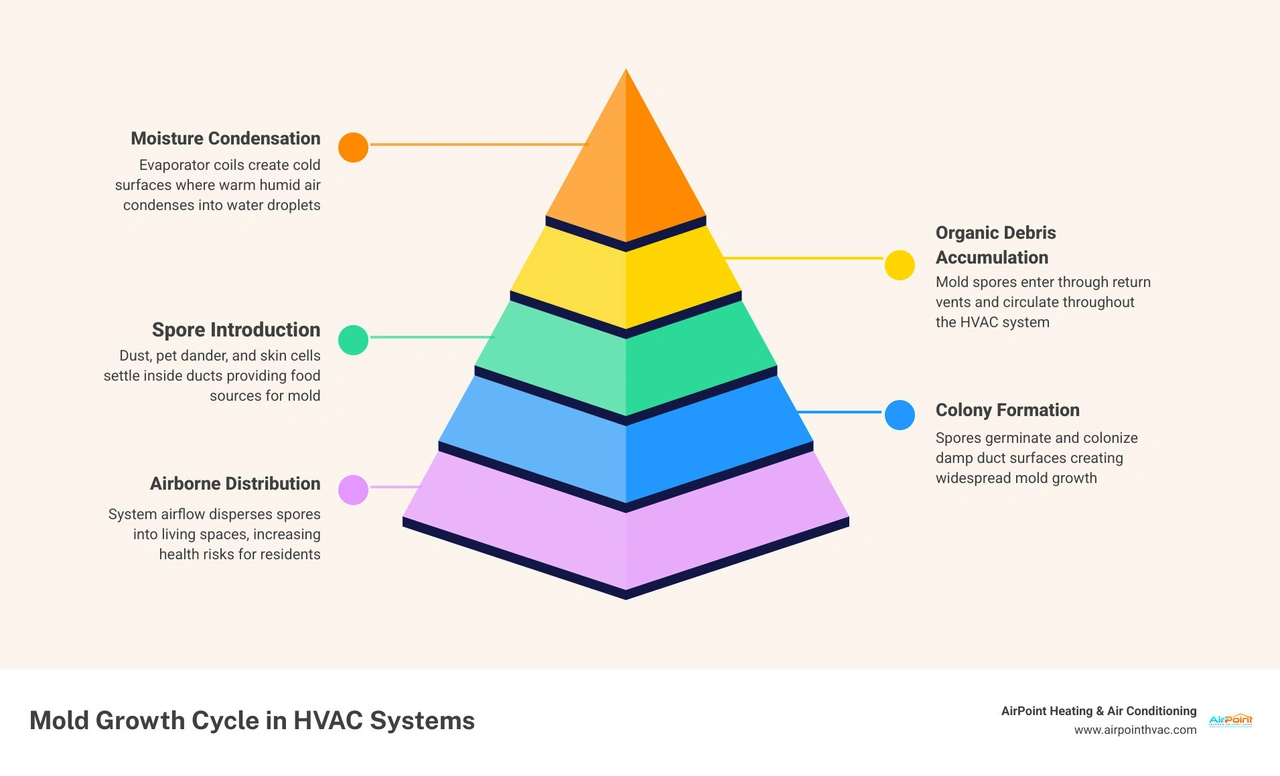
To stop mold, we first have to understand why it views your HVAC system as a five-star resort. Mold requires three primary ingredients to thrive: moisture, warmth, and a food source. Unfortunately, a neglected HVAC system can provide all three in abundance.
The "warmth" is often provided by our Southern California climate or the heat generated by the system's motor. The "food" comes from the accumulation of household dust and organic debris. But the most critical factor is moisture. Inside your air handler, the evaporator coil gets very cold to remove heat from your home. As warm air passes over it, water condenses on the coil—much like sweat on a cold glass of lemonade on a July day in Yorba Linda.
If this moisture doesn't drain away properly, or if the air ducts themselves are poorly insulated, condensation begins to pool. This creates a damp environment where mold spores, which are naturally present in almost all air, can settle and begin to grow. How Coastal Humidity Creates Mold Risk is a major factor for our neighbors along the coast, where the air is naturally more saturated.

Common Moisture Sources in Orange County Homes
Living in places like Newport Beach or Huntington Beach means we deal with higher outdoor humidity than inland areas like Whittier or La Mirada. However, moisture isn't just an outdoor problem. We often see mold risk increase due to:
- Clogged Condensate Lines: If the drain line from your AC is blocked, water backs up into the drain pan, creating a standing pool of water right next to your airflow.
- Uninsulated Ductwork: When cold air travels through metal ducts located in a hot attic (common in older Downey or Lakewood homes), the temperature difference causes the outside of the duct to "sweat." If there are leaks in the duct joints, this moisture can pull into the system.
- Poor Bathroom/Kitchen Ventilation: If your exhaust fans aren't venting moisture directly outside, that humid air stays in the house and eventually gets pulled into the return vents of your HVAC system.
How Clean Ducts and Air Filtration Reduce Mold Risk in Your Home
You might wonder, "If mold is caused by moisture, why does cleaning the dust out of my ducts matter?" The answer lies in the "food" we mentioned earlier. Mold cannot grow on bare, clean sheet metal. It needs organic matter to latch onto.
By scheduling professional duct cleaning, we remove the "soil" that mold needs to take root. When we talk about Enhancing Indoor Air Quality, we are really talking about breaking the mold growth cycle. Without dust and debris to feed on, spores that enter the system simply pass through or get caught by the filter rather than starting a colony.
Why Clean Ducts and Air Filtration Reduce Mold Risk by Removing Food Sources
Household dust is more than just "dirt." It is a buffet for mold, consisting of:
- Skin cells and pet dander: Organic proteins that mold loves.
- Microscopic fibers: From carpets, clothes, and furniture.
- Pollen and outdoor spores: Pulled in every time a door opens in Anaheim or Fullerton.
When these materials settle in your ducts, they create a porous layer that holds onto moisture. This damp "blanket" of dust is exactly where mold colonies begin. By keeping the ducts clean, you are effectively "starving" potential mold growth.
How Clean Ducts and Air Filtration Reduce Mold Risk Through Improved Airflow
Airflow is mold's enemy. Mold thrives in stagnant, humid pockets. When your ducts are restricted by heavy dust or when your air filter is so clogged that air can barely move, the velocity of the air drops. This allows moisture to linger on the coils and inside the plenums longer than it should.
Properly maintained ducts ensure that air moves at the designed speed, which helps evaporate minor condensation before it can cause trouble. Furthermore, high-quality filtration prevents the "Dirty Sock Syndrome"—a situation where bacteria and mold grow on the damp evaporator coil, creating a locker-room smell throughout your home in Seal Beach or Cypress.
The Role of Advanced Filtration and HEPA Technology
If clean ducts are the "defense," then advanced air filtration is your "offense." Standard 1-inch fiberglass filters (the cheap ones you can see through) are designed to protect the HVAC equipment from large dust bunnies, but they do almost nothing to stop microscopic mold spores.
To truly reduce mold risk, we recommend moving up the MERV (Minimum Efficiency Reporting Value) scale. Mold spores typically range from 1 to 20 microns in size. A MERV 13 filter is significantly more effective at capturing these than a MERV 8. For the ultimate protection, many homeowners in Los Alamitos are opting for Whole House Air Filtration systems that utilize HEPA technology.
| Filter Type | Efficiency on Mold Spores (1–20 microns) | Best Use Case |
|---|---|---|
| Fiberglass (MERV 1-4) | Less than 20% | Protecting the furnace motor only; not for IAQ. |
| Pleated (MERV 8) | Approximately 70-85% | Standard protection for homes without allergies. |
| High-Efficiency (MERV 13) | Over 90% | Recommended for mold prevention and allergy relief. |
| HEPA Filter | 99.97% (down to 0.3 microns) | Medical-grade protection; captures almost all spores. |
Capturing Spores Before They Settle
HEPA (High-Efficiency Particulate Air) filters are the gold standard. They are rated to capture 99.97% of particles as small as 0.3 microns. Since mold spores are much larger than that, a HEPA filter is essentially a brick wall for mold.
By integrating these into your system or using standalone units in damp-prone areas like basements or laundry rooms, you stop the spores from ever reaching the "food sources" in your ductwork. If you're looking for the Best Home Air Filtration in Huntington Beach, focusing on HEPA or high-MERV media filters is the most effective path forward.
Preventive Maintenance Strategies for Orange County Homeowners
We often tell our customers that "an ounce of prevention is worth a gallon of mold cleaner." Because mold can begin to grow in as little as 24 to 48 hours after a water event, staying ahead of moisture is vital.
The goal is to keep your indoor relative humidity between 30% and 50%. In more humid months in Laguna Beach or Newport Beach, you might need a whole-home dehumidifier to achieve this. When humidity stays below 50%, mold has a very difficult time germinating, even if spores and food sources are present. Check out our Indoor Air Quality Solutions Complete Guide for a deeper dive into humidity management.
Essential Maintenance Checklist
To keep your home mold-free, we suggest following this simple monthly and annual schedule:
- Check the Filter Monthly: Especially during peak summer and winter months in Irvine or Mission Viejo. If it looks gray or "fuzzy," replace it.
- Inspect the Drain Pan: Look at your indoor unit (usually in a closet or attic). If you see standing water in the pan, your drain line is likely clogged.
- Clean the Registers: Use a damp cloth to wipe down the metal slats of your supply vents. If you see black "dust" that feels greasy or smears, it might be mold, and you should call us for an inspection.
- Listen for "Sloshing": If your AC sounds like a washing machine, water isn't draining. Shut it off and call for service immediately to prevent a mold-inducing flood.
- Schedule Annual Tune-Ups: We check the evaporator coil, clean the condensate lines, and inspect duct integrity to ensure no moisture is sneaking in.
Frequently Asked Questions About HVAC Mold Prevention
When does the EPA recommend professional duct cleaning for mold?
The EPA suggests duct cleaning is appropriate when there is "substantial visible mold growth" inside hard-surface ducts or on other components of your heating and cooling system. However, they also note that many sections of your system may not be accessible for a visual inspection. If you smell a persistent musty odor only when the air turns on, or if you have visible growth covering more than 10 square feet, professional remediation is required. We often use laboratory confirmation (sticky tape samples) if there is any doubt about whether a substance is actually mold.
Can air purifiers actually kill mold growing inside vents?
This is a common misconception. Air purifiers with HEPA filters are excellent at trapping spores that are already floating in the air, but they cannot "reach" into your vents to kill an active colony growing on the duct liner. To stop mold inside the vents, you must physically remove the mold and the moisture source. However, we often recommend installing UV-C germicidal lights inside the air handler. These lights shine directly on the evaporator coil 24/7, destroying the DNA of mold and bacteria so they cannot reproduce on the system's dampest components.
How often should I replace my HVAC filters to prevent mold?
For most Orange County homes, we recommend every 1 to 3 months. If you live in a dustier area near construction in Buena Park or have multiple pets in Garden Grove, you should lean toward the 1-month mark. Using high-efficiency pleated filters is better than the basic ones, but remember: a high-efficiency filter that is clogged is worse for mold risk than a clean, lower-efficiency filter because it kills the airflow your system needs to stay dry.
Conclusion: Breathe Easier with AirPoint
At AirPoint Heating & Air Conditioning, we believe that "comfort is happiness," and nothing ruins home comfort faster than the smell of mold or the respiratory issues it causes. As a family-owned, award-winning business based in Los Alamitos, we’ve seen how clean ducts and air filtration reduce mold risk for our neighbors across Orange County.
Whether you are in Long Beach, Rossmoor, or Yorba Linda, our licensed and certified technicians are ready to help you take control of your indoor air. From precision tune-ups that catch moisture leaks to the installation of medical-grade filtration systems, we back all our work with a 100% satisfaction guarantee.
Don't let your HVAC system become a breeding ground for mold. Take the first step toward a healthier home today.
Concerned about the air quality in your house? We can help! View our Indoor Air Quality Solutions for fast, honest service in Orange County.
Other Blogs
Latest Blog Posts
How to Inspect Your Attic Ductwork for Rodent Damage Before Winter Sets In
Addressing Fullerton's Unique Microclimate Shifts During Fall HVAC Transitions
Why We Check Your Carbon Monoxide Detectors Before Firing Up Older Gas Furnaces

Customer Testimonials




I recommend Air Point for your HVAC needs."