






Why We Check Your Carbon Monoxide Detectors Before Firing Up Older Gas Furnaces
The Silent Risk Hiding in Aging Gas Furnaces
You wake up to the first real chill of the season, and the immediate temptation is to walk over to the thermostat and switch it to "heat" just to see if the system still works. But here is the thing: understanding exactly why we check your carbon monoxide detectors before firing up older gas furnaces can be the difference between a cozy morning and a serious safety hazard. Aging gas furnaces in Los Alamitos often sit entirely dormant over the long summer months. During that extended off-season, invisible heat exchanger cracks can develop deep inside the cabinet, creating a silent risk that homeowners cannot see or smell.
This hidden deterioration is exactly why our technicians refuse to initiate the first ignition of an older gas furnace without verifying that carbon monoxide (CO) protection is active and functioning in your home. It is not about adding extra steps to a service call; it is a strict standard of care designed to protect your family. We treat the invisible threat of a cracked heat exchanger as a "when, not if" scenario for older systems. If you want to ensure the safety and reliability of your home's heating systems, a professional evaluation is the only way to proceed with confidence.
The Hidden Danger of a 9-Month Furnace Dormancy
The mild weather we enjoy in Southern California is undoubtedly a blessing, but it creates a unique and often overlooked risk for residential heating equipment. In the Los Alamitos area, furnaces frequently sit dormant for eight to nine months out of the year. While the system is completely powered down and ignored, ambient humidity, temperature fluctuations, and residual moisture slowly go to work on the aging metal components inside your unit.
One local homeowner reached out to us during the winter regarding an old, run-down HVAC unit that had developed a leaky compressor and was severely showing its age. By performing a complete and meticulous tune-up—which included fixing the compressor, topping off coolant, rewrapping pipes, replacing heavily soiled filters, and thoroughly cleaning the internal system—the aging unit was made significantly more efficient and safe. This perfectly illustrates how a system that seems "fine" at the end of one winter can deteriorate significantly by the time the next cold season arrives if it is ignored during its long dormancy.
The off-season deterioration cycle generally follows this pattern:
• Problem: The furnace sits unused in a garage, attic, or closet for three-quarters of the year, exposed to ambient humidity and temperature swings.
• Cause: Residual combustion byproducts left over from the previous winter mix with summer humidity, creating a mildly acidic environment that promotes silent corrosion on internal metal parts.
• Solution: A comprehensive pre-season inspection that visually and mechanically verifies the integrity of these components before introducing the intense heat of a new combustion cycle.
How Off-Season Moisture Attacks Aging Metal
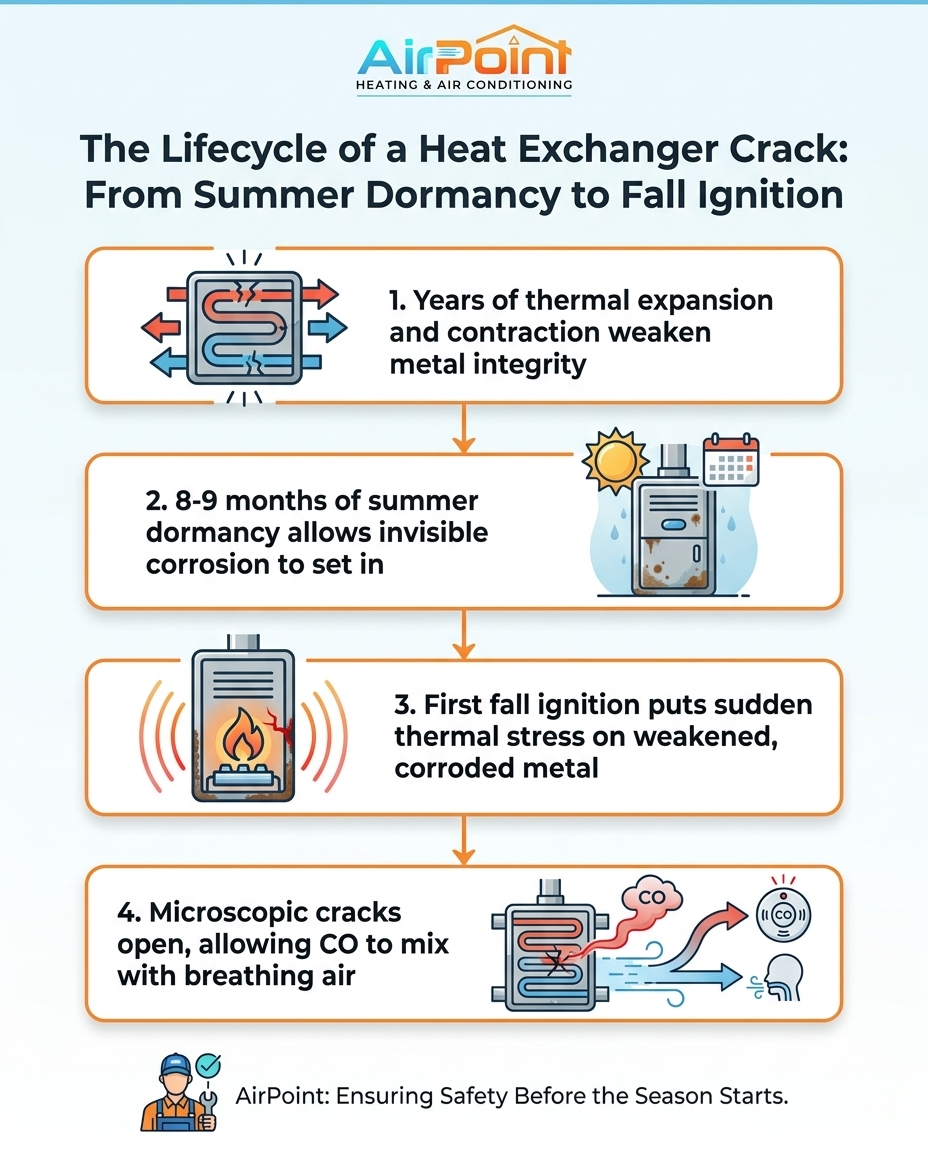
To understand the danger, we have to look at the chemical reality of condensation. When a furnace operates, it produces combustion byproducts, including trace amounts of moisture and acidic compounds. If a system is not properly cleaned at the end of the heating season, these residues settle onto the metal surfaces of the heat exchanger. Over a nine-month summer dormancy, ambient humidity interacts with these residues to accelerate rust and corrosion.
Furnaces that are over 10 to 15 years old are particularly vulnerable. They often lack the advanced protective coatings found on newer models, and their structural resilience has already been compromised by years of use. The most concerning aspect of this off-season moisture attack is that the damage is entirely invisible from the outside of the furnace cabinet. A homeowner looking at their unit will see a perfectly normal metal box, completely unaware that the critical safety barrier inside has been steadily weakening since early spring.
The Mechanics of Metal Fatigue in Heat Exchangers
The heat exchanger is arguably the most critical component inside your gas furnace. It acts as the absolute barrier that keeps deadly combustion gases—like carbon monoxide—safely contained and routed out of your home through the exhaust flue, while allowing clean, breathable air to be warmed and circulated through your vents. When this barrier fails, the results can be catastrophic.
The primary enemy of a heat exchanger is thermal fatigue. Every time your furnace turns on, the metal heat exchanger rapidly heats up and expands. When the heating cycle finishes and the blower cools the unit down, the metal contracts. Over thousands of heating cycles across a decade or more, this constant expansion and contraction weakens the metal at a molecular level. Think of bending a paperclip back and forth repeatedly; eventually, the metal fatigues and snaps. In a furnace, this fatigue manifests as microscopic stress cracks.
For heavily aged systems, a cracked heat exchanger is rarely a matter of "if" it will happen, but rather "when" it will happen. The highest-risk period for discovering these dangerous failures is during the September pre-heating season transition. This is when a weakened, corroded heat exchanger is suddenly subjected to intense thermal stress for the first time in nearly a year, often causing those microscopic stress fractures to split wide open during the very first ignition.
Our Non-Negotiable Internal Safety Protocol
Because the risks associated with heat exchanger failure are so severe, our technicians follow a strict mandate: we do not fire up an aging gas unit for the first time in the season without verifying working carbon monoxide detectors in the home. This is a core component of our internal HVAC safety protocol for aging gas units, and it is entirely non-negotiable. We prioritize family safety over speed, every single time.
This rigorous standard of care stands in stark contrast to the generic, low-effort "dust-off and filter swap" tune-ups that are unfortunately common in the industry. A true professional furnace safety inspection goes far beyond simply making sure the unit turns on. It involves a systematic methodology designed to catch hidden dangers before they threaten your home.
Our step-by-step pre-ignition methodology includes:
1. Carbon Monoxide Detector Verification: Before touching the thermostat, we physically locate and verify the operation of the home's CO detectors, ensuring they are placed correctly and have active power.
2. Visual Chamber Inspection: We use specialized inspection cameras to visually examine the heat exchanger for obvious signs of rust, scaling, or stress fractures that occurred over the summer.
3. Burner and Flue Evaluation: We inspect the burner assembly for proper alignment and check the exhaust flue to ensure there are no blockages (like bird nests or debris) that could force exhaust gases back into the home.
4. Controlled Initial Ignition: Only after the safety checks are complete do we initiate a controlled ignition, using sensitive combustion analysis tools to monitor for any trace amounts of CO escaping into the ambient air stream.
This protocol is rooted in treating carbon monoxide leaks as a serious, preventative priority rather than an afterthought. We refuse to leave a home to chance.
Carbon Monoxide: The Silent Threat You Cannot Detect
To fully appreciate why our internal HVAC safety protocol for aging gas units is so strict, you must understand the nature of carbon monoxide itself. Carbon monoxide is a byproduct of incomplete combustion. When a gas furnace operates perfectly, the fuel burns cleanly and the exhaust is safely vented outdoors. However, if the burners are dirty, the fuel-to-air ratio is off, or the heat exchanger is compromised, CO can become a serious problem.
The most dangerous characteristic of carbon monoxide is that it is completely colorless, odorless, and tasteless. Human detection is physically impossible. You cannot see a CO leak, you cannot smell it like you can raw natural gas, and it does not irritate your eyes or throat like smoke. By the time physical symptoms—such as headaches, dizziness, nausea, or confusion—begin to manifest, the exposure level is already dangerously high.
If a microscopic crack opens up mid-season, long after your initial fall inspection, a working carbon monoxide detector is your family's absolute only fail-safe. Because of this, general safety guidelines from organizations like the National Fire Protection Association (NFPA) strongly dictate the use of CO alarms.
Proper CO detector placement guidelines include:
• Outside Sleeping Areas: Detectors should be installed in the immediate vicinity of all bedrooms so the alarm can wake sleeping occupants.
• Every Level of the Home: There should be at least one working detector on every level of the residence, including the basement.
• Distance from Appliances: Detectors should be placed at least 15 feet away from fuel-burning appliances to prevent false alarms during normal startup.
What Happens During a Comprehensive Pre-Season Tune-Up
While verifying CO detectors and inspecting the heat exchanger are the most critical safety steps, they are just the beginning of a proper fall maintenance visit. Once the safety of the unit is confirmed, our technicians transition into broader performance and efficiency checks designed to keep your system running reliably all winter long.
Another local homeowner scheduled a preventative check with us during the winter, feeling anxious about uncertain economic times and wanting to avoid sudden, catastrophic breakdown costs. During the visit, our technician thoroughly explained potential aging issues and wear-and-tear without applying any pressure for unnecessary services. By focusing on education and preventative care, the customer was left feeling completely confident in the work performed and their system's future performance.
A comprehensive tune-up involves deep cleaning the burner assembly, testing the flame sensor, calibrating the thermostat, and measuring the electrical draw of the blower motor. We also evaluate the system's airflow, which directly impacts your home's indoor air quality. A furnace that struggles to move air not only costs more to operate, but it also fails to properly filter out dust and allergens. By addressing these performance metrics alongside our strict safety protocols, a proper tune-up ensures your aging furnace delivers reliable, efficient, and—most importantly—safe heat when you need it most.
Taking the Next Step for Your Family's Safety
While older gas furnaces can absolutely continue to provide reliable heat for your home, they simply require a higher standard of preventative care than newer models. The mechanical reality of metal fatigue and off-season corrosion means that safety can never be taken for granted. Verifying working carbon monoxide detectors is a small, straightforward step, but it is a critical anchor in our overarching safety methodology.
Do not wait for the first freezing night to discover that your aging furnace is struggling or unsafe. We strongly encourage homeowners to take a proactive approach to their family's comfort and well-being. Before the cold weather sets in permanently, schedule HVAC service to ensure your system is meticulously inspected, cleaned, and verified safe for the season ahead.
Frequently Asked Questions
Can an old gas furnace leak carbon monoxide?
Yes, an old gas furnace has a significantly higher risk of leaking carbon monoxide. As the system ages, the metal heat exchanger undergoes thousands of heating and cooling cycles, which can eventually cause stress fractures or cracks. If the heat exchanger cracks, the deadly combustion gases that are supposed to be vented outside can escape and mix with the warm air being circulated directly into your living spaces.
Why do furnace heat exchangers crack over time?
Furnace heat exchangers crack primarily due to a process called thermal fatigue. Every time the furnace ignites, the metal expands rapidly from the intense heat, and when the cycle ends, it contracts as it cools down. Over 10 to 15 years of continuous expansion and contraction, the structural integrity of the metal weakens, eventually leading to microscopic stress fractures that can split open under heat.
Do you need a carbon monoxide detector if you have a gas furnace?
Absolutely. A carbon monoxide detector is a mandatory safety requirement for any home operating a gas furnace or any other fuel-burning appliance. Because carbon monoxide is completely invisible, odorless, and tasteless, a working electronic detector is the only way you will be alerted to a dangerous leak before it causes severe health consequences for your family.
What exactly happens during a furnace safety inspection?
During a true furnace safety inspection, a technician does much more than just change the air filter. They will verify that your carbon monoxide detectors are functioning, use a specialized camera to visually inspect the heat exchanger for cracks or severe rust, check the exhaust flue for blockages, and test the burner assembly. Finally, they will monitor the initial ignition with a combustion analyzer to ensure no gases are escaping into the home.
How often should an aging furnace's heat exchanger be checked?
An aging furnace's heat exchanger should be thoroughly inspected by a licensed professional at least once a year, ideally during a pre-heating season tune-up in the early fall. Because metal fatigue and off-season corrosion can develop rapidly over the summer months, an annual check is the best way to catch developing stress fractures before you begin running the system daily.
Why is the first fall ignition the most dangerous time for older furnaces?
The first fall ignition is the most dangerous time because the furnace has likely been sitting completely dormant for eight to nine months. During this off-season, hidden corrosion and rust can weaken the heat exchanger significantly. When the system is suddenly fired up and subjected to intense thermal expansion for the first time in nearly a year, previously unnoticed weak spots can violently crack open, immediately releasing carbon monoxide.
Other Blogs
Latest Blog Posts
Navigating Belmont Heights' Historic District Rules for Exterior HVAC Equipment Replacements
Deciding Whether to Repair a Failing AC in September or Wait Until Spring

Upgrading Your Air Filtration System to Handle Fall Allergens in Los Alamitos

Customer Testimonials



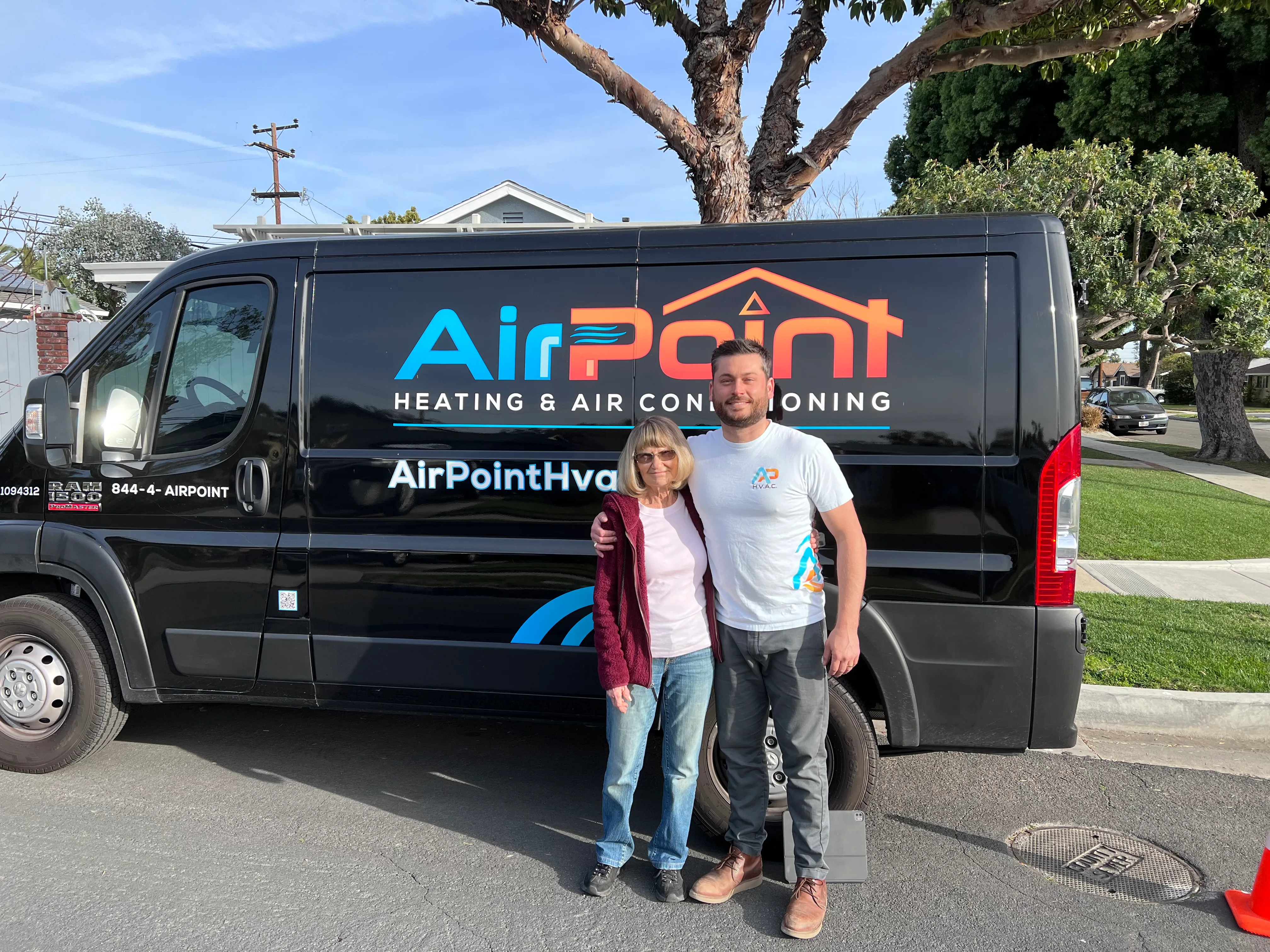
I recommend Air Point for your HVAC needs."