






Why Clearing Dry Leaves from Your Heat Pump is Crucial Before the Santa Ana Winds Arrive
The Hidden Autumn Threat to Your Heat Pump
As local HVAC professionals serving Los Alamitos, our team at AirPoint Heating & Air Conditioning has seen firsthand how understanding why clearing dry leaves from your heat pump is crucial before the Santa Ana winds arrive can mean the difference between a cozy, efficient autumn and a sudden, stressful system breakdown. As the September / Early Fall Santa Ana wind season approaches, many homeowners naturally shift their focus away from summer cooling and begin preparing for cooler weather. However, this transition period creates a unique and often overlooked hazard. Your outdoor condenser unit has likely collected a steady buildup of dry yard debris over the summer months. When you combine that resting debris with the sudden arrival of high-velocity, low-humidity wind events, you are left with an immediate threat to both the performance and the safety of your outdoor HVAC equipment.
To protect your home and your wallet, you need a proactive plan. If you are ready to secure your equipment for the season, you can explore our heat pump systems guide or go ahead and schedule HVAC service today.
Ignoring the debris piling up around your outdoor unit might seem harmless on a quiet afternoon. But weather conditions change rapidly. Making the decision to clear the area around your unit and schedule a professional tune-up before the winds start howling is the single best way to protect your investment. A little bit of proactive care right now prevents massive headaches when the extreme weather inevitably rolls in.
Understanding the Mechanics of Santa Ana Winds
To truly grasp the risk to your outdoor equipment, you have to look at the unique physics behind our regional weather events. These are not your typical, gentle autumn breezes. Santa Ana winds are notoriously fierce, driven by high-pressure systems that push air down from the Great Basin toward the Pacific Ocean. As this air descends in elevation, it undergoes a process called compressional heating. The air heats up rapidly and its relative humidity plummets, often dropping into the single digits.
For homeowners in Los Alamitos and surrounding Southern California communities, this means living in active wind corridors that experience intense, dry gusts. Every September, our technicians respond to calls where 40-mph offshore wind events have turned outdoor units into forceful delivery systems for every loose piece of dirt, dust, and dry foliage in the neighborhood.
Your outdoor heat pump is designed to pull air through its narrow metal fins to facilitate heat transfer. During a high-wind event, the unit essentially becomes a vacuum for airborne debris. Leaves, twigs, and fine particulate matter are driven deep into the delicate fins of the condenser. Unlike typical seasonal changes in other parts of the country, where falling leaves gently accumulate on the ground, our regional winds forcefully pack that dry debris directly into the mechanical heart of your home comfort system.
How Wind-Driven Debris Suffocates Airflow and Efficiency
Your heat pump relies on a very simple physical requirement to do its job: unobstructed airflow. The outdoor condenser coil works by transferring heat between the refrigerant inside the coils and the outside air. If the air cannot flow freely across those metal fins, the entire heat transfer process breaks down. In our years of servicing heat pumps across Orange County, a pattern we see often is that when wind-driven leaves and dirt coat the outside of the unit, they create a thick, suffocating blanket that chokes off the system.
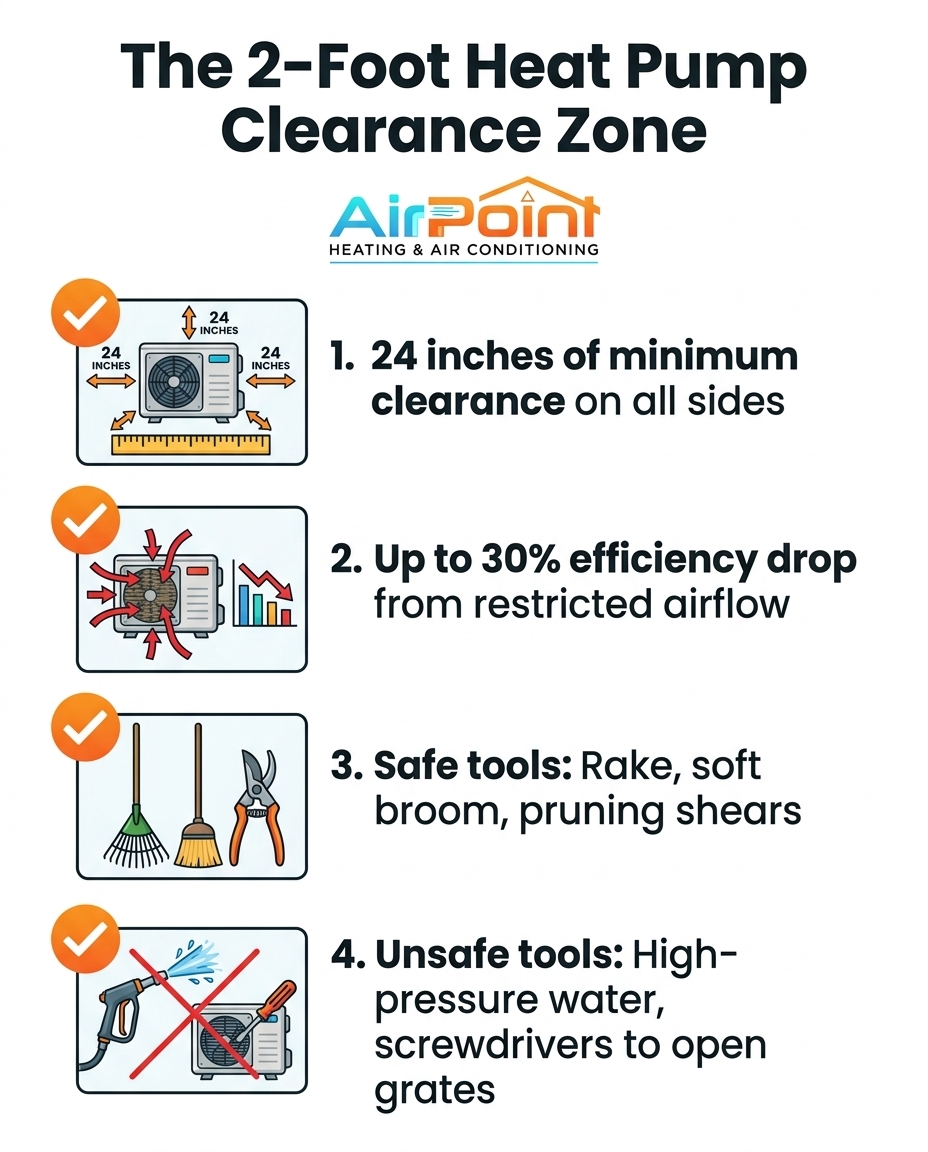
According to data from the Department of Energy, restricted airflow caused by dirt and debris buildup can reduce your HVAC system's efficiency by up to 30%. That is a massive drop in performance just when you are transitioning to your cooler weather needs and relying on your heating services to keep your home comfortable.
When a unit is suffocating, you will notice several distinct symptoms. First, the system has to run much longer to reach the temperature set on your thermostat. This extended run time leads to significantly higher energy consumption. Second, the internal components—especially the compressor—have to work much harder to pump refrigerant through the restricted system. This added strain accelerates mechanical wear and tear, turning what should be a normal operational cycle into a grueling marathon for your equipment.
• Clean and Clear — Airflow Status: Unobstructed air intake and exhaust — System Efficiency: Operating at peak manufacturer ratings — Mechanical Strain: Normal, expected operational wear
• Light Debris Buildup — Airflow Status: Partial blockage on lower fins — System Efficiency: Slight drop in efficiency; longer cycles — Mechanical Strain: Elevated strain on the blower motor
• Severe Wind-Packed Debris — Airflow Status: Completely suffocated condenser coil — System Efficiency: Up to 30% efficiency loss; wasted energy — Mechanical Strain: Extreme risk of compressor overheating
The bottom line: A suffocated heat pump is an expensive heat pump. Keeping the exterior clear is not just about keeping your yard looking tidy; it is a mandatory step for preserving the mechanical integrity and efficiency of your system.
The Fire Risk: Dry Leaves and Electrical Components
Beyond the loss of efficiency, the combination of dry autumn foliage and Santa Ana winds creates a severe safety hazard. Because compressional heating drops the relative humidity to such extreme lows, ordinary yard leaves are quickly turned into highly combustible tinder. When this bone-dry debris piles up against your outdoor unit, you are essentially storing kindling right next to a high-voltage machine.
Your outdoor heat pump houses several heavy-duty electrical components. Inside the access panel, you will find high-voltage contactors, capacitors, and fan motors. When the system cycles on, electrical contacts snap together to send power to the compressor. This action can occasionally produce a tiny, normal electrical arc. Under normal, clean conditions, this is perfectly safe. However, a hazardous pattern our team typically sees after major wind storms is dry, crushed leaves packed tightly into the electrical compartment or against a hot compressor. In those conditions, that tiny spark has the potential to ignite the debris.
Fire safety organizations, including Cal Fire, strongly advocate for maintaining defensible space around residential structures. These same defensible space concepts must be applied directly to your HVAC equipment. Allowing a buildup of dry fuel to sit against a high-voltage appliance during the driest, windiest time of the year is a localized fire hazard that no homeowner should ignore. The low-humidity aspect of our regional winds acts as a dangerous accelerant, meaning even a small accumulation of leaves requires immediate attention.
Protecting Your Equipment: The 2-Foot Clearance Rule
The most effective way to protect your home and your heat pump from these wind-driven hazards is to establish and strictly maintain a 2-foot minimum clearance zone around the entire outdoor unit. This mandatory perimeter ensures that the system has the breathing room it needs to operate efficiently and creates a vital buffer against creeping yard fires.
Maintaining this zone is straightforward, provided you follow safe exterior maintenance practices. You do not need specialized tools to keep the perimeter clear, but you do need to be consistent, especially before and immediately after a major wind event.
Safe Exterior Maintenance Steps
• Rake away loose leaves: Keep the ground bare or covered in non-combustible gravel for at least 24 inches in every direction around the concrete pad.
• Trim encroaching bushes: Cut back any shrubs, low-hanging branches, or tall grasses that are growing into the clearance zone.
• Remove wind-blown trash: Plastic bags, newspaper, and cardboard can easily blow against the unit and block airflow just as severely as organic debris.
• Visually inspect the outer grate: Look for leaves that are stuck flat against the metal exterior.
• Gently brush the outside: Use a soft-bristled broom to lightly sweep away debris clinging to the outer fins. Sweep in a downward motion to avoid bending the delicate metal.
What you should NEVER do: Homeowners should never attempt to open the unit, remove the protective outer grates, or use tools like screwdrivers to dig leaves out of the internal fins. Furthermore, never use a high-pressure water hose or a pressure washer to clean the unit. High-pressure water will instantly bend the soft aluminum fins, permanently restricting airflow and ruining the coil. Internal cleaning requires specialized, non-acidic chemical foams and the careful touch of a trained professional.
From Outdoor Dust to Indoor Discomfort: The Air Quality Link
It is easy to think of a heat pump as strictly an outdoor machine, but the conditions outside have a direct and profound impact on the air you breathe inside. When heavy winds stir up massive amounts of particulate matter, dust, pollen, and ash, that contaminated air inevitably infiltrates your home through tiny gaps around windows, doors, and ductwork.
If your outdoor unit is choked with debris, your entire HVAC system is under immense strain. A strained system struggles to circulate indoor air effectively. When circulation drops, the air inside your home becomes stagnant, allowing the fine dust and allergens brought in by the wind to settle into your carpets, furniture, and lungs. Your indoor blower motor relies on a balanced system to push air through your filtration media; if the outdoor unit is suffocating, the indoor unit cannot perform its job properly.
This makes the autumn wind season a critical time to evaluate your indoor air quality solutions. Checking and upgrading your indoor air filters is mandatory when the winds are howling outside. A standard fiberglass filter will not catch the fine particulate matter stirred up by a Santa Ana event. You need a pleated filter with an appropriate rating to trap microscopic dust without restricting the indoor blower. If you are unsure which filter is right for your system, understanding air filter MERV ratings is a great place to start.
Additionally, lateral solutions like whole-home air purifiers or upgraded media cabinets can work in tandem with your heat pump to actively scrub the air inside your home, ensuring that the dust storms outside do not ruin your comfort inside.
Professional Fall Maintenance vs. Exterior Yard Work
While maintaining the exterior 2-foot clearance zone is a crucial responsibility for every homeowner, it is only half of the equation. No matter how diligently you rake and sweep, fine dust and small, fragmented debris will inevitably bypass the outer grate during 40-mph winds. Once that debris is inside the unit, it requires a licensed professional to safely remove it.
A professional fall tune-up goes far beyond what you can accomplish with a yard broom. As local Orange County experts, the team at AirPoint Heating & Air Conditioning understands exactly how to protect HVAC equipment against the unique weather hazards of Southern California. During a professional maintenance visit, a technician will safely disconnect the high-voltage power, open the unit, and use specialized coil cleaners to dissolve the baked-on dirt and dust trapped deep inside the fins. They will also check all electrical connections, test the capacitors, and verify that your refrigerant levels are exactly where they need to be for the upcoming season.
• Debris Removal — Homeowner Responsibility (Exterior): Raking leaves away from the concrete pad — Professional Responsibility (Internal): Removing the top panel to clear internal debris
• Coil Cleaning — Homeowner Responsibility (Exterior): Lightly brushing the outer grate with a soft broom — Professional Responsibility (Internal): Applying specialized foaming coil cleaner to internal fins
• Electrical Safety — Homeowner Responsibility (Exterior): Keeping wet/dry foliage away from the unit — Professional Responsibility (Internal): Testing contactors, tightening high-voltage connections
• System Check — Homeowner Responsibility (Exterior): Monitoring for strange noises or poor airflow — Professional Responsibility (Internal): Measuring refrigerant pressures and motor amp draw
We see the massive difference this deep cleaning makes all the time in our daily service routes. For example, during a recent early fall service call, a homeowner reached out for a preventative check on an older, run-down HVAC unit that was struggling to keep up. Our technicians performed a complete tune-up—addressing a leaky compressor, topping off the coolant, rewrapping the exposed piping, replacing the clogged filters, and thoroughly cleaning the internal system. The outcome was remarkable: the outdated unit was made vastly more efficient and was fully prepared to handle the extreme weather safely. That is the peace of mind that only comes from professional, comprehensive maintenance. Furthermore, keeping your system at peak efficiency through a professional tune-up is often necessary to qualify for generally applicable energy rebates or federal tax credits for heat pump installations (we always recommend verifying current programs with your utility provider or a tax professional).
Frequently Asked Questions About Heat Pumps and Wind Storms
Can leaves inside a heat pump cause a fire?
Yes, dry leaves inside a heat pump can absolutely cause a fire. When low-humidity winds turn autumn foliage into dry tinder, any accumulation near the high-voltage electrical components or the hot compressor creates a localized fire hazard. A tiny electrical arc from a normal contactor can ignite this dry fuel instantly.
How much clearance does my outdoor HVAC unit need?
Your outdoor HVAC unit requires a minimum of 24 inches (2 feet) of clearance on all sides. This perimeter ensures that the condenser coil has enough unobstructed airflow to transfer heat efficiently. It also provides a safe, defensible space buffer against creeping yard fires.
Should I cover my heat pump in the fall?
No, you should never cover your heat pump while it is operational. Heat pumps are designed to run year-round and need constant access to open air. Covering the unit traps moisture, which leads to rust, and completely suffocates the system, which will cause immediate mechanical failure when it turns on.
What happens if debris gets inside my AC condenser?
When debris gets inside the condenser, it coats the internal coils and blocks airflow. This forces the compressor to work much harder to pump refrigerant, leading to increased wear and tear, longer run times, and a significant drop in overall system efficiency. Over time, this strain can cause the compressor to overheat and fail.
How do Santa Ana winds affect my HVAC system's efficiency?
Santa Ana winds affect efficiency by forcefully packing dirt, dust, and crushed leaves deep into the narrow fins of your outdoor unit. This suffocating layer of debris restricts the airflow required for heat transfer, which can reduce your system's efficiency by up to 30% and drive up your energy consumption.
Is it safe to use a hose to wash leaves out of my heat pump?
No, it is not safe to use a high-pressure hose to wash out your heat pump. High-pressure water can easily bend the soft, delicate aluminum fins on the coil, permanently blocking airflow and ruining the unit. Internal cleaning should always be handled by a professional using specialized, low-pressure chemical cleaners.
Secure Your Comfort Before the High Winds Hit
The transition into the fall season brings beautiful weather to Southern California, but it also brings the dual threat of severe fire risks and massive efficiency losses caused by dry leaves and high winds. Your heat pump is a major investment, and leaving it vulnerable to suffocating debris is a risk you do not have to take. By maintaining a strict 2-foot clearance zone in your yard and relying on licensed professionals for the deep internal cleaning, you can ensure your system runs safely and smoothly all season long.
Do not wait until the first major wind event leaves you with a struggling, unsafe system. Take action now to protect your equipment and secure your indoor comfort. Reach out today to schedule HVAC service and let our expert technicians prepare your home for whatever the season brings.
Other Blogs
Latest Blog Posts
How to Verify an HVAC Contractor's Liability Insurance Before They Step on Your Property
Heat Pump vs. Gas Furnace: Weighing Operating Costs Under Current California Utility Rates
Why DIY Mini Split Pre-Charged Lines Often Leak Refrigerant After the First Season

Customer Testimonials



I recommend Air Point for your HVAC needs."