






What AC Making Strange Noises Means — and What to Do About It
If your ac making strange noises is keeping you up at night or has you worried about a breakdown, you're not alone. Here's a quick look at the most common sounds and what they signal:
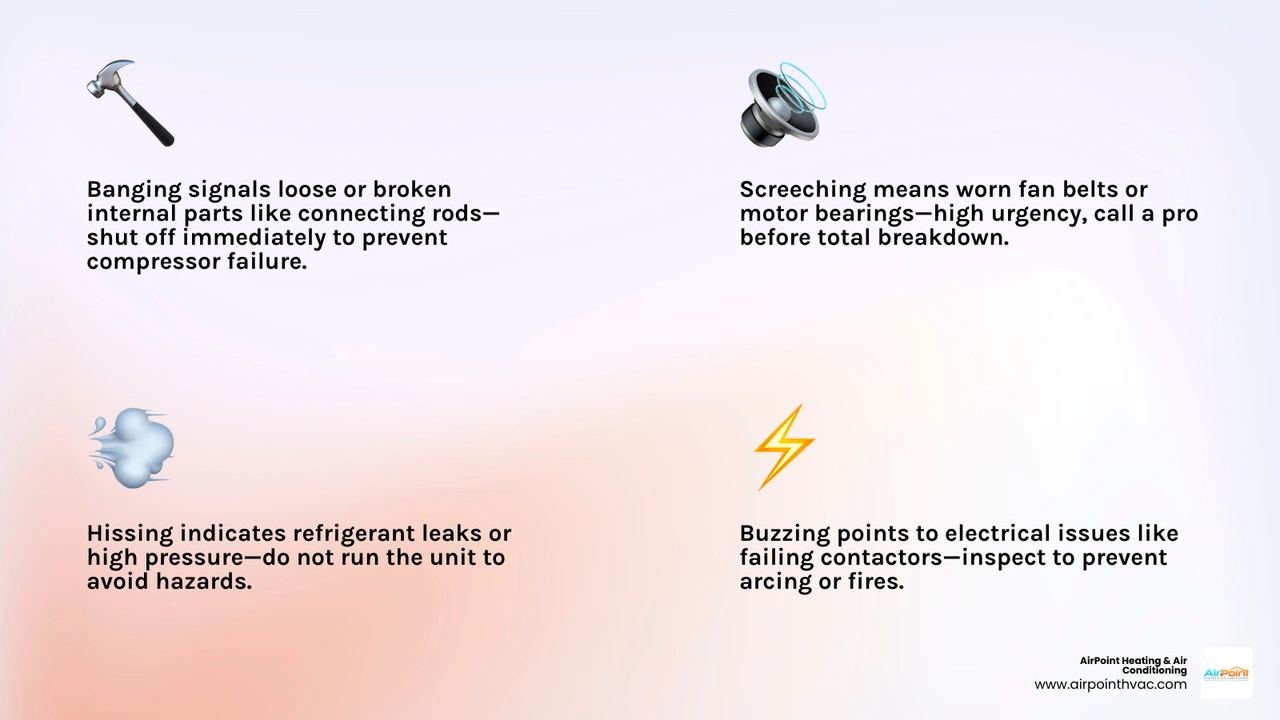
| Sound | What It Likely Means | Urgency |
|---|---|---|
| Banging / Clanking | Loose or broken internal part | High — shut off immediately |
| Screeching / Squealing | Worn fan belt or motor bearings | High — turn off and call a pro |
| Hissing | Refrigerant leak or high pressure | High — do not run the unit |
| Whistling | Clogged filter or blocked vents | Moderate — check filter first |
| Buzzing | Electrical issue or frozen coils | Moderate to High |
| Clicking (repeated) | Failing relay, capacitor, or thermostat | Moderate — needs inspection |
| Gurgling / Bubbling | Clogged condensate drain or refrigerant issue | Moderate |
| Rattling | Loose panel, debris, or hardware | Low to Moderate |
| Soft hum / whoosh | Normal operation | No action needed |
Modern air conditioners are built to run quietly — typically between 25 and 55 decibels, which is roughly the level of a soft conversation in the room. Some high-efficiency units run as low as 19 decibels, quieter than a whisper. That's exactly why any new or unusual sound coming from your system is worth paying attention to right away.
When something shifts in that familiar background hum, your AC is usually trying to tell you something specific. A banging sound points to a different problem than a hiss, and a single click at startup means something completely different from a rapid, repeating click that won't stop. Knowing the difference can mean catching a small issue early — before it turns into a full system failure during a hot Los Alamitos summer.
The good news? Many of these noises have clear causes, and some can be addressed with simple maintenance. Others need a licensed HVAC technician right away.
AC Making Strange Noises What They Mean for Your System

When we talk about an ac making strange noises what they mean, we first have to establish what "normal" sounds like. Most modern systems, like the Hitachi airHome range, are engineered to be so quiet you might forget they are even running. A healthy unit produces a steady, low-pitched hum and a gentle "whoosh" of air through the vents.
However, as a system ages or if maintenance is neglected, these sounds can change. A well-maintained AC system in Orange County should last between 15 and 20 years. If your unit is closer to the 10-year mark and starts producing new sounds, it’s often a sign that internal components are wearing down. Ignoring these sounds is one of the fastest ways to shorten that 20-year lifespan down to 10.
It is vital to recognize signs you need immediate AC repair. While a light rattle might just be a loose screw, sounds like grinding or screeching are "red flags" that indicate mechanical pain. Think of your AC as a machine that translates its mechanical issues into a language of sound—our job is to help you translate those sounds into action.
Mechanical Alarms: Banging, Clanking, and Screeching
When you hear heavy metal-on-metal sounds, it is rarely a minor issue. These noises usually originate from the two most hard-working parts of your system: the compressor (the heart of the outdoor unit) and the blower motor (the lungs of the indoor unit).
If you hear these sounds, we recommend an immediate shutdown. Running a system that is banging or clanking is like driving a car with a broken engine rod—you are likely causing more damage every second the power is on. If you've ever thought, "my heater is making a loud noise who can I call for furnace repair in La Mirada," you already know that loud mechanical sounds in any HVAC equipment require professional attention.
Why Banging and Clanking Noises Mean Trouble
A loud banging sound coming from your outdoor condenser usually points to a problem inside the compressor. Because the compressor is a sealed unit, a banging sound often suggests a loose connecting rod, a broken piston pin, or an internal crankshaft that has come apart. These components act like shrapnel inside the casing, and once they break, the compressor usually needs a full replacement.
If the banging is coming from your indoor unit, it’s often the blower wheel. A loose or unbalanced blower wheel can hit the surrounding housing, creating a rhythmic clanking. This can also lead to an AC unit not cooling because the fan isn't moving enough air across the coils to keep your home comfortable.
High-Pitched Screeching and Squealing
Screeching is one of those sounds that makes everyone in the house wince. In older units, this is frequently a failing fan belt. If the belt slips or frays, it creates a high-pitched squeal. Modern units are mostly direct-drive, so if you hear screeching in a newer system, it’s more likely the motor bearings in the condenser fan or the blower motor.
Sometimes, a high-pitched "scream" that lasts for 10 to 15 seconds at the start of a cycle indicates dangerously high pressure within the compressor. This is an emergency. If your unit is AC blowing warm air while also screaming, the compressor is under immense stress and could fail catastrophically.
Airflow and Pressure: Hissing, Whistling, and Gurgling
Not all strange noises are mechanical. Some are caused by the way air and refrigerant move through your system. These sounds often relate to the "breathability" of your AC and the integrity of the lines carrying the cooling power.
Issues with airflow don't just cause noise; they can lead to ice buildup. Understanding evaporator coil freezing causes explained can help you see why a "simple" whistling sound might actually be the first step toward a frozen, non-functional system.
Hissing and Whistling: AC Making Strange Noises What They Mean for Airflow
A persistent hissing sound is the classic sign of a refrigerant leak. Since refrigerant is kept under high pressure, it makes a "snake-like" sound as it escapes through small cracks in the copper lines or the evaporator coil. This is a health and environmental hazard and requires an EPA-licensed technician to fix.
Whistling, on the other hand, is usually an airflow issue known as the "tea kettle effect." When your blower motor tries to pull air through a heavily clogged filter or undersized vents, the air speeds up as it passes through tiny gaps, creating a whistle. This can also happen if too many of your home’s vents are closed. We always recommend keeping at least 80% of your vents open to maintain proper pressure. Interestingly, airflow issues can even contribute to why 7 reasons why your air conditioner smells, as stagnant air and moisture create the perfect environment for mold.
Gurgling and Bubbling Sounds
If your AC sounds like someone finishing a drink with a straw, you’re likely hearing gurgling or bubbling. This usually happens in the condensate drain line. If the line is partially clogged with algae or debris, water can trap air pockets, creating a gurgling sound as it tries to drain.
In some cases, bubbling can also indicate air has entered the refrigerant lines. This is serious because air and moisture in the refrigerant can form acid, which eats away at the compressor from the inside. If you hear this and notice my air conditioner is leaking water who are the best AC repair specialists in Huntington Beach, it’s time to call in the experts to clear your drains and check your levels.
Electrical Gremlins: Buzzing and Clicking
Electrical issues are often the hardest for homeowners to diagnose because the sounds can be subtle. However, electrical failures are a leading cause of system "no-starts" during a heatwave.
| Click Type | Meaning | Action |
|---|---|---|
| Single Click at Startup | Normal - Contactor engaging | None |
| Rapid, Repeating Clicks | Failing relay or capacitor | Call for repair |
| Clicking with No Startup | Thermostat or control board issue | Professional inspection |
Buzzing and Clicking: AC Making Strange Noises What They Mean for Electronics
A constant buzzing sound often points to an electrical component that is struggling. This could be a failing contactor relay (the switch that tells the unit to turn on) or a weak capacitor. Capacitors act like large batteries that give the motors the "kick" they need to start. If you notice AC capacitor failure signs, like the outdoor fan motor humming but not spinning, the capacitor is likely the culprit.
Buzzing can also be caused by "electrical arcing," where electricity jumps between loose wires. This is a significant fire risk. If the buzzing is accompanied by a burning smell, shut the system off at the breaker immediately.
Identifying Circuit and Component Failures
Sometimes the brain of the system—the circuit board—is to blame. If the board has a short or a failing solder joint, it can cause the system to click repeatedly as it tries and fails to initiate a cooling cycle. Diagnosing AC circuit board failures requires specialized tools to test voltage and continuity.
Another common cause of buzzing is actually a frozen evaporator coil. If the coils turn into a block of ice due to low refrigerant or a dirty filter, the blower motor will strain and vibrate, creating a loud, low-frequency buzz that resonates through the ductwork.
When to Call an Orange County HVAC Professional
While we encourage homeowners to check their air filters and clear away leaves or twigs from the outdoor unit, most of these sounds require a pro. If you hear banging, screeching, or hissing, the best thing you can do is perform an "emergency shutdown." Turn the system off at the thermostat and, if possible, flip the circuit breaker.
If you aren't sure where the sound is coming from, you can try a simple "isolation test." Turn your thermostat to "Fan Only" mode. If the noise persists, it’s likely in the indoor blower or ductwork. If the noise only happens when the "Cool" mode is on, the problem is likely in the outdoor condenser or the refrigerant lines.
Knowing what to expect during an AC repair appointment can take the stress out of the process. Our technicians will perform a full diagnostic, checking everything from electrical connections to refrigerant pressures, to ensure that once we silence the noise, it stays gone.
Frequently Asked Questions about AC Noises
Is it dangerous to ignore a hissing sound from my AC?
Yes. Hissing usually indicates a refrigerant leak. Refrigerant is a pressurized chemical that can cause respiratory issues, headaches, and nausea if it leaks into your home. Furthermore, running a system low on refrigerant will eventually cause the compressor to overheat and seize, leading to a much more expensive repair.
Why does my air conditioner make a loud bang when it turns off?
A single thud or bang when the system shuts down can sometimes be the metal ductwork expanding or contracting as the pressure changes. However, it can also mean the "isolation feet" (the rubber mounts that hold the compressor) have perished. When the motor stops, the compressor thrashes against the frame because it is no longer supported.
Can a dirty air filter really cause my AC to whistle?
Absolutely. A clogged filter is the "root of many HVAC evils." It restricts the volume of air the fan can pull in. This creates high static pressure, forcing air through tiny gaps in the filter or around the edges of the filter rack at high speeds, which creates that distinct "tea kettle" whistle.
Conclusion
At AirPoint Heating & Air Conditioning, we believe that "comfort is happiness," and a noisy air conditioner is anything but comfortable. Whether you're in Los Alamitos, Huntington Beach, or Irvine, our family-owned team is here to provide the honest, expert service you need to restore peace to your home.
Don't wait for a small rattle to become a total system failure. If your AC is trying to tell you something, we're here to help you listen. For fast, reliable service backed by a 100% satisfaction guarantee, contact us today. Let's get your home back to the "Symphony of Silence" you deserve.
Other Blogs
Latest Blog Posts

Using a SEER Savings Calculator: Balancing Efficiency Upgrades with Fall HVAC Prep

Troubleshooting Heating Startup Smells: Is Your Furnace Safe for Fall?
Fall Home Maintenance Tips: Troubleshooting Heating Odors and Using a SEER Savings Calculator

Customer Testimonials



I recommend Air Point for your HVAC needs."