






Why Knowing How to Prepare Your HVAC for Santa Ana Conditions Can Save Your System
How to prepare your HVAC for Santa Ana conditions is one of the most important things you can understand as a Southern California homeowner — and it pays to act before the winds arrive, not after.
Here's a quick overview of the essential steps:
- Replace your air filter with a MERV 8-13 pleated filter and keep spares on hand
- Clear a 2-foot perimeter around your outdoor condenser unit
- Secure loose outdoor items that could become wind-driven debris
- Seal gaps around windows, doors, and ductwork to stop hot air infiltration
- Switch to recirculation mode during heavy dust or smoke events
- Close blinds or blackout curtains to cut solar heat gain by up to 60%
- Rinse condenser coils gently with a garden hose after winds subside
- Check your filter daily — in extreme conditions, it can clog in as little as 24 to 48 hours
- Turn your thermostat to OFF during power outages and wait before restarting
- Schedule a professional tune-up before and after peak wind season
Southern California sees between 10 and 25 Santa Ana events every single year, each one averaging around three days. These aren't gentle breezes. Nicknamed the "Devil Winds," Santa Ana conditions bring gusts past 50 mph, temperatures that can exceed 100°F, and humidity that can drop to single digits — drier than the Sahara Desert. Your HVAC system takes the brunt of all of it.
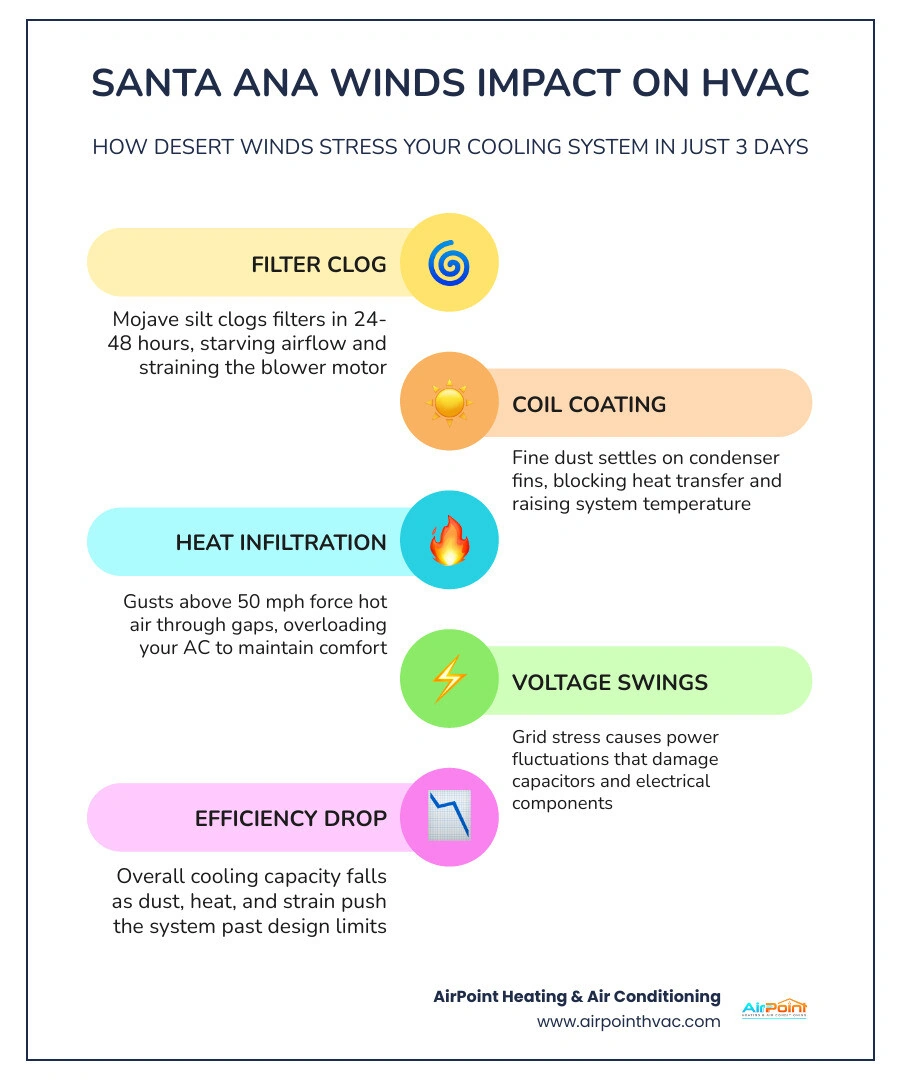
Most homeowners don't think about the strain on their system until something breaks mid-event. Filters get choked with Mojave Desert silt. Condenser coils get coated in abrasive dust. Voltage swings from grid stress threaten electrical components. And your AC — designed to handle outdoor temps of around 95 to 100°F — gets pushed well past its limits.
At AirPoint Heating & Air Conditioning, we work with homeowners across Orange County and the greater Los Alamitos area who face these challenges every season. This guide walks you through exactly what to do before, during, and after a Santa Ana event to protect your system and keep your family comfortable.
Understanding the "Devil Winds" and Your HVAC System
To truly understand how to prepare your HVAC for Santa Ana conditions, we first have to look at the science behind these events. Santa Anas are "katabatic" winds. This means they originate from high-pressure systems over the Great Basin (the high desert areas of Nevada and Utah). As that air spills over the Sierra Nevada and San Bernardino mountains and descends toward the coast, it undergoes "compression heating."
For every 1,000 feet the air drops, it warms by roughly 5.5°F. By the time it reaches cities like Anaheim or Fullerton, it is scorching hot and incredibly dry. This process also creates a "Dust Bowl" effect. The winds pick up fine Mojave Desert silt and sand, carrying them directly into your neighborhood.
This combination of heat and grit is a nightmare for air conditioners. Low humidity (often dropping to 5% or lower) creates static electricity, which actually makes dust adhere more aggressively to your system’s internal components. For a deeper dive into these regional challenges, check out our Santa Ana Winds HVAC Guide and learn more about How Coastal California Climate Affects Your HVAC System.
How to Prepare Your HVAC for Santa Ana Conditions: A Pre-Event Checklist
Preparation is your best defense. When the National Weather Service issues a Red Flag Warning or a High Wind Watch for Orange County, your first move should be heading outside to check your outdoor unit.
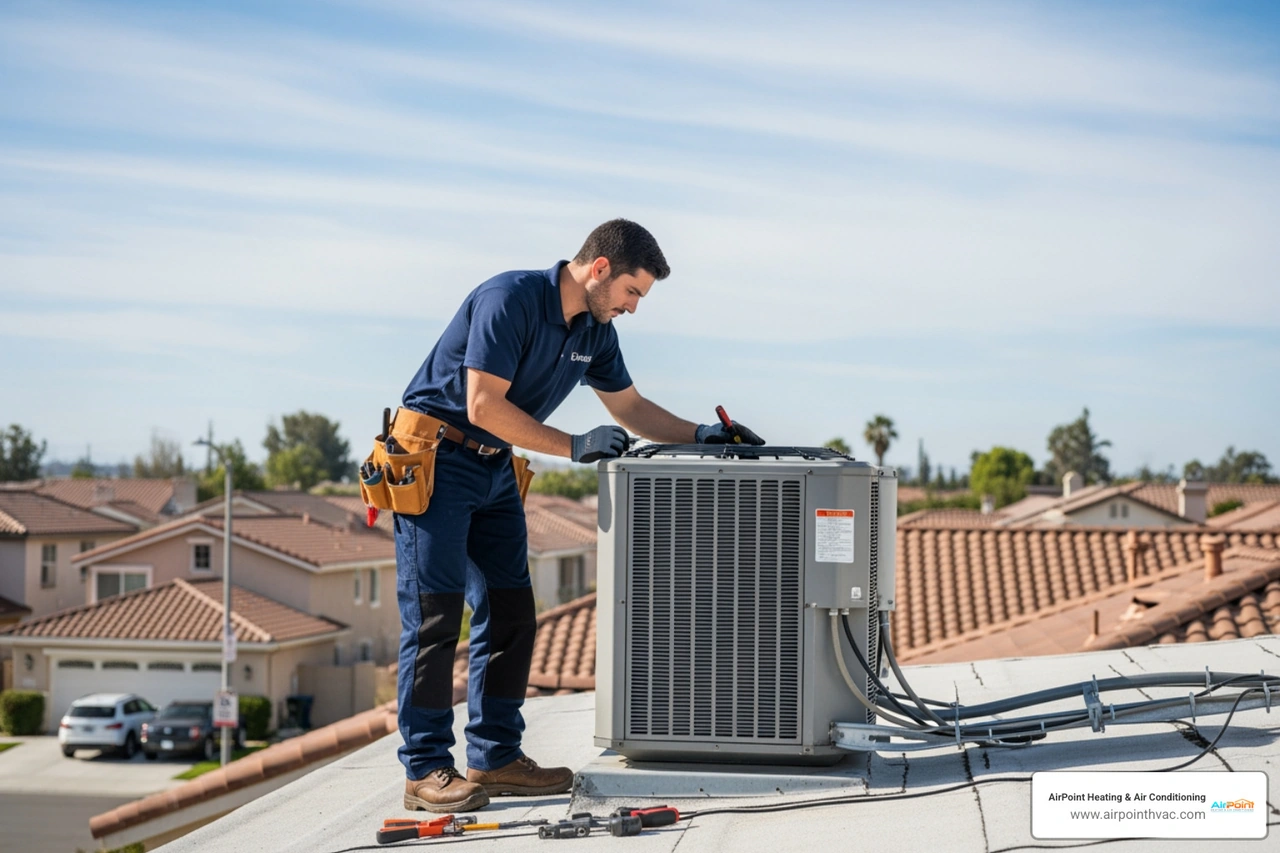
We recommend maintaining a strict "two-foot rule." Clear away any weeds, dried leaves, or vegetation within a 2-foot radius of your condenser. During 50 mph gusts, loose debris can be sucked against the delicate aluminum fins, blocking airflow and causing the system to overheat.
You should also:
- Trim nearby trees: Cut back branches that could snap and fall on your unit.
- Secure loose items: Umbrellas, patio furniture, and trash cans can become projectiles that dent or destroy your AC's exterior.
- Inspect the panels: Ensure the access panels on your unit are tight. High-frequency vibrations from the wind can loosen screws over time.
For more detailed seasonal advice, see our guide on Spring AC Preparation for Southern California and understand the Home AC Maintenance Importance.
How to prepare your hvac for santa ana conditions with high-efficiency filters
Your air filter is your system's primary shield against the silt, pollen, and wildfire smoke that often accompany Santa Ana winds. During these events, standard fiberglass filters simply won't cut it. We suggest using a pleated filter with a MERV rating between 8 and 13.
A MERV 13 filter is particularly effective if there is wildfire smoke in the air, as it can capture microscopic soot particles. However, there is a catch: because the air is so full of debris, these filters can become significantly clogged within just 24 to 48 hours. When a filter is that dirty, your blower motor has to work twice as hard to pull air through, which can lead to a total system breakdown. Always keep a "Santa Ana Stash" of 3-4 spare filters in your garage. Check our Ultimate HVAC Maintenance Tips Coastal California for more filtration strategies.
How to prepare your hvac for santa ana conditions against electrical surges
Santa Ana winds are notorious for causing power fluctuations. High winds can knock branches into power lines, leading to brownouts or Public Safety Power Shutoffs (PSPS). These voltage fluctuations are incredibly hard on your AC’s electrical components, particularly the capacitor and the compressor.
If the power flickers, your AC might try to restart immediately while the refrigerant pressures are still high. This "short-cycling" can burn out a motor in minutes. Regular professional checks ensure your electrical connections are tight and your capacitors are within their safety specs before the wind hits. Learn Why Regular AC Maintenance is Crucial to prevent these avoidable electrical failures.
Protecting Your System During High-Wind and Dust Events
Once the winds are howling, your goal shifts to reducing the "load" on your system. It’s a common sight in places like Yorba Linda or Newport Beach: the AC is running 24/7, but the indoor temperature is still climbing. This happens because the home is "leaking" cool air and "inhaling" heat.
One of the most effective things you can do is manage solar heat gain. Closing your blinds can reduce heat entering through windows by 45%. If you use blackout curtains, that reduction jumps to 60%. This is vital because, during Santa Ana events, attic temperatures can soar past 150°F. If your insulation isn't up to par, that heat radiates directly through your ceiling.
Pro-Tip for Smoke and Dust: Switch your HVAC fan setting from "Auto" to "Recirculate" (if your thermostat has the option) or simply keep the system in cooling mode with the windows shut tight. This prevents the system from pulling in "fresh" (smoky/dusty) outdoor air and instead focuses on cleaning the air already inside your home. See how this impacts your utility costs in our post on AC Maintenance Impact on Energy Bills.
| Setting | Standard Operation | Santa Ana Protection Setting |
|---|---|---|
| Thermostat | 72°F - 74°F | 76°F - 78°F (Reduces strain) |
| Fan Mode | Auto | Recirculate (Filters indoor air) |
| Windows/Blinds | Open for light | Closed/Blackout (Blocks solar heat) |
| Filter Check | Every 3 months | Every 24-48 hours |
Post-Wind Maintenance: Restoring Efficiency and Air Quality
After the winds die down and the dust settles, your HVAC system needs a "spa day." The most critical task is cleaning the outdoor condenser coils. Those coils are responsible for shedding the heat from your home into the outdoor air. If they are coated in a layer of Mojave silt, they act like a thermal blanket, trapping heat inside your system.
How to clean your coils safely:
- Turn off the power to the unit at the breaker or the outdoor disconnect.
- Use a standard garden hose with a gentle spray. Never use a pressure washer, as it will flatten the delicate aluminum fins and ruin the unit.
- Spray from the top down, rinsing the dust and sand out of the crevices.
- If you notice "bent" fins, you can use a fin comb to gently straighten them, or call us to handle it during a AC Tune Up Anaheim CA Complete Guide visit.
Rinsing your coils can improve system efficiency by up to 15% immediately. Don't forget to swap out that air filter one last time to remove any fine dust that made it into your ductwork. For a full list of post-event checks, read about Annual AC Tune Up Benefits.
Long-Term Upgrades for Santa Ana Resilience
If you find that your home is consistently uncomfortable during wind events, it may be time to look at the "envelope" of your house. In many Orange County homes, leaky ducts lose 20-30% of conditioned air before it ever reaches the living room. When your attic is 150°F, those leaks aren't just losing cool air—they are sucking in superheated attic air.
Consider these resilience upgrades:
- Attic Insulation: Ensure you meet R-38 standards to block radiant heat.
- Duct Sealing: Professional sealing prevents air loss and keeps dust out of your vents.
- Whole-Home Air Purifiers: Systems like UV lights or electronic air cleaners can catch the particles that standard filters miss.
- Smart Thermostats: These allow you to monitor your system's performance and get alerts if the run-time is unusually high.
If your system is more than 15 years old and struggles every time the wind blows, it might be more cost-effective to upgrade to a modern, high-SEER2 unit designed for extreme climates. Our guide on How to Decide Between Repair and Replacement can help you weigh the options.
Frequently Asked Questions about Santa Ana HVAC Care
Should I cover my outdoor AC unit during Santa Ana winds?
We generally advise against covering your unit with plastic wraps or tarps while it is in use. These trap moisture and can cause the system to overheat by restricting airflow. However, a breathable mesh "hail guard" or a dedicated windbreak (like a fence or sturdy shrubs located 3 feet away) can help reduce the amount of direct dust and sand hitting the coils.
How quickly can dust clog my HVAC filter during a wind event?
In May 2026, we’ve seen extreme cases where filters in Yorba Linda and Irvine became completely choked in just 24 to 48 hours. If you notice the air coming from your vents feels "weak" or if the AC is running but the house isn't getting cooler, check the filter immediately. A clogged filter is the #1 cause of a frozen evaporator coil.
What are the warning signs of wind-related HVAC damage?
Keep an ear out for new sounds. Rattling or clicking often means debris like a twig has made its way into the fan housing. If you see ice forming on the copper lines outside, your airflow is restricted (likely a clogged filter). Finally, if your circuit breaker trips repeatedly, the system is drawing too much power—likely because it's struggling to work through a layer of dirt or a failing capacitor.
Conclusion
The Santa Ana winds are a permanent fixture of life in Southern California, but they don't have to mean a broken AC and a massive repair bill. By following the steps in this guide — from clearing your 2-foot perimeter to keeping a fresh MERV 13 filter ready — you can protect your investment and maintain your home's comfort.
At AirPoint Heating & Air Conditioning, we are committed to the "comfort is happiness" philosophy. Whether you are in Mission Viejo, Huntington Beach, or right here in Los Alamitos, our family-owned team is ready to help you prep your home for whatever the "Devil Winds" throw your way.
Don't wait for the dust to start flying. Book your precision tune-up today to protect your system from the next wind event for fast, expert service.
Other Blogs
Latest Blog Posts
The Essential Fall Home Maintenance Checklist: Decoding HVAC Startup Smells

Finding Your Efficiency Sweet Spot: Using a SEER Savings Calculator for HVAC Upgrades

Common Homeowner Questions Answered: Why Does My Heater Smell Like Burning Dust?

Customer Testimonials



I recommend Air Point for your HVAC needs."