





Is It Worth Fixing an Old HVAC System? Here's How to Know Fast
Is it worth fixing an old HVAC system? The honest answer depends on a few key factors — and getting it wrong either way can be a major financial burden.
Here's a quick snapshot to guide your decision:
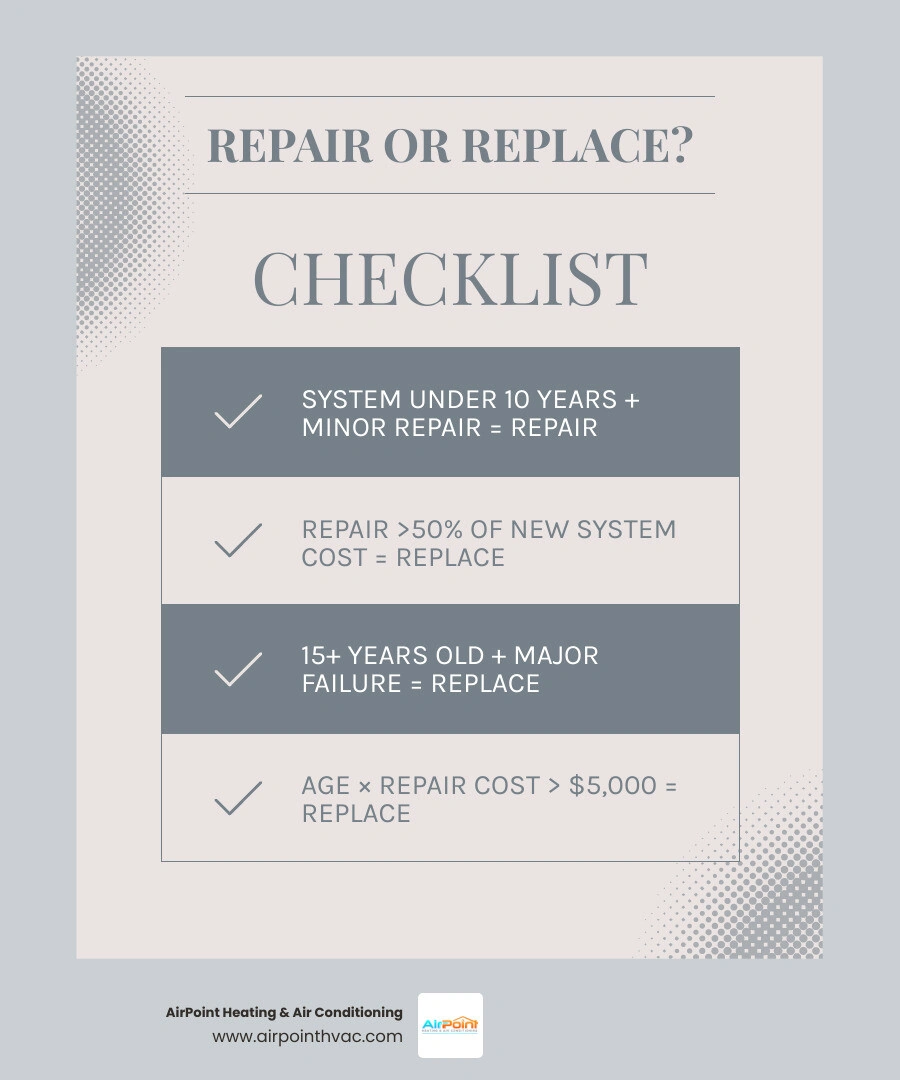
| Situation | Likely Best Move |
|---|---|
| System is under 10 years old, minor repair needed | Repair |
| Repair cost exceeds 50% of a new system's price | Replace |
| System is 15+ years old with a major component failure | Replace |
| Age × Repair Cost exceeds 5,000 (Rule of 5,000) | Replace |
| System uses R-22 refrigerant and needs a recharge | Replace |
| Small wear item (capacitor, contactor, thermostat) | Repair |
| Multiple breakdowns in the last 12–24 months | Replace |
For most homeowners in Los Alamitos and across Orange County, the question usually comes up at the worst possible moment — the house is too hot, the AC just stopped, and a technician is standing in your driveway with a repair estimate. That pressure makes it easy to either overspend on a dying system or rush into a replacement you weren't ready for.
The good news: there are clear, proven rules that take the guesswork out of this decision. In May 2026, with updated efficiency standards and new refrigerant transitions underway, the math around repair versus replacement has shifted — and knowing where your system stands can save you a significant amount.
This guide walks you through exactly how to evaluate your situation, step by step.
Evaluating the Age and Lifespan of Your Equipment
When we talk about whether is it worth fixing an old hvac system, age is the first metric we look at. On average, a central air conditioning unit lasts between 12 and 15 years, while a well-maintained furnace can stretch to 20 or even 25 years. However, these are general averages. In our local service areas like Huntington Beach, Newport Beach, and Seal Beach, we have to account for a unique factor: the coastal environment.
Living near the Pacific Ocean means your outdoor unit is constantly exposed to salt-laden air. Salt is highly corrosive to the delicate aluminum fins and copper tubing of your condenser coil. We often see systems in coastal Orange County show signs of terminal corrosion years earlier than systems inland in places like Yorba Linda or Fullerton. Understanding how long an HVAC system lasts in coastal California is essential for local homeowners.
If your system has crossed the 10-year mark, it has entered its "late-life" stage. At this point, mechanical parts are wearing down, and the efficiency that the unit had when it was brand new has likely dropped by 10% to 15% due to internal wear. When you reach this threshold, it’s worth asking how old is too old for an HVAC system before you sink more money into a major repair.

Using Financial Formulas to Decide: Is It Worth Fixing an Old HVAC System?
We know that choosing between a repair and a replacement can feel emotional, especially when your home’s comfort is on the line. To remove the "gut feeling" from the equation, we recommend using three proven financial formulas.
- The 50% Rule: This is the gold standard. If a single repair costs 50% or more of what a brand-new system would cost, you should almost always choose replacement. You’re better off putting that money toward a new unit with a fresh 10-year warranty than "patching" a system that is halfway to its grave.
- The Rule of 5,000: Multiply the age of your unit by the repair estimate. If the total is over 5,000, it’s time to replace. For example, if the product of your unit's age and the repair estimate exceeds this threshold, the math suggests replacement is the wiser long-term investment.
- The 30% Threshold: If your system is over 10 years old and the repair cost is more than 30% of a new unit, we generally advise against fixing it. The "repair spiral" often begins here, where one fix leads to another just a few months later.
| Factor | Repair Strategy | Replacement Strategy |
|---|---|---|
| Upfront Cost | Lower initial hit | Higher initial investment |
| Warranty | Usually 30–90 days on part | 10+ years on the whole system |
| Monthly Bills | Stay high or increase | Decrease by 20% to 40% |
| Reliability | "Ticking time bomb" risk | Peace of mind for a decade |
When you are planning for HVAC replacement, looking at these numbers helps you see the "effective cost" of keeping your old unit versus the long-term savings of a new one.
When is it worth fixing an old HVAC system for minor issues?
Not every breakdown means you need a new system. If your unit is under 10 years old and the issue is a "wear item," repairing it is a no-brainer. These minor components fail due to electrical surges or simple cycle limits and don't necessarily indicate the whole system is failing.
Common repairs that are almost always worth doing include:
- Capacitors and Contactors: These are inexpensive electrical parts that help the motor start and run.
- Thermostat Malfunctions: Sometimes the "broken AC" is just a faulty wall unit or a dead battery.
- Flame Sensors or Igniters: In furnaces, these are common maintenance items.
- Clogged Condensate Lines: A simple clearing of the drain line can get a system back up and running quickly.
The key to avoiding major failures is HVAC preventative maintenance. Regular tune-ups allow us to catch these small issues before they put stress on the expensive "heart" of your system — the compressor.
Comfort signals that suggest it isn't worth fixing an old HVAC system
Sometimes the system is technically "running," but it isn't doing its job. If you notice these comfort red flags, the internal mechanics are likely degraded beyond the point of a simple fix:
- Uneven Temperatures: If your bedroom is a sauna while the living room is an icebox, your system may no longer have the capacity to move air effectively.
- Excessive Humidity: Modern ACs are designed to dehumidify. If your home feels "sticky," the system is failing its primary mission.
- Grinding or Squealing Noises: These sounds often point to a failing motor bearing or a compressor on its last legs.
- Frequent Cycling: If the unit turns on and off every few minutes, it’s struggling to maintain the set temperature.
If you’re seeing these signs it’s time to say goodbye to your heater or you need to know when to replace your AC, it’s usually because the system is physically worn out.
Technical Red Flags: Refrigerants and Performance Failures
One of the biggest factors in the "repair vs. replace" debate in 2026 is the type of refrigerant your system uses. If your unit was manufactured before 2010, it likely uses R-22 (Freon). Production and import of R-22 were banned in the U.S. years ago. Today, the only supply comes from recycled sources, making it incredibly expensive. A simple leak repair and recharge on an R-22 system can cost as much as a down payment on a new unit.
Even the more recent standard, R-410A (Puron), is currently facing production quotas and phase-downs. In May 2026, the industry has transitioned to eco-friendly refrigerants like R-32 and R-454B. These new standards are much better for the environment and are the only way to ensure your system remains serviceable for the next 15 years.
If your technician tells you that your system has a refrigerant leak and it uses R-22, it is almost never worth fixing. It is officially time to replace your air conditioning unit when the chemical that makes it work is obsolete.
Long-Term Benefits of Upgrading in 2026
The technology inside a new HVAC system today is lightyears ahead of what was available just a decade ago. If you decide that it is no longer is it worth fixing an old hvac system, here is what you gain:
- SEER2 Ratings: The Seasonal Energy Efficiency Ratio (SEER2) measures how much cooling you get for every watt of electricity. Moving from an old SEER 10 unit to a modern SEER2 18 unit can slash your cooling costs by 40% or more.
- Variable-Speed Compressors: Unlike old systems that are either "all on" or "all off," variable-speed units ramp up and down to match your home's exact needs. This leads to perfect temperature consistency and whisper-quiet operation.
- Smart Home Integration: Modern systems connect seamlessly with your phone and home automation, allowing for precision control that saves energy while you’re away.
- Better Air Quality: New systems often feature advanced filtration options that remove allergens, dust, and pollutants more effectively than older models.
When looking for the best option for furnace replacement, many Orange County homeowners are choosing high-efficiency heat pumps. There are many top reasons to consider furnace replacement with a heat pump, including the fact that they handle both heating and cooling in one highly efficient outdoor unit.
Incentives and Rebates for Orange County Homeowners
The financial "sting" of a replacement is significantly softened in 2026 by federal and local incentives. Under current energy acts, homeowners can qualify for substantial federal tax credits for installing a qualifying high-efficiency heat pump.
Additionally, local utility companies in cities like Anaheim, Cerritos, and Long Beach often offer their own rebates for energy-efficient upgrades. When you consider furnace replacement, we can help you navigate these credits to ensure you're getting the maximum return on your investment. Between the tax credits and the 20% to 40% reduction in monthly energy bills, many new systems effectively pay for themselves within 5 to 8 years.
Frequently Asked Questions
Should I proactively replace a working system or wait for it to fail?
Waiting for total failure usually leads to an "emergency replacement" during a heatwave in July or a cold snap in January. During these times, labor is in high demand and you may not have time to shop for the best system for your needs. If your system is over 15 years old, proactively replacing it during the "shoulder seasons" (spring or fall) allows you to take advantage of better scheduling and off-peak incentives.
How can I avoid high-pressure sales tactics from contractors?
A reliable technician should always show you the failed part and explain why it failed. They should provide a written diagnostic and offer you options for both repair and replacement without forcing a decision. At AirPoint, we believe in honest communication and a 100% satisfaction guarantee — if the math doesn't support a replacement, we won't tell you that you need one.
Does a new HVAC system significantly increase home resale value?
Yes. In the Orange County real estate market, a new, high-efficiency HVAC system is a major selling point. Potential buyers view an old system as a looming expense. Having a warrantied, energy-efficient system can increase your home's appeal and potentially its closing price.
Conclusion
Deciding whether is it worth fixing an old hvac system doesn't have to be a stressful guessing game. By looking at the age of your unit, applying the "Rule of 5,000," and considering the rising costs of outdated refrigerants, the right choice usually becomes clear.
At AirPoint Heating & Air Conditioning, we’ve spent years helping our neighbors in Los Alamitos, Rossmoor, Cypress, and the surrounding areas stay comfortable without unnecessary expenses. Whether you need a precision repair to get one more season out of your unit or a high-efficiency upgrade to lower your bills for the next decade, we are here to provide fast, expert service you can trust.
Don’t wait for your system to leave you in the heat. Book your HVAC evaluation online today. Our family-owned team is ready to make sure your home’s comfort is our top priority!
Other Blogs
Latest Blog Posts

Troubleshooting Heating Startup Smells: Is Your Furnace Safe for Fall?
Fall Home Maintenance Tips: Troubleshooting Heating Odors and Using a SEER Savings Calculator
Home Maintenance Tips: Troubleshooting a Burning Smell During Your Fall Heating Startup

Customer Testimonials



I recommend Air Point for your HVAC needs."